Number Play - Class 6 Maths Chapter 3 Notes (PDF · 18 pages · ₹49) Unlock the full PDF for ₹49
Free sample: pages 1 to 3 of 18. The full PDF costs ₹49.
Why does every 4-digit number you try end up at 6174? Why can a child standing at the end of a line never say “2”? And why has nobody been able to prove that halving and tripling numbers always leads to 1? These Number Play Class 6 Maths Chapter 3 notes answer these puzzles for CBSE students using the NCERT Ganita Prakash textbook, with colourful pictures instead of long rules.
This is a premium 18-page PDF (₹49) of revision notes for CBSE Class 6 Mathematics, Chapter 3, Number Play, prepared for the 2026-27 session. It is our own NCERT-based study material written by subject teachers; it is not an official CBSE or NCERT publication. Every number in it was recomputed before publishing.
Class 6 Maths Chapter 3 Number Play Notes: What Is Included
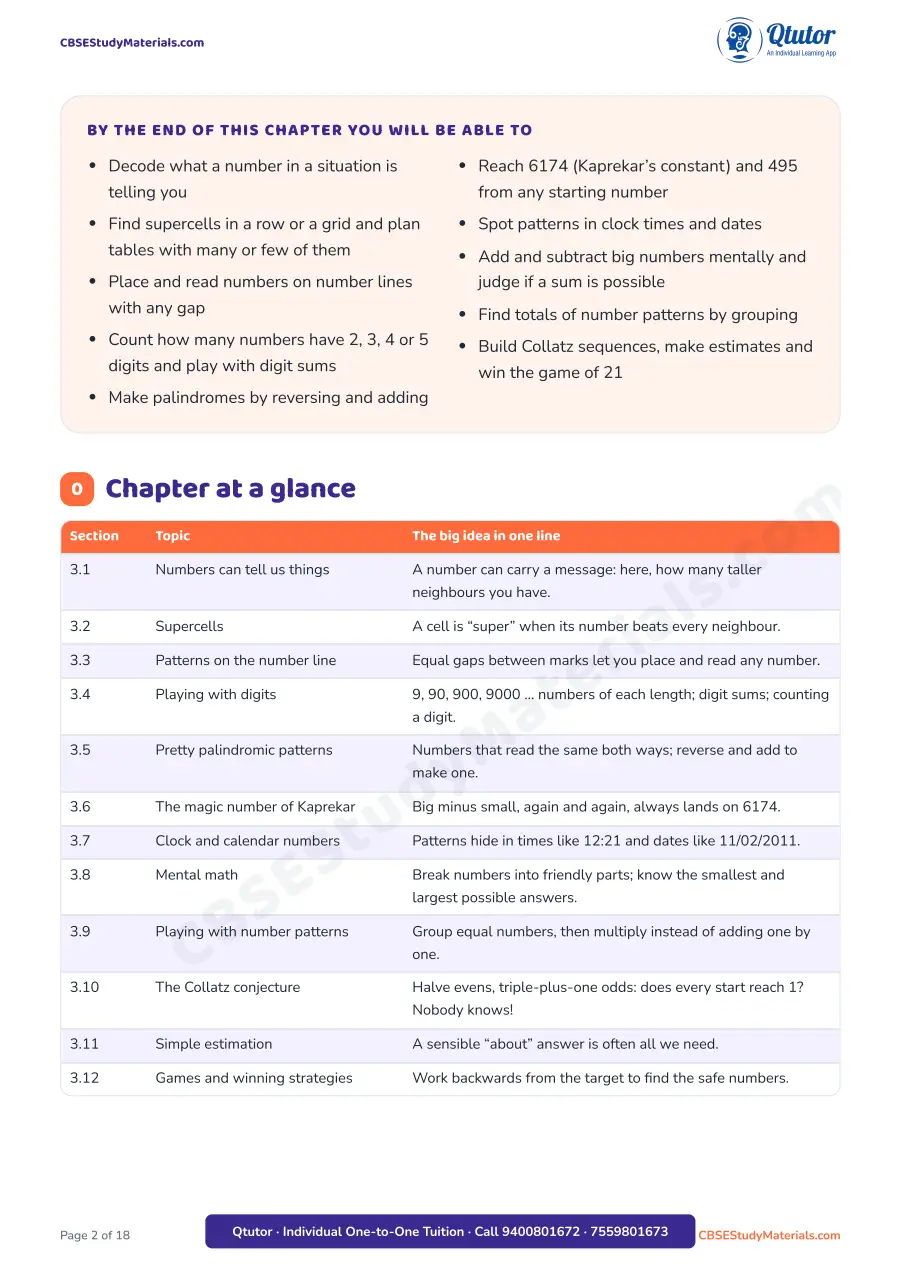
- A chapter at a glance table with the big idea of each of the 12 sections (3.1 to 3.12) in one line
- Clear explanations of every topic: taller neighbours, supercells, number lines, digit sums, palindromes, Kaprekar’s constant, clock and calendar patterns, mental maths, number-pattern sums, the Collatz conjecture, estimation and winning game strategies
- 20+ original figures: children-and-heights pictures, supercell rows and grids, number lines, a digit-sum chart, reverse-and-add chains, Kaprekar rounds, clocks, the mental-maths web, Collatz graphs and the game-of-21 track
- Worked examples, “Think deeper” prompts, “Did you know?” boxes and common-mistake warnings
- A key terms grid (supercell, palindrome, Kaprekar constant, conjecture, digit sum and more)
- A full-page mind map of the chapter
- 12 Check-yourself questions with a compact answer key
- A one-page summary to revise the whole chapter in five minutes
Structure of the Notes PDF
| Part | What you get |
|---|---|
| Pages 1–2 | Cover, learning goals, chapter at a glance |
| Pages 3–14 | Sections 3.1 to 3.12 explained with figures, worked examples and tips |
| Pages 14–15 | Key terms and the mind map |
| Pages 16–17 | Check yourself: 12 questions and the answer key |
| Page 18 | One-page summary of Number Play |
Number Play Class 6 Important Topics
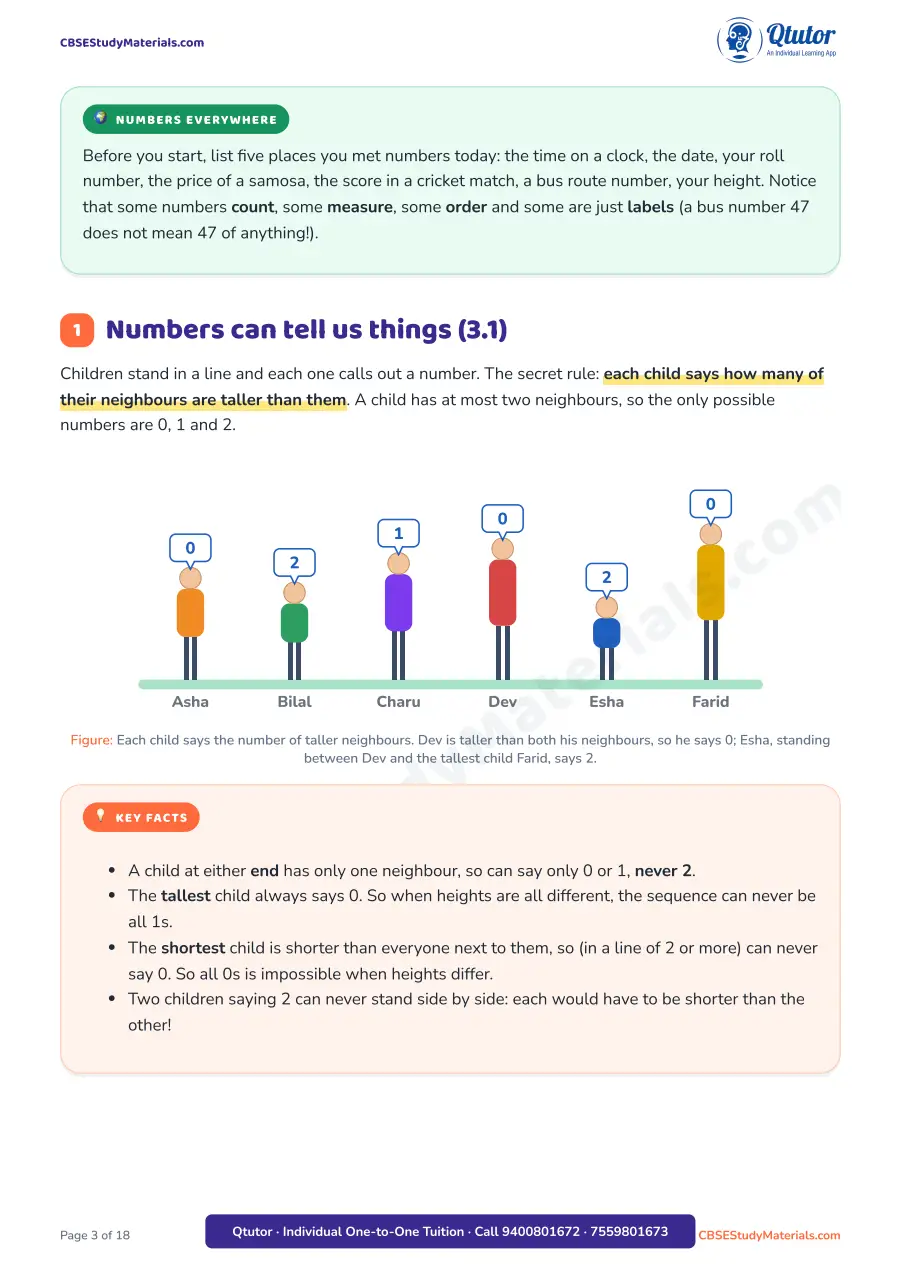
- Numbers can tell us things: each child says how many neighbours are taller; why the ends can never say 2 and the tallest always says 0.
- Supercells: the largest number is always a supercell, the smallest never; at most half the cells (rounded up) can be supercells in a row; neighbours in a grid.
- Number line: gap size = difference ÷ number of gaps.
- Playing with digits: 9, 90, 900, 9000 and 90,000 numbers of each length; digit sum 14; how often the digit 7 appears.
- Palindromes: reverse-and-add, the slow number 89 and the mystery of 196.
- Kaprekar’s routine: 6174 for 4-digit numbers, 495 for 3-digit numbers.
- Clock and calendar numbers: all 57 palindromic times on a 12-hour clock, special dates and when a calendar can be reused.
- Mental maths and digits: which sums and differences are possible and which are not.
- Collatz conjecture, estimation and games: the game of 21 and the game of 99.
Number Play Class 6 Important Questions (Sample)
A sample from the notes on the game of 21:
> Each round the two players can always add exactly 4 together. So the first player wins by saying 1, then 5, 9, 13, 17 and 21.
A sample worked example on digit sums:
| Question | Answer | Why |
|---|---|---|
| Smallest number with digit sum 14 | 59 | One digit is not enough, so make the last digit 9 |
| Largest 5-digit number with digit sum 14 | 95,000 | Biggest digit first, then zeros |
| Largest number with digit sum 14 | None | Adding a 0 at the end always makes a bigger one |
And a Kaprekar example: 6382 → 8632 − 2368 = 6264 → 6642 − 2466 = 4176 → 7641 − 1467 = 6174.
How These Revision Notes Help
- Concept first: every rule comes with a reason, such as why two supercells can never be neighbours.
- Pictures that explain: the figures show the idea, so students can redraw them in exams and projects.
- Spot the traps: common mistakes like reading a number-line gap wrongly are named and fixed.
- Quick revision: the mind map and one-page summary make last-minute revision easy.
- Practice built in: the Check-yourself questions are indirect and reasoning-based, in the competency style of CBSE 2026-27.
Who Should Use It
Class 6 students learning from NCERT Ganita Prakash, parents who want a clear chapter summary to revise with their child, and teachers who need ready explanations and figures for Number Play. It is useful while reading the chapter, for homework, and before unit tests.
How to Download the Class 6 Number Play Notes PDF
These notes are a premium PDF priced at ₹49. Use the download button below; the PDF prints well on A4 paper.
Number Play - Class 6 Maths Chapter 3 Notes (PDF · 18 pages · ₹49)
Related Resources
- Class 6 Maths Chapter 3 Number Play NCERT solutions: answers to every textbook question in order
- Class 6 Maths Chapter 3 Number Play question bank: important questions with answers
- Number Play chapter page
- All Class 6 Mathematics study material
- Previous chapter: Lines and Angles
- Next chapter: Data Handling and Presentation
FAQs on Class 6 Maths Chapter 3 Number Play
Where can I download Class 6 Maths Chapter 3 Number Play notes PDF? On this page. Use the download button to get the 18-page premium notes PDF for ₹49.
What are the important topics in Number Play Class 6? Supercells, number lines, digit sums, palindromes, Kaprekar’s constant 6174, clock and calendar patterns, mental maths, number patterns, the Collatz conjecture, estimation and winning strategies for number games.
Which book is Number Play Class 6 from? It is Chapter 3 of Ganita Prakash, the NCERT Mathematics textbook for Grade 6 used in CBSE schools for 2026-27.
What is the Kaprekar constant in Class 6 Maths? It is 6174. Arrange the digits of a 4-digit number (with at least two different digits) from largest to smallest and smallest to largest, subtract, and repeat; you always reach 6174. For 3-digit numbers you reach 495.
Do these notes include a mind map and a summary? Yes. There is a full-page mind map and a one-page summary at the end, plus 12 practice questions with answers.
Is the Number Play notes PDF the same as NCERT solutions? No. The notes explain the concepts. For answers to every textbook question, see our NCERT solutions for this chapter.
Study tip: when a number puzzle seems hard, try three or four small examples first, then look for the pattern and ask why it works.