Diversity in the Living World - Class 6 Science Ch 2 Question Bank (PDF · 23 pages · ₹49) Unlock the full PDF for ₹49
Free sample: pages 1 to 3 of 23. The full PDF costs ₹49.
Why can a camel in Rajasthan walk on loose sand without sinking, and why does a deodar in Himachal Pradesh shed snow so easily? This Question Bank for Diversity in the Living World, Class 6 Science Chapter 2 (CBSE, NCERT Curiosity textbook 2026-27), turns ideas like these into 67 practice questions with a full answer key. It is a premium 23-page PDF for ₹49, NCERT based study material written by our team, and not an official CBSE or NCERT publication.
The questions are new and written in our own words, not copied from the textbook exercises. Most of them ask you to apply, compare, predict or explain, so you practise thinking like a scientist and not only remembering lines. If you want the textbook's own questions answered, use the separate NCERT Solutions PDF linked below.
Class 6 Science Chapter 2 Diversity in the Living World Question Bank: What Is Included
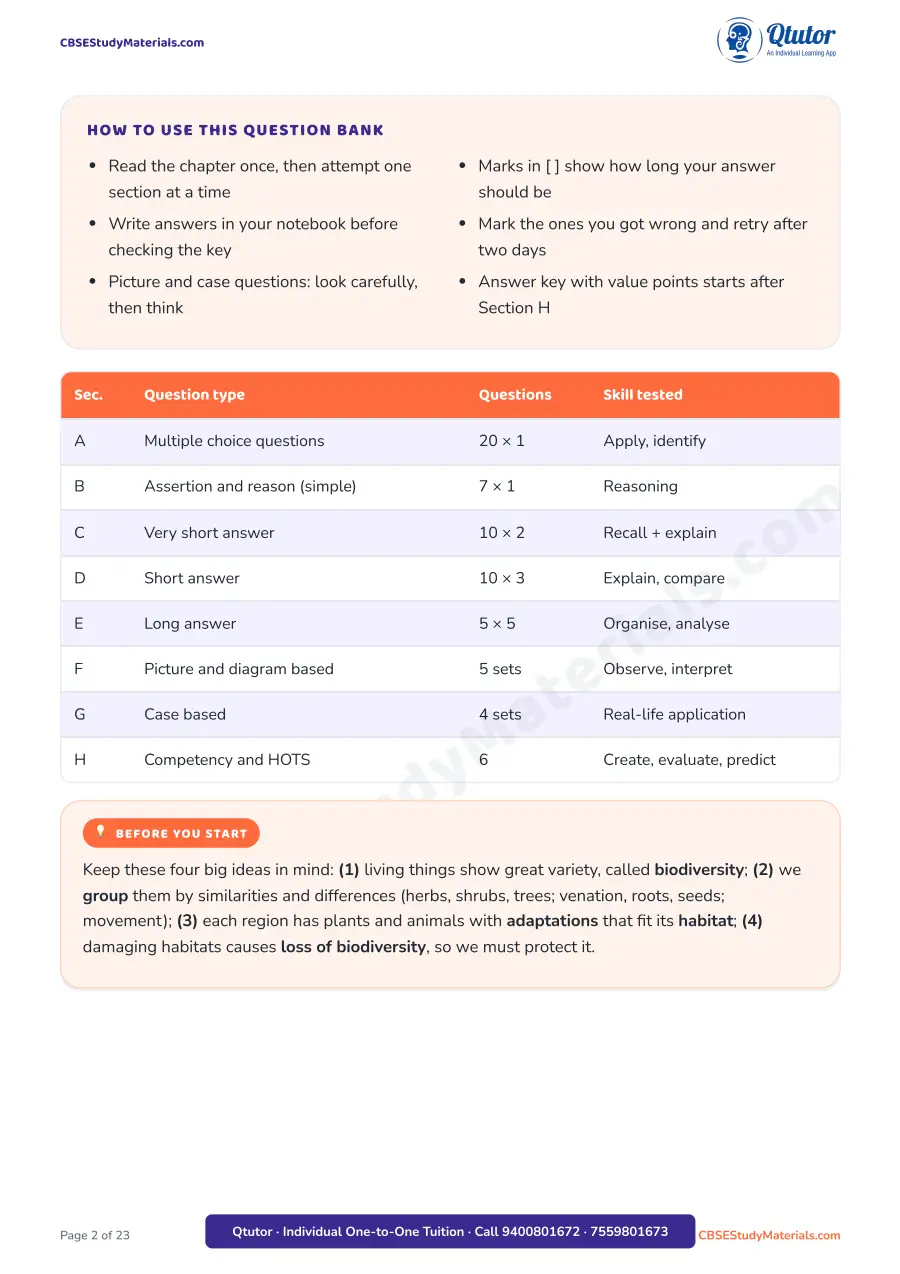
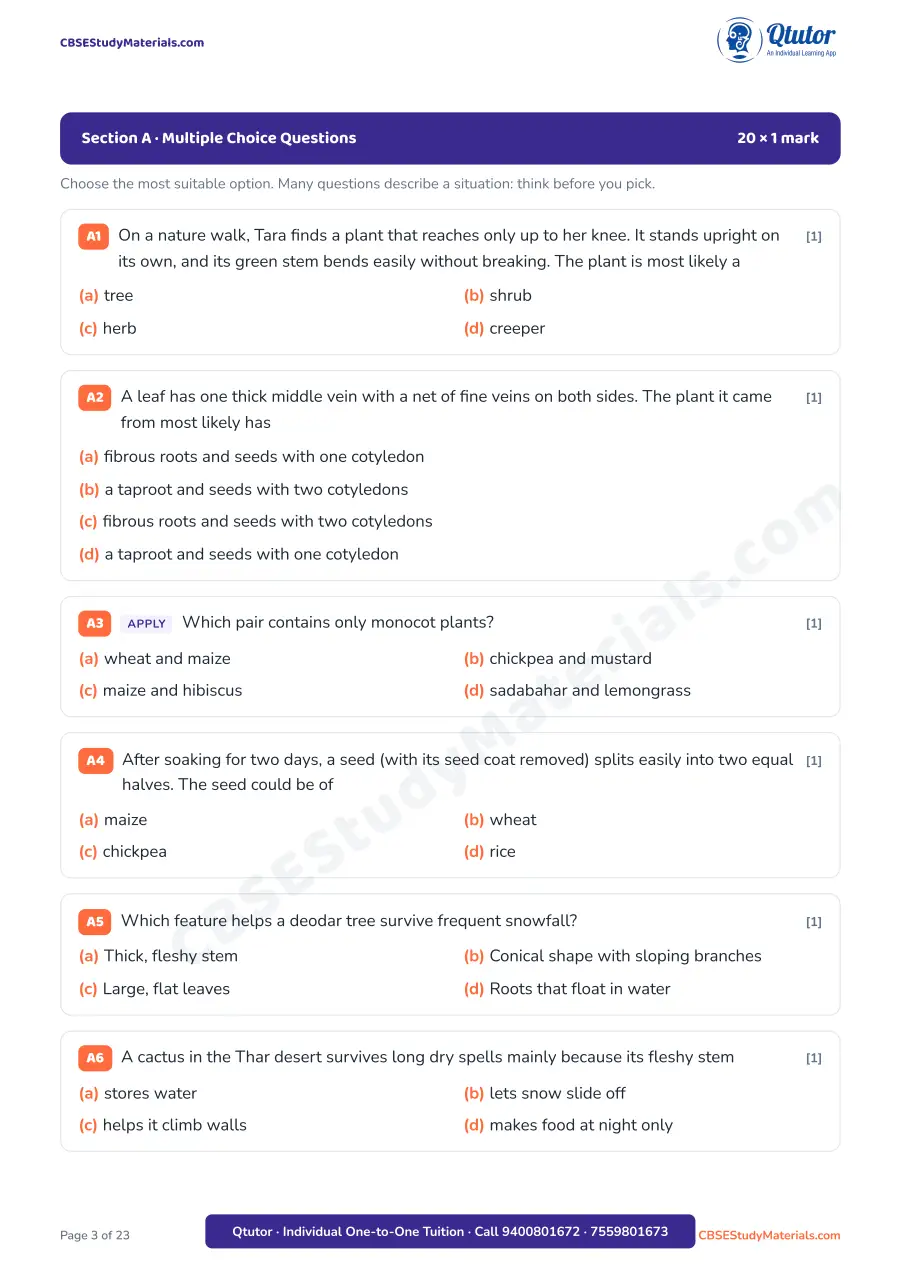
- 20 multiple choice questions (Section A), most set in a small real-life situation such as a nature walk, a garden or a trip.
- 7 simple assertion-reason questions (Section B) with a short "how to answer" box for first-time users.
- 10 very short answer questions (2 marks) and 10 short answer questions (3 marks).
- 5 long answer questions (5 marks) plus a "Writing a 5-mark answer" tips card.
- 5 picture and diagram based sets (Section F): leaf venation and root types, herbs, shrubs and trees beside a student for scale, two desert camels, a bar graph of bird species on a school campus, and a plant key with blanks to fill.
- 4 case-based sets (Section G): a sapling experiment, a village sacred grove, a winter trip to Himachal Pradesh and a disappearing pond.
- 6 competency and HOTS questions (Section H): make your own animal key, "what if" predictions, a table of what grandparents remember, odd one out and a source passage on a famous bird scientist.
- A complete answer key with one-line reasons for every MCQ and assertion-reason item, and value points and marks split for the written answers.
- A score tracker (157 marks in all) to record your first and second attempts.
Structure of the Diversity in the Living World Question Bank PDF
| Section | Question type | Number |
|---|---|---|
| A | Multiple choice questions | 20 × 1 mark |
| B | Assertion and reason (simple) | 7 × 1 mark |
| C | Very short answer | 10 × 2 marks |
| D | Short answer | 10 × 3 marks |
| E | Long answer | 5 × 5 marks |
| F | Picture and diagram based | 5 sets × 4 marks |
| G | Case based | 4 sets × 4 marks |
| H | Competency and HOTS | 6 questions |
| Key | Answers with value points | All 67 questions |
Diversity in the Living World Class 6 Important Topics Covered
- Biodiversity and how plants and animals depend on each other
- Grouping living things using similarities and differences
- Herbs, shrubs and trees, and how climbers and creepers differ
- Reticulate and parallel venation
- Taproot and fibrous root systems
- Dicot and monocot seeds and how they relate to roots and venation
- Movement in animals and the body parts used
- Adaptations of the cactus, deodar, rhododendron and the camels of hot and cold deserts
- Habitats: terrestrial, aquatic and amphibians
- Loss of biodiversity, Project Tiger, the Cheetah Reintroduction Project, the Great Indian Bustard, sacred groves, the Save Silent Valley movement, Janaki Ammal and Salim Ali
Diversity in the Living World Class 6 Important Questions (Sample)
From Section A (MCQ): A leaf has one thick middle vein with a net of fine veins on both sides. The plant it came from most likely has (a) fibrous roots and seeds with one cotyledon (b) a taproot and seeds with two cotyledons (c) fibrous roots and seeds with two cotyledons (d) a taproot and seeds with one cotyledon. Answer: (b). Reticulate venation goes with a taproot and dicot seeds.
From Section B (Assertion-Reason): A: Deodar trees grow naturally in the sandy deserts of Rajasthan. R: Deodar trees are conical in shape with sloping branches. Answer: (d). The assertion is false because deodars grow in the cold, snowy Himalayas; the reason correctly describes the tree.
From Section F (data based): An eco-club counted the kinds of birds on its campus every two years after a row of old trees was cut in 2020.
| Year | 2016 | 2018 | 2020 | 2022 | 2024 |
|---|---|---|---|---|---|
| Kinds of birds | 22 | 21 | 20 | 13 | 11 |
How many fewer kinds were seen in 2024 than in 2016? 22 − 11 = 11. The biggest fall came between 2020 and 2022, when the birds lost their habitat. (The data is made up for practice and is labelled that way in the PDF.)
How This Question Bank Helps
- It checks whether you really understand the chapter, because most questions describe a new situation.
- Picture and data questions train you to read diagrams, graphs and tables carefully.
- The assertion-reason section gives you a gentle first look at a question type you will see in higher classes.
- Value points in the answer key show what a complete answer needs, so you learn to write to the point.
- The score tracker shows which section to revise before a class test or the half-yearly exam.
Who Should Use It
Class 6 students studying the NCERT Curiosity science book in CBSE 2026-27, who have read the chapter or its notes and now want practice. Parents and tutors can use the sections as short worksheets or a chapter test, and teachers can pick case-based sets for class discussion.
How to Download the Class 6 Science Chapter 2 Question Bank PDF
Click the button below to buy and download the premium PDF (₹49). It prints well on A4 and also works on a phone or tablet.
Diversity in the Living World - Class 6 Science Ch 2 Question Bank (PDF · 23 pages · ₹49)
Related Resources
- Diversity in the Living World Class 6 Notes: chapter notes, revision notes and a one-page summary
- Diversity in the Living World Class 6 NCERT Solutions: answers to every textbook activity and exercise question
- Class 6 Science Chapter 2 Diversity in the Living World: the chapter page
- Class 6 Science: all chapters and study material
- Previous chapter: The Wonderful World of Science
- Next chapter: Mindful Eating: A Path to a Healthy Body
FAQs on Class 6 Science Chapter 2 Diversity in the Living World
Where can I download Class 6 Science Chapter 2 Diversity in the Living World important questions PDF? You can download this question bank from this page. It has 67 questions with answers in one 23-page PDF.
What is the price of the Diversity in the Living World question bank PDF? It is a premium PDF priced at ₹49. It includes all 67 questions and the complete answer key.
Are these the same as the NCERT textbook questions? No. All questions are newly written for practice. The textbook questions are answered in our separate NCERT Solutions PDF for this chapter.
What are the important topics in Diversity in the Living World Class 6? Grouping plants into herbs, shrubs and trees; venation, roots and seeds (dicots and monocots); movement in animals; adaptations; habitats; and protecting biodiversity.
Which book is Diversity in the Living World Class 6 from? It is Chapter 2 of Curiosity, the NCERT Class 6 Science textbook used in CBSE schools for 2026-27.
Does the question bank have assertion-reason and case-based questions? Yes. It has 7 simple assertion-reason questions, 4 case-based sets and 5 picture or data based sets, all with answers.
Study tip: try each section without looking at the key, then redo only the questions you missed two days later.