Patterns in Mathematics - Class 6 Maths Chapter 1 Notes (PDF · 18 pages · Free download) Download the full PDF free
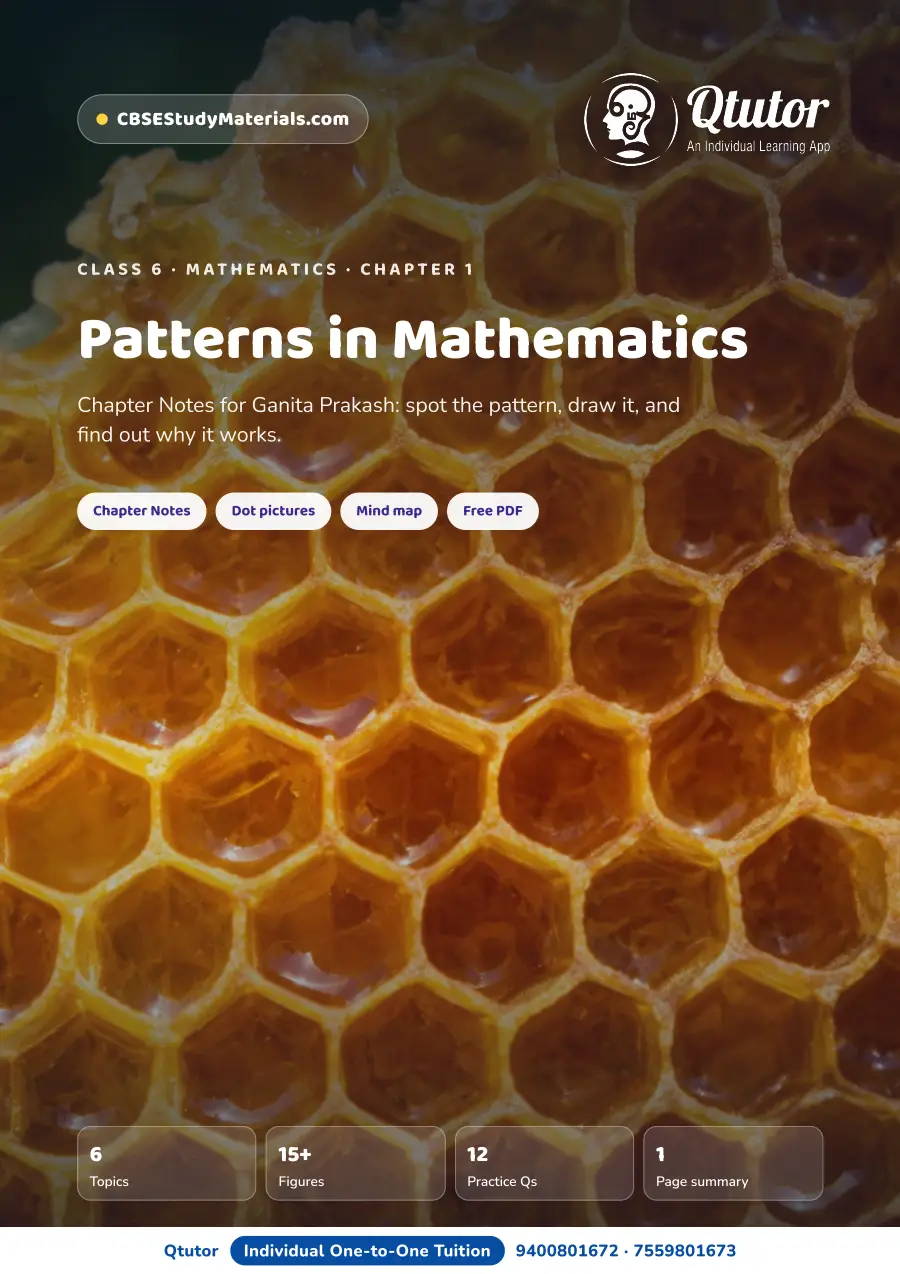
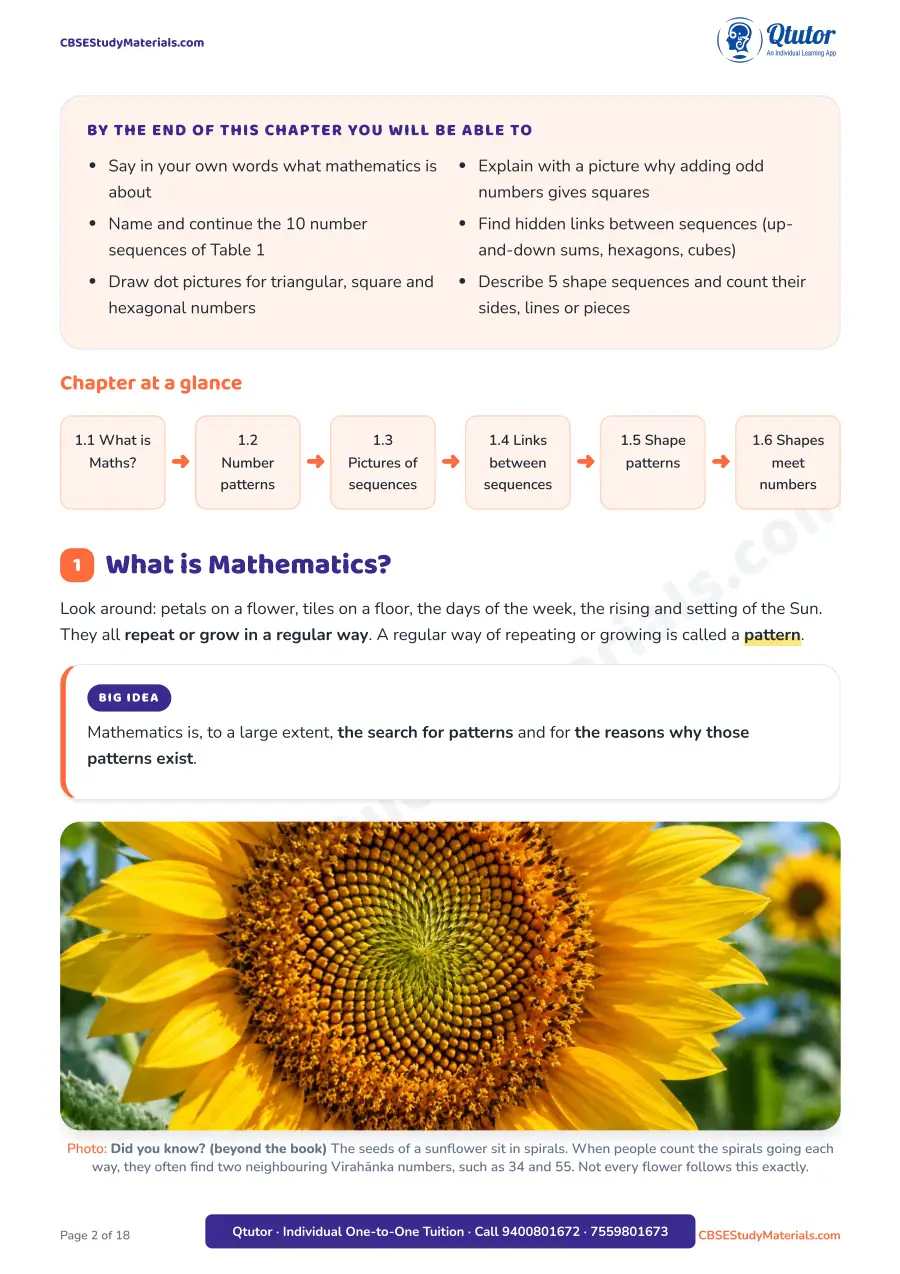
You are looking at pages 1 to 3 of 18. The full PDF is free to download.
Why does adding 1 + 3 + 5 + 7 + 9 + 11 give exactly 36, which is 6 × 6? And why does 36 show up again as a perfect triangle of dots? These puzzles open Patterns in Mathematics, Class 6 Maths Chapter 1, and these CBSE Class 6 Maths notes explain them with colourful dot pictures instead of long rules. This is a free 18-page chapter notes PDF written from the NCERT Ganita Prakash textbook (2026-27 edition). It is an independent study resource and is not an official CBSE or NCERT publication.
The notes follow the chapter in the same order as the book: what mathematics is, patterns in numbers, visualising number sequences, relations among number sequences, patterns in shapes, and how shape sequences connect to number sequences. Every number in the notes, every "next term" and every answer was checked by calculation, so you can trust the study material while you revise.
Class 6 Maths Chapter 1 Patterns in Mathematics Notes: What Is Included
- A cover, a list of six learning goals and a "Chapter at a glance" flow of the six sections
- 10 numbered sections covering every topic of the NCERT chapter, plus revision pages
- A table of all ten number sequences from the book (All 1's, counting, odd, even, triangular, squares, cubes, Virahānka numbers, powers of 2 and powers of 3) with the rule in simple words and the next three terms
- 16 original figures plus a mind map: dot pictures of seven sequences, 36 as a triangle and a square, hexagonal numbers, pictures of powers of 2 and 3, the L-shapes that turn odd numbers into squares, the tilted square for "up and down" sums, two triangles making a square, a hexagon as six triangles plus one, a cube seen from its corner, regular polygons, complete graphs, stacked squares, stacked triangles and the Koch snowflake
- Worked examples, "Common mistake" boxes, "Think deeper" prompts, "Did you know?" facts and "Try this" activities
- A key-terms grid with 12 keywords and their meanings
- 12 "Check yourself" important questions (MCQ, pattern, error-spotting, real-life and HOTS) with a full answer key
- A one-page summary (chapter summary and revision notes) with three quick tables
Structure of the PDF
| Part | What you get |
|---|---|
| Cover and goals | Learning goals and chapter at a glance |
| Sections 1-2 | What is mathematics, number theory, Table 1 sequences with rules |
| Section 3 | Dot and block pictures, 36 in two ways, hexagonal numbers, powers of 2 and 3 |
| Section 4 | Odd numbers make squares, adding up and down, seven surprising links |
| Sections 5-6 | Five shape sequences and the number sequences hidden in them |
| Revision | Mind map, key terms, 12 questions with answers, one-page summary |
Patterns in Mathematics Class 6 Important Topics
- What mathematics is: the search for patterns and for the reasons behind them, both an art and a science
- Number sequences: number theory and the ten sequences of the chapter
- Virahānka numbers: 1, 2, 3, 5, 8, 13, 21, where each term is the sum of the two before it
- Visualising sequences: why triangular, square and cube numbers have those names; hexagonal numbers 1, 7, 19, 37, 61
- Relations among sequences: odd numbers add up to squares; up-and-down sums give squares; neighbouring triangular numbers add to squares; 1 + 2 + 4 + 8 + 1 = 16; 6 × triangular + 1 gives hexagonal numbers; hexagonal numbers add up to cubes
- Shape sequences: regular polygons, complete graphs, stacked squares, stacked triangles and the Koch snowflake
- Shapes and numbers: sides = corners, lines in complete graphs are triangular numbers (1, 3, 6, 10, 15), stacked triangles give squares, Koch snowflake segments 3, 12, 48, 192
Patterns in Mathematics Class 6 Important Questions (Sample)
Here is how the notes explain the odd-number pattern. A 6 × 6 square of dots is cut into L-shapes holding 1, 3, 5, 7, 9 and 11 dots, so
1 + 3 + 5 + 7 + 9 + 11 = 36 = 6 × 6
The same picture works for a square of any size, so the sum of the first 100 odd numbers is 100 × 100 = 10000.
A sample from the "Check yourself" set:
> Q8 (HOTS). Is 127 a hexagonal number? Use the rule "6 × triangular + 1" to decide. > Answer: 127 − 1 = 126 and 126 ÷ 6 = 21, which is triangular (1 + 2 + … + 6). So yes, 127 is the 7th hexagonal number.
And one row of the shape table:
| Shape sequence | What we count | Numbers |
|---|---|---|
| Complete graphs K2 to K6 | lines | 1, 3, 6, 10, 15 (triangular) |
| Koch snowflake | line segments | 3, 12, 48, 192, 768 |
How These Class 6 Maths Notes Help
The new Ganita Prakash book asks students to explain why a pattern works, not just to continue it. These notes show the picture behind every pattern, so a student can draw it in the exam and reason with it. The common-mistake boxes warn about the usual traps, such as adding 5 to get the next triangular number or counting only the upward triangles in a stacked triangle. The important questions are mostly application and reasoning questions, which build the habit of thinking before calculating.
Who Should Use It
- Class 6 students starting Ganita Prakash who want clear, picture-based notes for Chapter 1
- Students revising before a class test who need the one-page summary and quick answer key
- Parents and tutors looking for NCERT based examples and extra practice questions for CBSE 2026-27
How to Download the Class 6 Patterns in Mathematics Notes PDF
Click the download button below. The PDF is free, prints well on A4 and works on a phone.
Patterns in Mathematics - Class 6 Maths Chapter 1 Notes (PDF · 18 pages · Free download)
Related Resources
- Class 6 Maths Chapter 1 Patterns in Mathematics chapter page
- All Class 6 Mathematics study material
- Patterns in Mathematics Class 6 NCERT Solutions PDF
- Patterns in Mathematics Class 6 Question Bank PDF
- Next chapter: Lines and Angles (Class 6 Maths Chapter 2), coming soon
FAQs on Class 6 Maths Chapter 1 Patterns in Mathematics
Where can I download Class 6 Maths Chapter 1 Patterns in Mathematics notes PDF? You can download it free from this page using the download button. It is an 18-page PDF download with pictures, questions and a one-page summary.
What are the important topics in Patterns in Mathematics Class 6? Number sequences, visualising sequences with dots and blocks, relations among sequences (odd numbers add to squares, hexagonal numbers add to cubes), shape sequences, and the link between shapes and numbers.
Is the Patterns in Mathematics Class 6 notes PDF free? Yes. Chapter 1 notes are free to download.
Which book is Patterns in Mathematics Class 6 from? It is Chapter 1 of Ganita Prakash, the NCERT Class 6 Mathematics textbook used in CBSE schools for 2026-27.
What are Virahānka numbers in Class 6 Maths? They are the sequence 1, 2, 3, 5, 8, 13, 21, …, where each number is the sum of the two numbers before it. The next two are 34 and 55.
Why is the sum of odd numbers always a square number? A square of dots can be cut into L-shapes of 1, 3, 5, 7, … dots. Each L makes the square one size bigger, so the sum of the first N odd numbers is N × N.
Study tip: whenever you meet a new pattern, draw it with dots before you try to explain it in words.