Perimeter and Area Class 6 Maths Chapter 6 NCERT Solutions PDF (PDF · 24 pages · ₹49) Unlock the full PDF for ₹49
Free sample: pages 1 to 3 of 24. The full PDF costs ₹49.
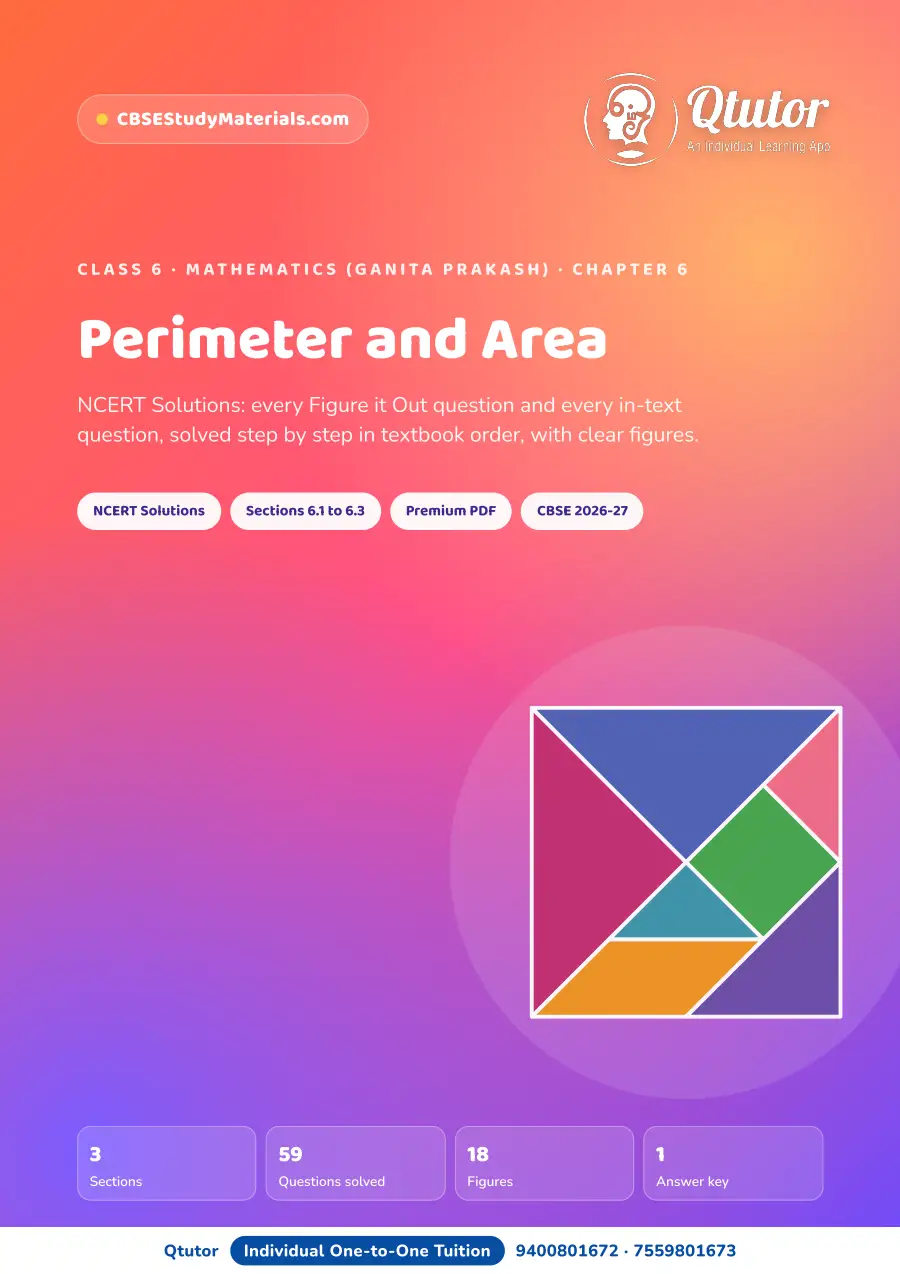
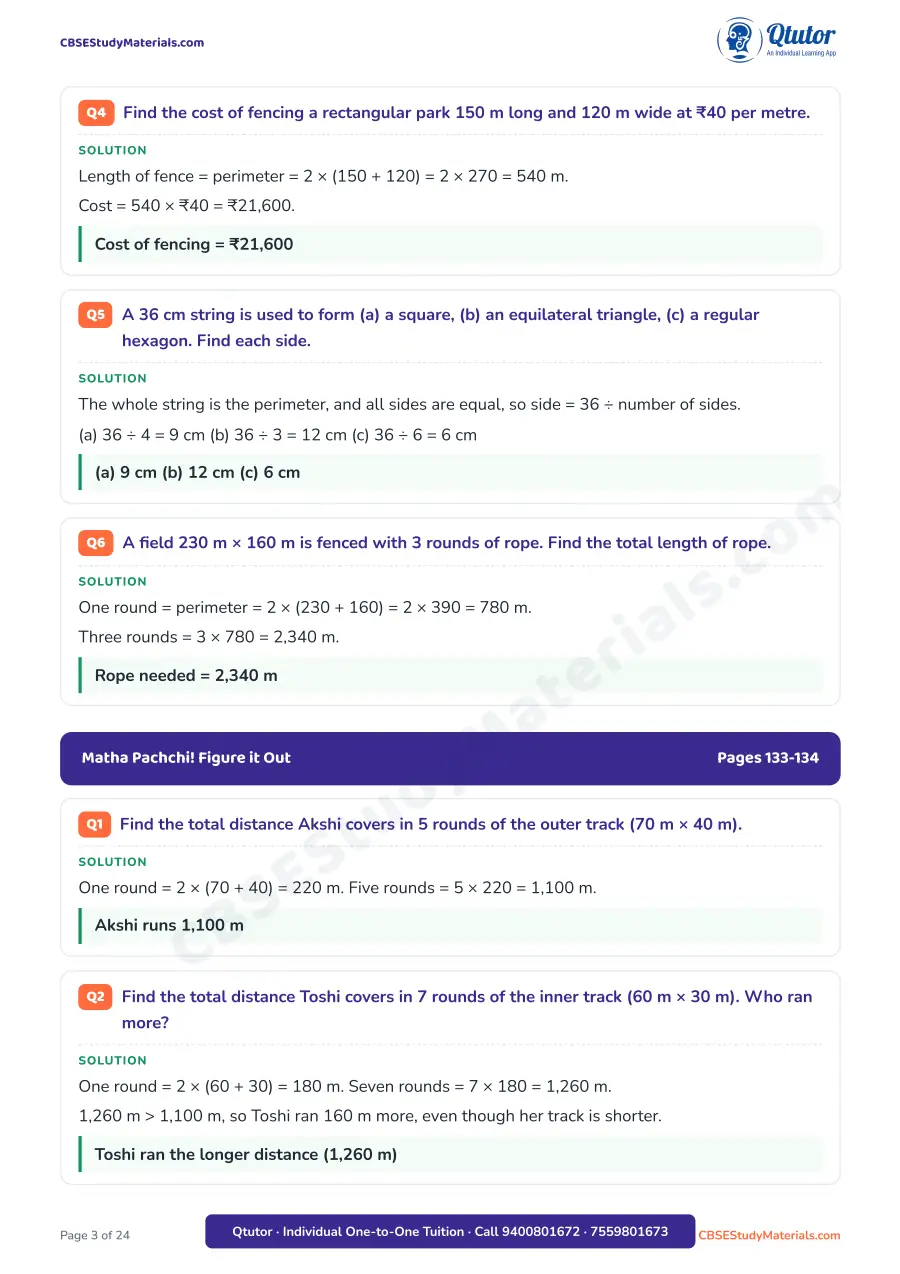
How far does Toshi run in 7 rounds of a 60 m × 30 m track, and where exactly is she standing after 500 m? What are the missing room sizes in Charan's and Sharan's house plans? These Perimeter and Area Class 6 Maths Chapter 6 NCERT Solutions answer every question of CBSE Class 6 NCERT Ganita Prakash Chapter 6 step by step, with clear figures. This is a premium 24-page PDF built on the 2026-27 NCERT Ganita Prakash (Grade 6) textbook. It is our own study material and not an official CBSE or NCERT publication.
The solutions follow the exact order and page numbering of the textbook, from 6.1 Perimeter to 6.3 Area of a Triangle. Each question is restated briefly and then solved, so the PDF can be used side by side with the book.
Class 6 Maths Chapter 6 Perimeter and Area NCERT Solutions: What Is Included
- Solutions to 59 questions and activities in textbook order: Figure it Out on pages 132, 133-134, 138, 139 (tangram), 144 and 149, the Deep Dive race, the Area Maze puzzles, Charan's and Sharan's house plans, "Making it More or Less", and every in-text question and Let's Explore task
- 18 original figures: the running tracks with points A, B, C, X, Y and Z marked, the staggered race start, dot-grid figures with their s-and-d perimeters and areas, split-and-rejoin arrangements, the tangram with piece areas, grid shapes split into rectangles and triangles, both house plans with every measurement filled in, and the area mazes with answers
- Expected observations and conclusions for activities (Estimate and Verify, cutting a rectangle along its diagonal, measuring the floor and playground)
- Green "final answer" boxes for quick checking
- A Quick Answer Key at the end
Structure of the PDF
| Part | What you get |
|---|---|
| 6.1 Perimeter | Figure it Out Q1-Q6, Matha Pachchi Q1-Q3, Deep Dive, straight and diagonal units, regular polygons, split and rejoin |
| 6.2 Area | Formulas, Figure it Out Q1-Q4, tangram Q1-Q8, counting squares, Let's Explore (circles, rectangles of area 24 and 32) |
| 6.3 Area of a Triangle | Diagonal activity, grid triangles BAD and ABE, Figure it Out Q1 (a)-(e), 9 unit squares, adding a square |
| Applications | Charan's and Sharan's houses, Area Maze puzzles (a)-(d), Figure it Out Q1-Q8 (p. 149) |
| Answer key | One-line answers to all questions |
Perimeter and Area Class 6 Important Topics Covered
- Perimeter of rectangles, squares, triangles and regular polygons, and working backwards to a missing side
- Rounds of a track and the position of a runner after a given distance
- Straight (s) and diagonal (d) units on dot paper
- Area of rectangles and squares, costs of tiling and fencing, and areas of shapes split into rectangles
- Tangram piece areas in terms of the small triangle
- Estimating area by counting squares and why squares are used
- Area of a triangle as half of a rectangle
- Same area, different perimeter, with 9 unit squares and with rectangles
Perimeter and Area Class 6 Questions and Answers (Sample)
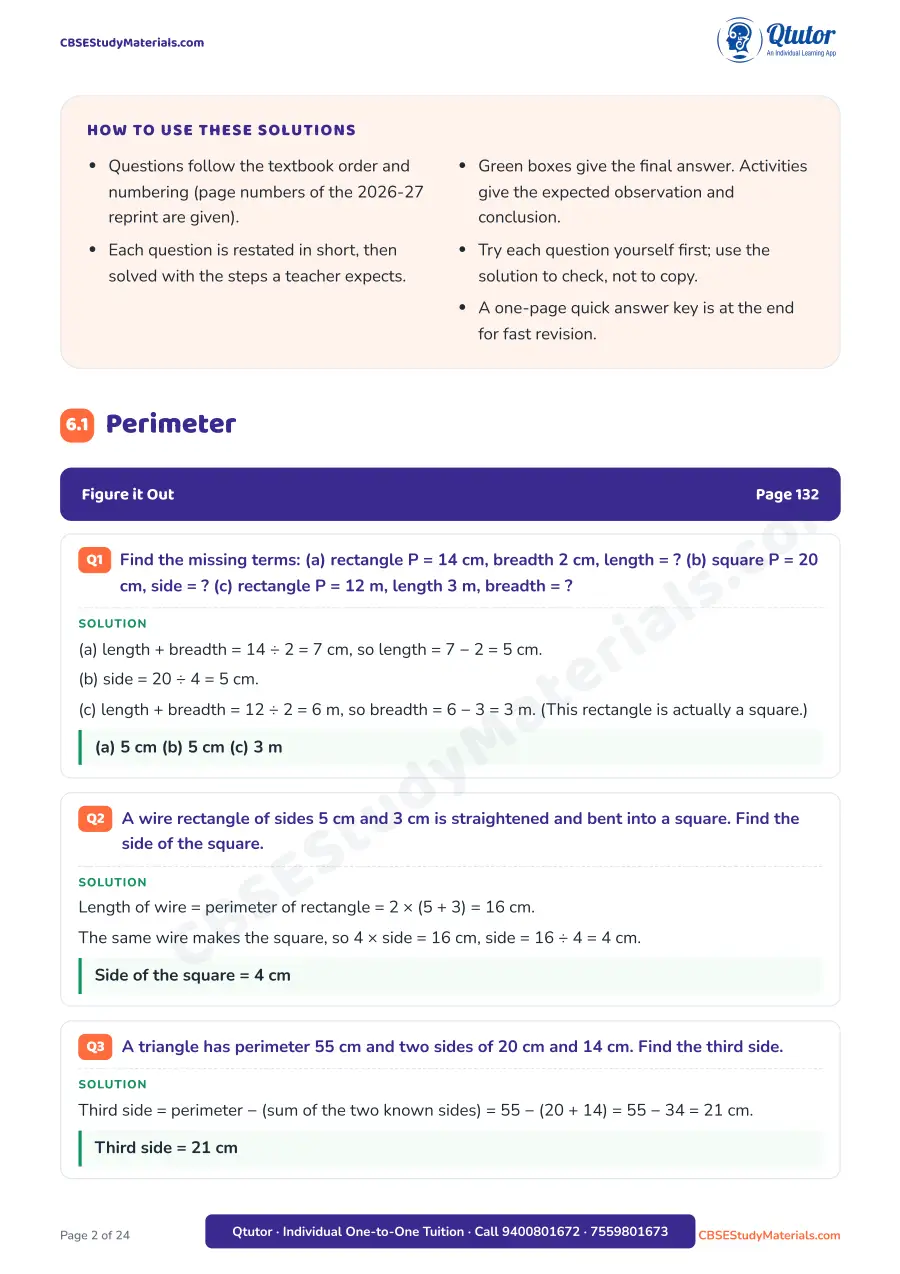
Page 132, Q4. Cost of fencing a park 150 m × 120 m at ₹40 per metre: perimeter = 2 × (150 + 120) = 540 m, cost = 540 × 40 = ₹21,600.
Page 144, Q1 (b). The figure is a 4 × 5 rectangle with a triangle above it (1⁄2 × 4 × 3 = 6) and one below it (1⁄2 × 4 × 2 = 4), so its area is 20 + 6 + 4 = 30 sq units.
Page 147, Sharan's house.
| Plot | Area | Perimeter | |
|---|---|---|---|
| Charan | 35 ft × 30 ft | 1,050 sq ft | 130 ft |
| Sharan | 42 ft × 25 ft | 1,050 sq ft | 134 ft |
Same area, different perimeters: a key idea of the chapter.
How These NCERT Solutions Help
Many questions in this chapter are puzzles rather than direct sums: where a runner stands after 1,000 m, how to start a race so both runners finish together, which tangram pieces have equal area, or how the perimeter changes when one square is added. The solutions show the thinking step, not just the final number, and the figures make each answer easy to check. A rule used again and again is written out clearly, for example "perimeter = 32 − 2 × (length where the strips touch)" for the split-and-rejoin task.
Who Should Use These Solutions
- Class 6 CBSE students checking their Ganita Prakash homework and Figure it Out answers
- Parents and tutors who want correct, clearly explained answers in the textbook's order
- Students preparing for unit tests who want a quick answer key for revision
How to Download the Class 6 Perimeter and Area NCERT Solutions PDF
The solutions are a premium PDF for ₹49. Use the download button below.
Perimeter and Area Class 6 Maths Chapter 6 NCERT Solutions PDF (PDF · 24 pages · ₹49)
Related Resources
- Class 6 Maths Chapter 6 Perimeter and Area notes: revision notes, worked examples, mind map and one-page summary
- Class 6 Maths Chapter 6 Perimeter and Area question bank: 71 important questions with answers
- Perimeter and Area chapter page
- All Class 6 Mathematics study material
- Previous chapter: Prime Time
- Next chapter: Fractions
FAQs on Class 6 Maths Chapter 6 Perimeter and Area NCERT Solutions
Where can I download Class 6 Maths Chapter 6 Perimeter and Area NCERT solutions PDF? On this page. The 24-page premium PDF costs ₹49 and covers every question of the chapter.
Do these solutions cover the in-text questions and activities? Yes. Besides every Figure it Out exercise, the PDF answers the in-text questions, Let's Explore tasks, the Deep Dive race, the house plans and the Area Maze puzzles.
What is the answer to the 9 unit squares question in Class 6 Perimeter and Area? The smallest possible perimeter is 12 units (the 3 × 3 square) and the largest is 20 units. A 2 × 2 block with a tail of five squares has perimeter 18 units.
Which book is Perimeter and Area Class 6 from? It is Chapter 6 of the NCERT Ganita Prakash textbook for Grade 6 (2026-27 reprint).
Are these the official NCERT solutions? No. They are our own worked solutions based on the NCERT textbook, with every answer rechecked.
Study tip: draw a quick sketch for every perimeter or area question; most mistakes disappear once the shape is on paper.