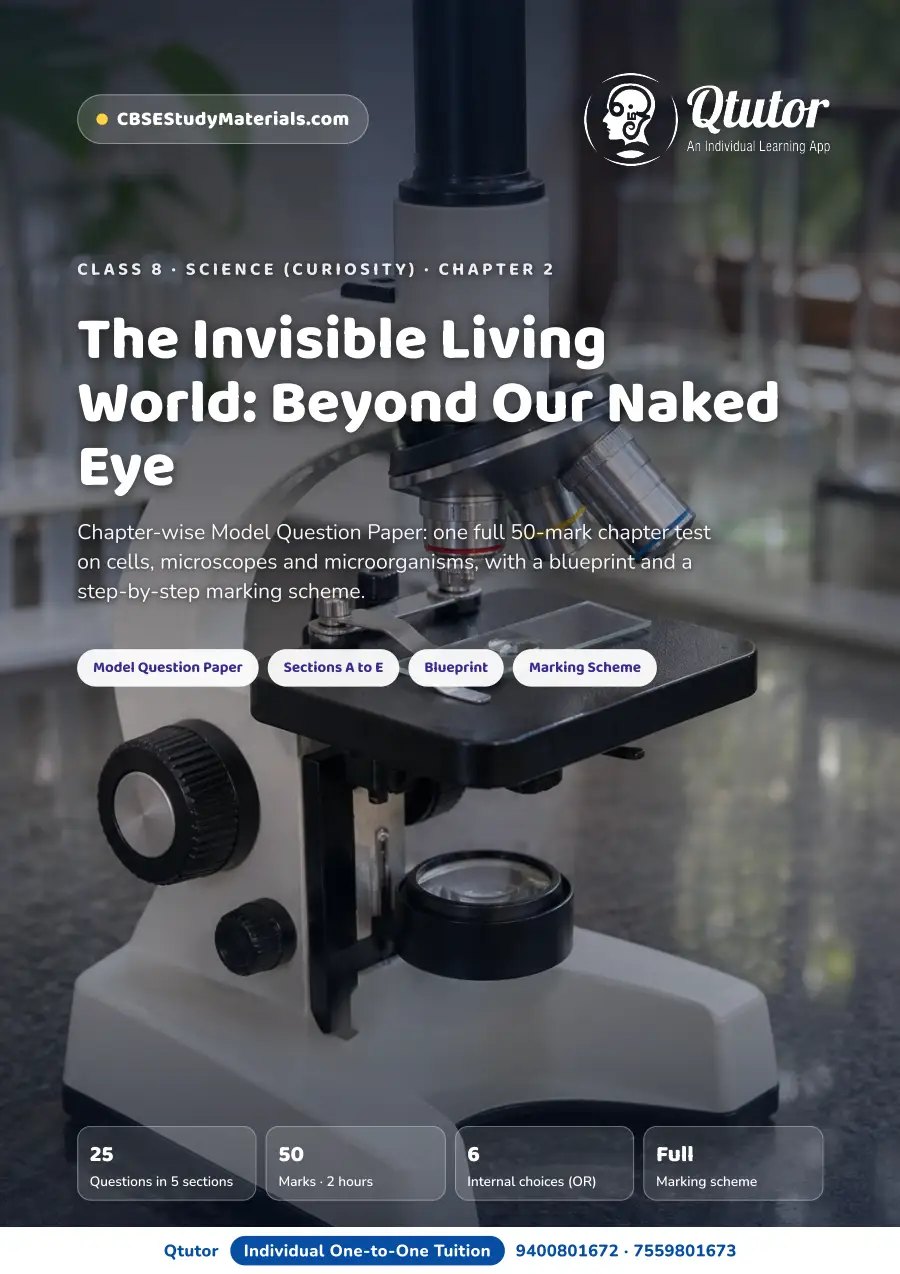
The Invisible Living World: Beyond Our Naked Eye - Class 8 Science Chapter 2 Model Question Paper (PDF · 15 pages · ₹49) Unlock the full PDF for ₹49
Free sample: pages 1 to 3 of 15. The full PDF costs ₹49.
Can you tell an onion peel slide from a cheek cell slide just by looking at a sketch, and explain why idli batter made on a freezing night hardly rises by morning? This The Invisible Living World: Beyond Our Naked Eye Class 8 Science Chapter 2 model question paper gives you a full CBSE-style chapter test of 25 questions for 50 marks, built on the NCERT Curiosity textbook for 2026-27. It is a premium 15-page PDF priced at ₹49, with a blueprint and a complete marking scheme. It is NCERT based practice material written by our team and is not an official CBSE or NCERT publication.
Use it after revising the chapter: sit for 2 hours, write your answers on the lines given, then check them against the marking scheme to see where each mark is earned or lost.
Class 8 Science Chapter 2 The Invisible Living World Model Question Paper: What Is Included
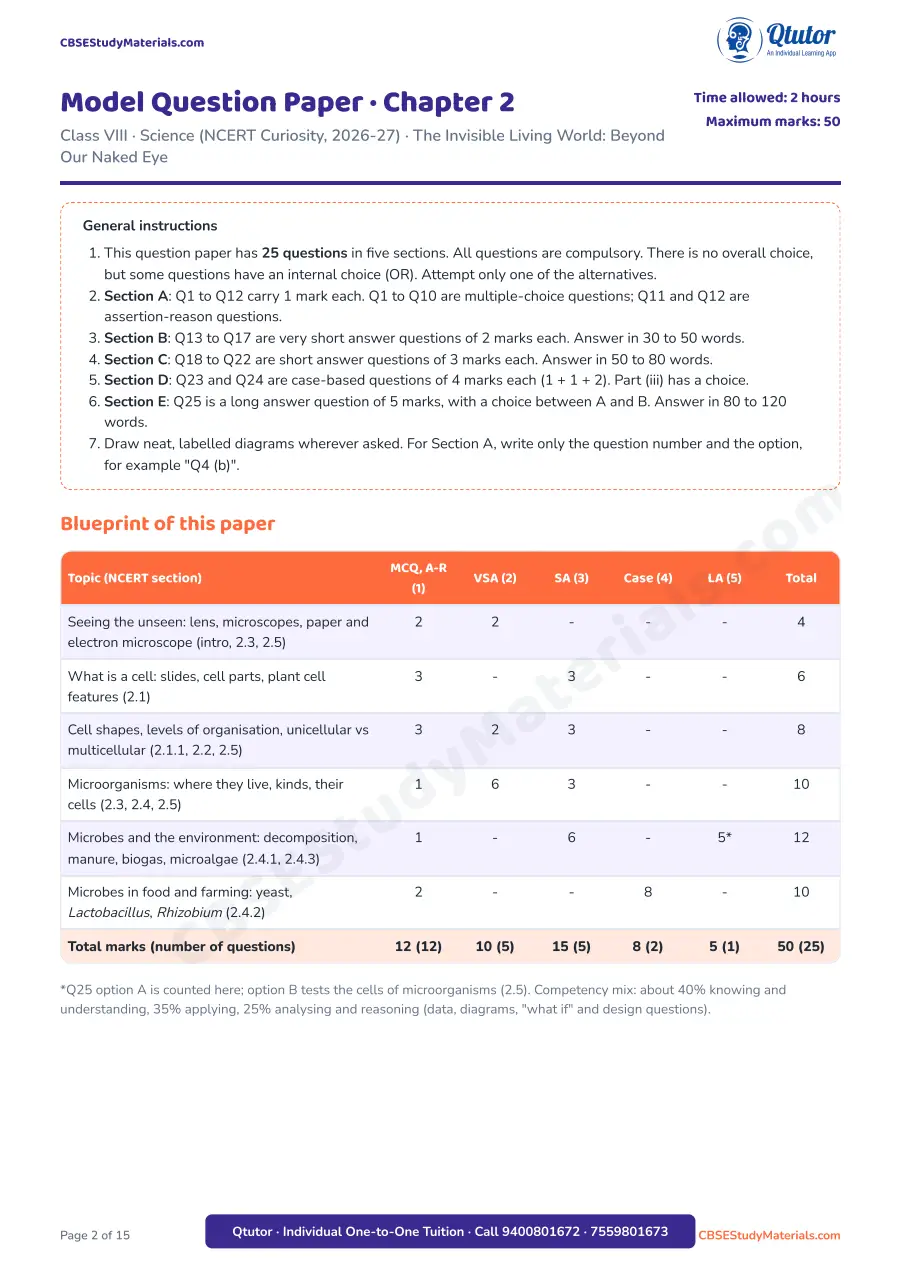
- A paper heading with time allowed (2 hours) and maximum marks (50), and seven general instructions written the way school exam papers are.
- A blueprint table that maps every mark to a part of the NCERT chapter and to a question type, with the competency mix (about 40% knowing and understanding, 35% applying, 25% analysing and reasoning).
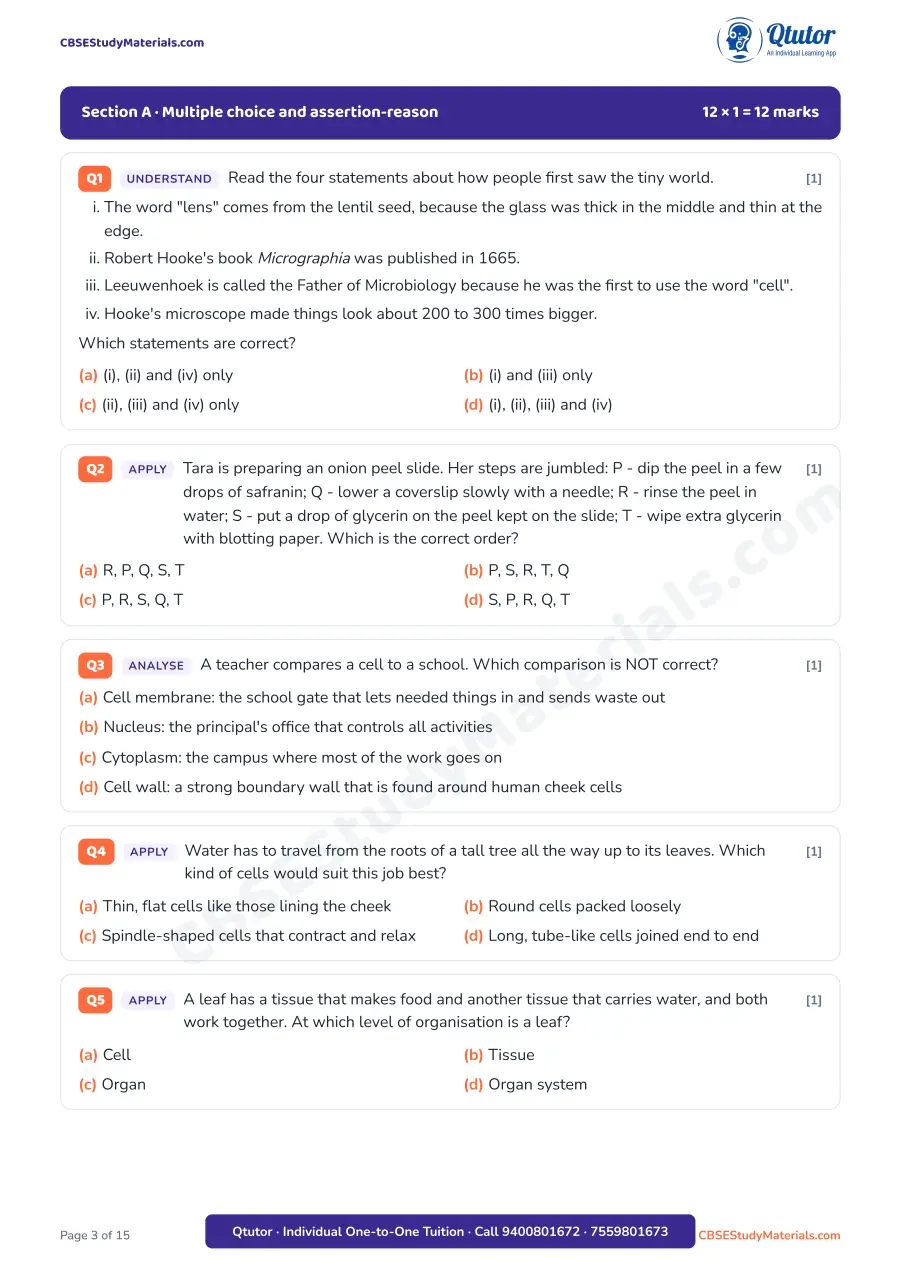
- Section A: 10 MCQs (including a "which statements are correct" item, a slide-making sequence item and a "which comparison is NOT correct" item) and 2 assertion-reason questions.
- Section B: 5 very short answer questions of 2 marks.
- Section C: 5 short answer questions of 3 marks, including a cell-slide diagram question with three sketches marked X, Y and Z.
- Section D: 2 case-based questions of 4 marks (1 + 1 + 2): a "Fermented Foods of India" fair, and a bar graph of root nodules and pods on four pea plants.
- Section E: 1 long answer question of 5 marks, with a choice between a decomposition and biogas question and a cell comparison with a labelled bacterial cell diagram.
- 6 internal choices (OR), text versions of the two figure questions for visually impaired candidates, and answer-writing lines after every question from Q13 onwards.
- 3 real photographs and 3 original diagrams (cell slides, a nodule bar graph and a model bacterial cell).
- A full answer key and marking scheme with value points and ½-mark splits, a "Where marks are lost" box and a score guide.
Structure of The Invisible Living World Class 8 Question Paper
| Section | Question type | Questions | Marks |
|---|---|---|---|
| A | MCQ and assertion-reason | Q1 to Q12 | 12 × 1 = 12 |
| B | Very short answer | Q13 to Q17 | 5 × 2 = 10 |
| C | Short answer | Q18 to Q22 | 5 × 3 = 15 |
| D | Case-based | Q23 and Q24 | 2 × 4 = 8 |
| E | Long answer | Q25 | 1 × 5 = 5 |
| Total | 25 questions | 50 marks |
The Invisible Living World Class 8 Important Topics Tested
The paper covers the whole chapter as it appears in the CBSE 2026-27 NCERT book: how a lentil-shaped piece of glass became the lens; Robert Hooke's Micrographia (1665) and Leeuwenhoek's first clear look at bacteria; the paper microscope and the electron microscope; preparing onion peel and cheek cell slides with safranin, methylene blue and glycerin; the cell membrane, cytoplasm, nucleus and cell wall; plastids and vacuoles; how cell shape suits the job in the food pipe, the stomach and plant water-carrying cells; the levels of organisation; unicellular and multicellular organisms; microbes in pond water and soil (algae, fungi, bacteria, protozoa); decomposition and manure; biogas; microalgae such as Spirulina; yeast and Lactobacillus in bread, idli, bhatura and curd; and Rhizobium in the root nodules of legumes.
The Invisible Living World Class 8 Important Questions (Sample)
Q3 (MCQ, 1 mark). A teacher compares a cell to a school. Which comparison is NOT correct? (a) Cell membrane: the school gate that lets needed things in and sends waste out (b) Nucleus: the principal's office that controls all activities (c) Cytoplasm: the campus where most of the work goes on (d) Cell wall: a strong boundary wall found around human cheek cells. Answer: (d). Cheek cells are animal cells and have no cell wall.
Q24 (Case, 4 marks). Students grew four pea plants without fertiliser and counted root nodules and pods at harvest (sample data):
| Plant | Root nodules | Pods |
|---|---|---|
| A | 42 | 18 |
| B | 25 | 12 |
| C | 9 | 6 |
| D | 0 | 3 |
(i) Which plant most probably got the most nitrogen from the air? (ii) Name the bacteria in the nodules and their job. (iii) Describe and explain the pattern. Marking scheme for (iii): more nodules, more pods (1); more Rhizobium means more nitrogen from the air is made useful, so the plant grows better without fertiliser (1).
Q25 (A), part (b) (2 marks). In what kind of environment do the bacteria in a biogas plant work, and what do they release? Answer: an environment without oxygen (1); while decomposing plant and animal waste they release biogas, a mixture made mainly of carbon dioxide and a high proportion of methane (1).
How This Model Question Paper Helps
- Exam practice under time. One 2-hour paper in the same section order (A to E) that higher classes use, scaled to a single chapter, so Class 8 students get used to MCQs, assertion-reason, case-based and long answers early.
- Thinking, not memorising. Most questions ask you to apply or explain: identify slides from sketches, read a bar graph, judge a classmate's wrong statement, or imagine a world without microbes.
- Honest self-checking. The marking scheme shows value points and ½-mark splits, so you can mark your own paper the way a teacher would.
- A final check. Take this paper as a last timed test after revising with the chapter notes, NCERT solutions and question bank.
Who Should Use It
Class 8 students preparing for a unit test, periodic test or half-yearly exam on Chapter 2; parents who want a ready-made timed test at home; and teachers who need a chapter test with a blueprint and marking scheme.
How to Download the Class 8 Science Chapter 2 Model Question Paper PDF
Click the download button below. The PDF prints well on A4 paper.
The Invisible Living World: Beyond Our Naked Eye - Class 8 Science Chapter 2 Model Question Paper (PDF · 15 pages · ₹49)
Related Resources
- The Invisible Living World: Beyond Our Naked Eye chapter page
- Class 8 Science chapters
- Class 8 Science Chapter 2 Notes
- Class 8 Science Chapter 2 NCERT Solutions
- Class 8 Science Chapter 2 Question Bank
- Previous chapter: Exploring the Investigative World of Science
- Next chapter: Health: The Ultimate Treasure
FAQs on Class 8 Science Chapter 2 The Invisible Living World
Where can I download the Class 8 Science Chapter 2 model question paper PDF? You can download it from this page. It is a 15-page PDF with 25 questions, a blueprint and a full marking scheme.
What is the price of The Invisible Living World Class 8 model question paper? It is a premium PDF priced at ₹49.
What is the pattern of this Class 8 Science chapter test? It has 50 marks and 2 hours: 10 MCQs and 2 assertion-reason questions (1 mark each), 5 questions of 2 marks, 5 of 3 marks, 2 case-based questions of 4 marks and 1 long answer of 5 marks, with 6 internal choices.
What are the important topics in The Invisible Living World Class 8? Cell structure and slides, cell shape and function, levels of organisation, kinds of microorganisms, and the uses of microbes in decomposition, biogas, food and farming (Rhizobium), plus microalgae.
Which book is The Invisible Living World chapter from? It is Chapter 2 of Curiosity, the NCERT Science textbook for Grade 8 (2026-27 reprint).
Does the paper include answers? Yes. Every question has a marking-scheme answer with value points and mark splits, including the OR alternatives.
Study tip: take the paper in one sitting with a timer, and only then open the marking scheme.