My Dear Soldiers - Class 7 English Chapter 14 Notes (PDF · 16 pages · ₹49) Unlock the full PDF for ₹49
Free sample: pages 1 to 3 of 16. The full PDF costs ₹49.
When the whole country is asleep, who is still awake? Class 7 English Chapter 14 My Dear Soldiers answers that question in fifteen short lines, and these CBSE chapter notes, based on the NCERT Poorvi textbook, explain Dr A.P.J. Abdul Kalam's poem line by line in a colourful 16-page PDF.
This is a premium Chapter Notes PDF (₹49) for Class 7 English, Chapter 14 "My Dear Soldiers", the poem in Unit 5 "Bravehearts" of the new NCERT Poorvi book (Grade 7, CBSE 2026-27). It is independent study material and is not an official CBSE or NCERT publication. The notes retell the poem in short, simple sentences with a friendly guide, Cadet Kiran from the school NCC unit, and they work as revision notes, a chapter summary and complete study material for the poem in one place.
Class 7 English Chapter 14 My Dear Soldiers Notes: What Is Included
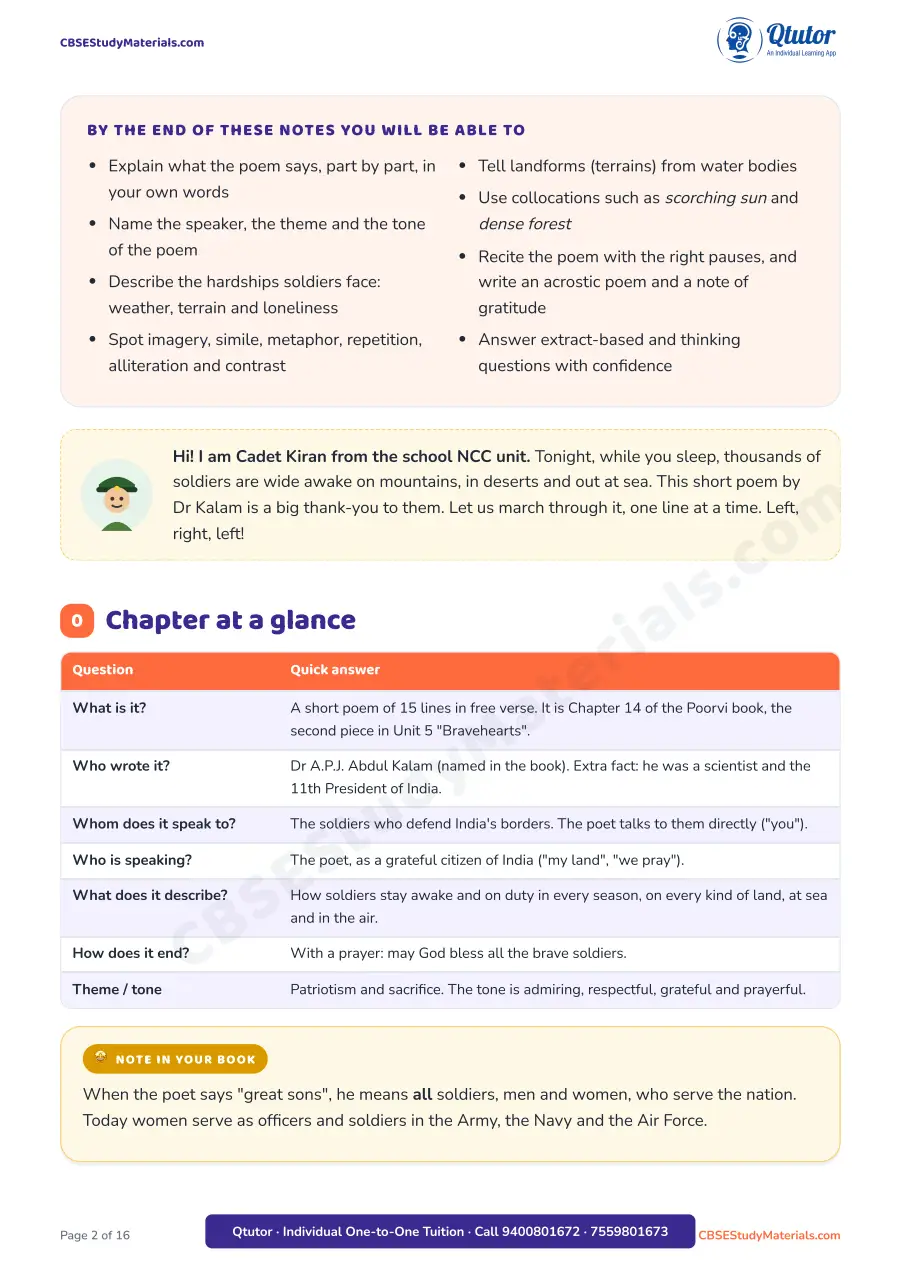
- Chapter at a glance: a quick table with the poet, the form, the speaker, whom the poem speaks to, what it describes, the theme and the tone.
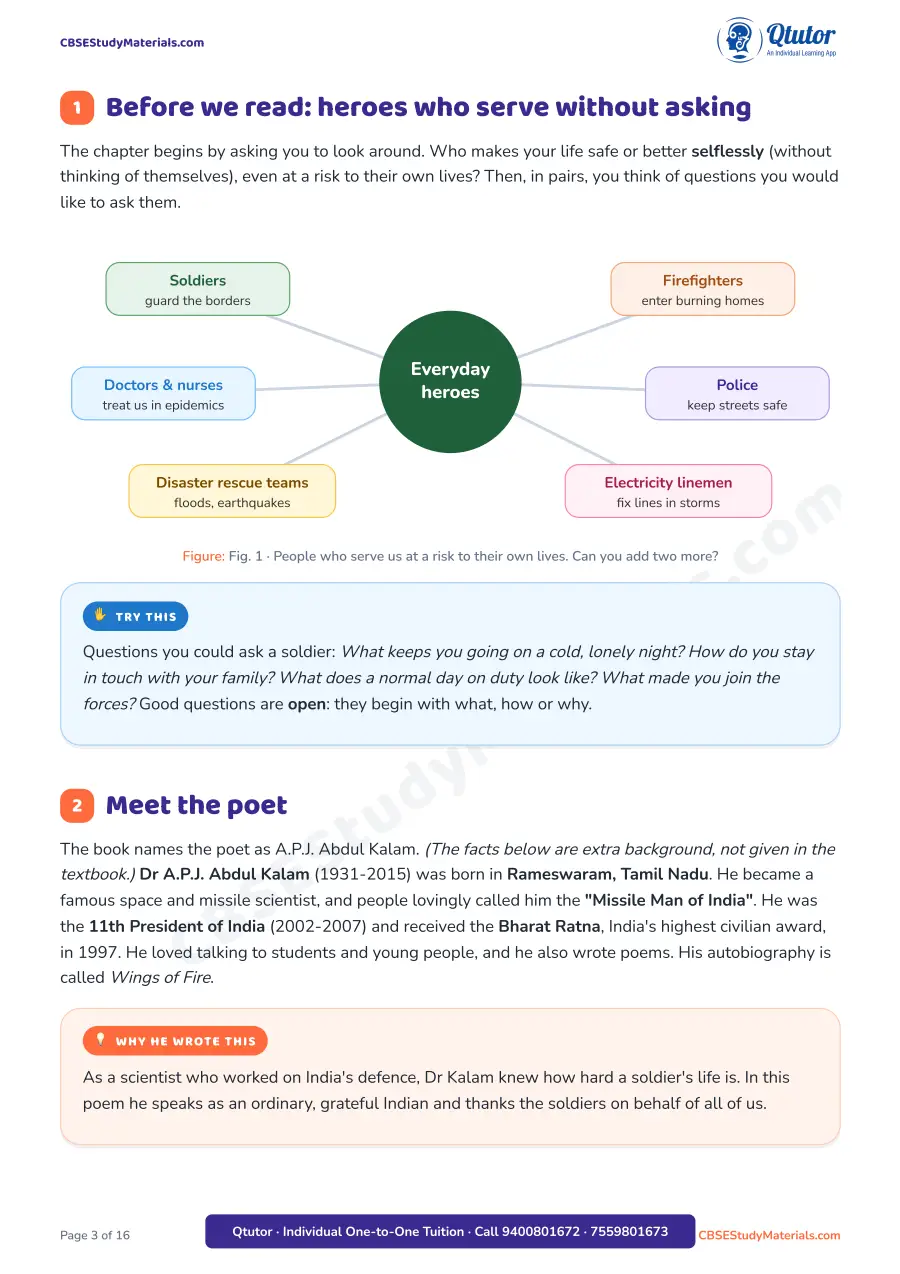
- Before we read: a diagram of everyday heroes who serve us at a risk to their lives, with sample questions you could ask a soldier.
- Meet the poet: short, accurate facts about Dr A.P.J. Abdul Kalam and why he wrote this tribute.
- The poem part by part: all 15 lines grouped into five parts, each with one key line and a retelling in our own words.
- Diagrams: the sleeping country and the soldier on watch (asleep vs awake), the three kinds of harsh weather, and a terrain picture that links heights, valleys, deserts, marshes, seas and air to the Army, the Navy and the Air Force.
- Speaker, theme, tone and message in a table with proof lines from the poem.
- Character notes: the soldiers ("you"), the poet ("I", "my land"), the people ("we") and the land, plus a table of the soldiers' qualities.
- Poetic devices: imagery, simile, metaphor, personification, repetition, alliteration, apostrophe, contrast and exclamation, with a diagram explaining the wind-chimes metaphor.
- 21 word meanings and a common-mistake box on the homophones feat and feet.
- Vocabulary: terrains vs water bodies (with a diagram) and collocations such as reach the summit, barren landscape and dense forest.
- Listening link: how to complete "A Soldier's Pride" using rhyme and meaning.
- Speaking and writing: recitation tips, a model acrostic poem on SOLDIER and a model note of gratitude.
- Explore: a sample badge of honour with a logo and slogan.
- Mind map, 12 "Check yourself" questions with an answer key, and a one-page summary.
Structure of the PDF
| Part | What you will find | Pages |
|---|---|---|
| Cover, objectives, chapter at a glance | Quick overview table | 1-2 |
| Sections 1-3 | Everyday heroes, the poet, the poem in five parts | 3-6 |
| Sections 4-6 | Speaker, theme, tone, characters, poetic devices | 7-9 |
| Sections 7-8 | Word meanings, terrains and collocations | 9-11 |
| Sections 9-12 | Listening, speaking, writing, badge of honour | 11-13 |
| Mind map | One-glance revision | 13 |
| Check yourself and answer key | 12 questions with answers | 14-15 |
| One-page summary | Full revision page | 16 |
My Dear Soldiers Class 7 Important Topics
- What the poem says in each of its five parts
- The contrast between the sleeping nation and the soldiers who stay awake
- The harsh weather soldiers face: wind, snow and the scorching sun
- Every terrain they guard, and how the poem covers land, sea and air
- The meaning of "Prime of your youth given to the nation"
- Speaker, theme (patriotism and sacrifice) and tone (admiring, respectful, grateful, prayerful)
- Imagery, the simile "as yogis", the wind-chimes metaphor, repetition of "you" and "we", and alliteration
- Terrains vs water bodies, collocations, and the homophones feat and feet
- Acrostic poems and a note of gratitude
My Dear Soldiers Class 7 Important Questions (Sample)
Here are three real excerpts from the PDF.
From "Common mistake": Feat (a brave or difficult achievement) and feet (more than one foot) sound the same but mean different things. They are homophones. The poem uses feat.
From "Poetic devices":
| Device | Example from the poem | Why the poet uses it |
|---|---|---|
| Simile | "Treading the lonely expanses as yogis" | Shows the soldiers' calm, discipline and ability to live alone and simply |
| Repetition | "you" (soldiers) and "we" (citizens) | Builds a bond between the soldiers and the people |
From "Check yourself": Pick the odd one out and give a reason: ghats, plateau, bay, delta. Answer: bay, because it is a water body; the others are land features.
How These Notes Help
A short poem can be the hardest to explain in your own words. These notes break the 15 lines into five clear parts, so you always know what each line is about and how it links to the next. The tables of devices and qualities give you ready proof lines for 3-mark and 5-mark answers. The diagrams make the soldiers' world easy to picture, and the mind map and one-page summary let you revise the whole chapter in minutes before a test. The Check yourself questions are mostly thinking questions, so they prepare you for extract-based and competency-based questions.
Who Should Use These Notes
- Class 7 CBSE students using the Poorvi English book in 2026-27
- Students preparing for unit tests, periodic tests and half-yearly exams
- Parents and tutors who want a clear, ready explanation of the poem
- Students who missed the class or want a quick chapter summary before an exam
My Dear Soldiers - Class 7 English Chapter 14 Notes (PDF · 16 pages · ₹49)
How to Download the Class 7 My Dear Soldiers Notes PDF
Click the download button above to get the 16-page PDF. It is a premium resource priced at ₹49, and you can save it on your phone or print it for revision.
Related Resources
- Chapter page: My Dear Soldiers, Class 7 English Chapter 14
- Subject page: Class 7 English study material
- My Dear Soldiers Class 7 NCERT Solutions: every textbook question answered in book order (10 pages)
- My Dear Soldiers Class 7 question bank: 60 extra important questions with answers, grammar and writing practice (12 pages)
- Previous chapter: A Homage to Our Brave Soldiers, Class 7 English Chapter 13
- Next chapter: Rani Abbakka, Class 7 English Chapter 15
FAQs on Class 7 English Chapter 14 My Dear Soldiers
Where can I download Class 7 English Chapter 14 My Dear Soldiers notes PDF? You can download the 16-page notes PDF from this page using the download button. It is a premium PDF priced at ₹49.
Who wrote the poem My Dear Soldiers in Class 7 English? The poem is by Dr A.P.J. Abdul Kalam, the scientist who was the 11th President of India. It is Chapter 14 in Unit 5 "Bravehearts" of the NCERT Poorvi book.
What is the theme of My Dear Soldiers Class 7? The theme is patriotism and sacrifice. The poem honours soldiers who guard the nation in every season and on every kind of land, sea and air, and who give the prime of their youth to the country.
What are the important topics in My Dear Soldiers Class 7? The meaning of each part of the poem, the speaker, theme and tone, the soldiers' qualities, poetic devices such as imagery, simile and metaphor, terrains, collocations, and the acrostic poem task.
What is the price of the My Dear Soldiers notes PDF? It is a premium PDF priced at ₹49, with diagrams, a mind map, 12 practice questions with answers and a one-page summary.
Are these notes NCERT based? Yes. They follow the 2026-27 NCERT Poorvi textbook for Class 7, but they are written independently and are not an official NCERT or CBSE publication.
Study tip: read the poem aloud once with the pauses, then revise from the one-page summary; reading aloud helps you remember the key lines for extract questions.