Exploring Substances: Acidic, Basic, and Neutral - Class 7 Science Chapter 2 NCERT Solutions (PDF · 18 pages · ₹49) Unlock the full PDF for ₹49
Free sample: pages 1 to 3 of 18. The full PDF costs ₹49.
Why does a white sheet of paper suddenly show the words "Welcome to the Wonderful World of Science" when a liquid is sprayed on it? Class 7 Science Chapter 2, Exploring Substances: Acidic, Basic, and Neutral, begins with exactly this puzzle, and these CBSE NCERT Solutions answer it along with every other question in the chapter. This is a premium 18-page PDF (₹49) of NCERT based solutions for the new Curiosity textbook (CBSE 2026-27). It is our own study material, not an official CBSE or NCERT publication.
The PDF follows the textbook page by page. Every activity, every thought bubble, every "Can you predict?" prompt and all twelve "Let Us Enhance Our Learning" questions are answered in the same order and with the same numbering as the book, so you can keep the textbook open beside it.
Class 7 Science Chapter 2 NCERT Solutions: What Is Included
- Answers to all 7 activities (2.1 to 2.7), each with the expected observation and the conclusion you should write.
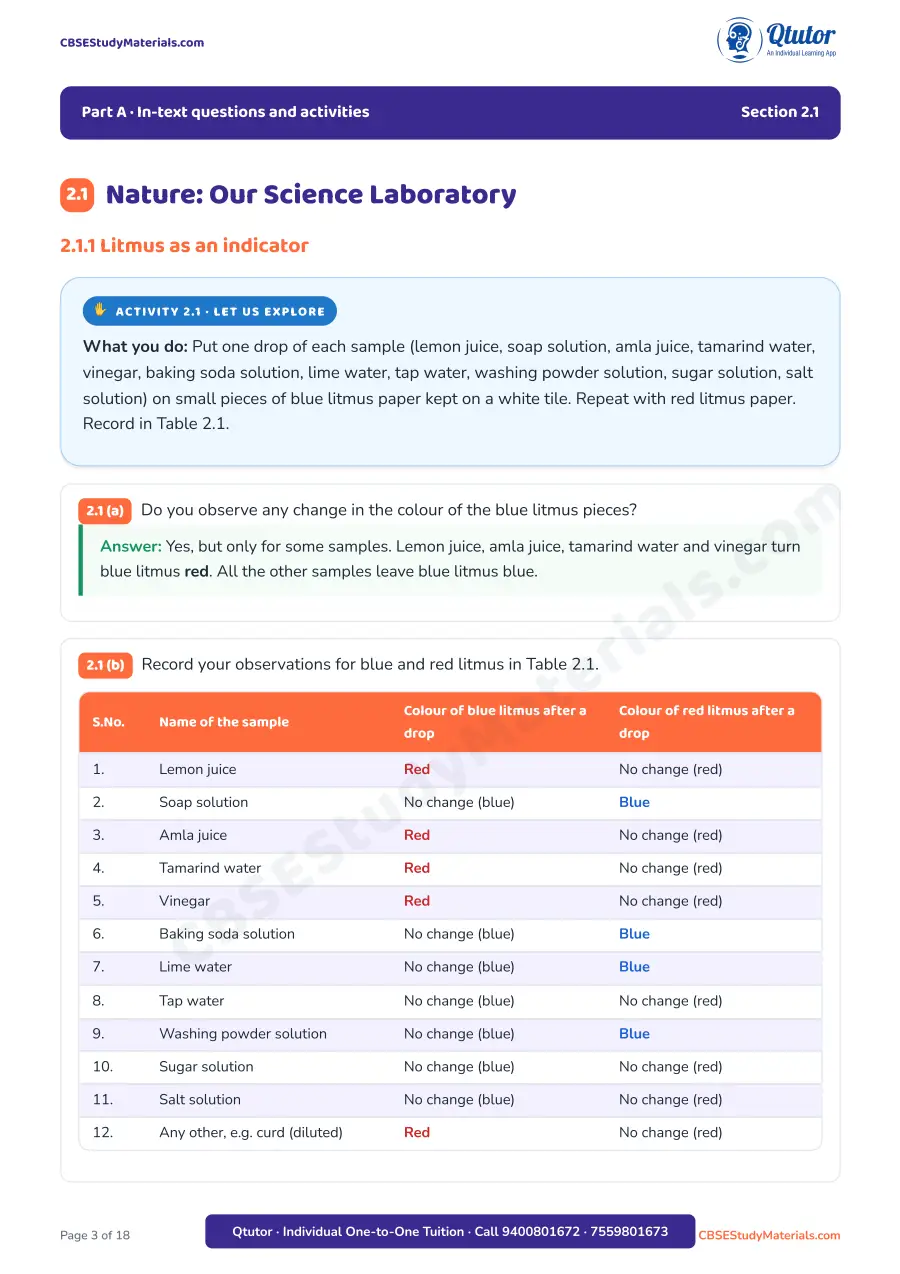
- Four filled-in tables: Table 2.1 (blue and red litmus), Table 2.2 (Groups A, B and C), Table 2.3 (red rose extract with the nature of each sample) and Table 2.4 (turmeric paper).
- Every in-text question from Sections 2.1, 2.2 and 2.3, including the Holistic Lens on lichens, the hydrangea Fascinating Facts box, the curry-stain thought bubble, Ashwin's turmeric greeting card and the three daily-life situations (ant bite, acidic soil, fish in a polluted lake).
- Exercise Q1 to Q12 solved: MCQs with reasons for the right option, the red rose strip figures (Figs. 2.13 to 2.15) redrawn and labelled, a full table of hidden-message combinations for Q6, and the completed soil flowchart for Q12.
- Dive Deeper (eggshell and vinegar bubbles) and guidance for all three Exploratory Projects.
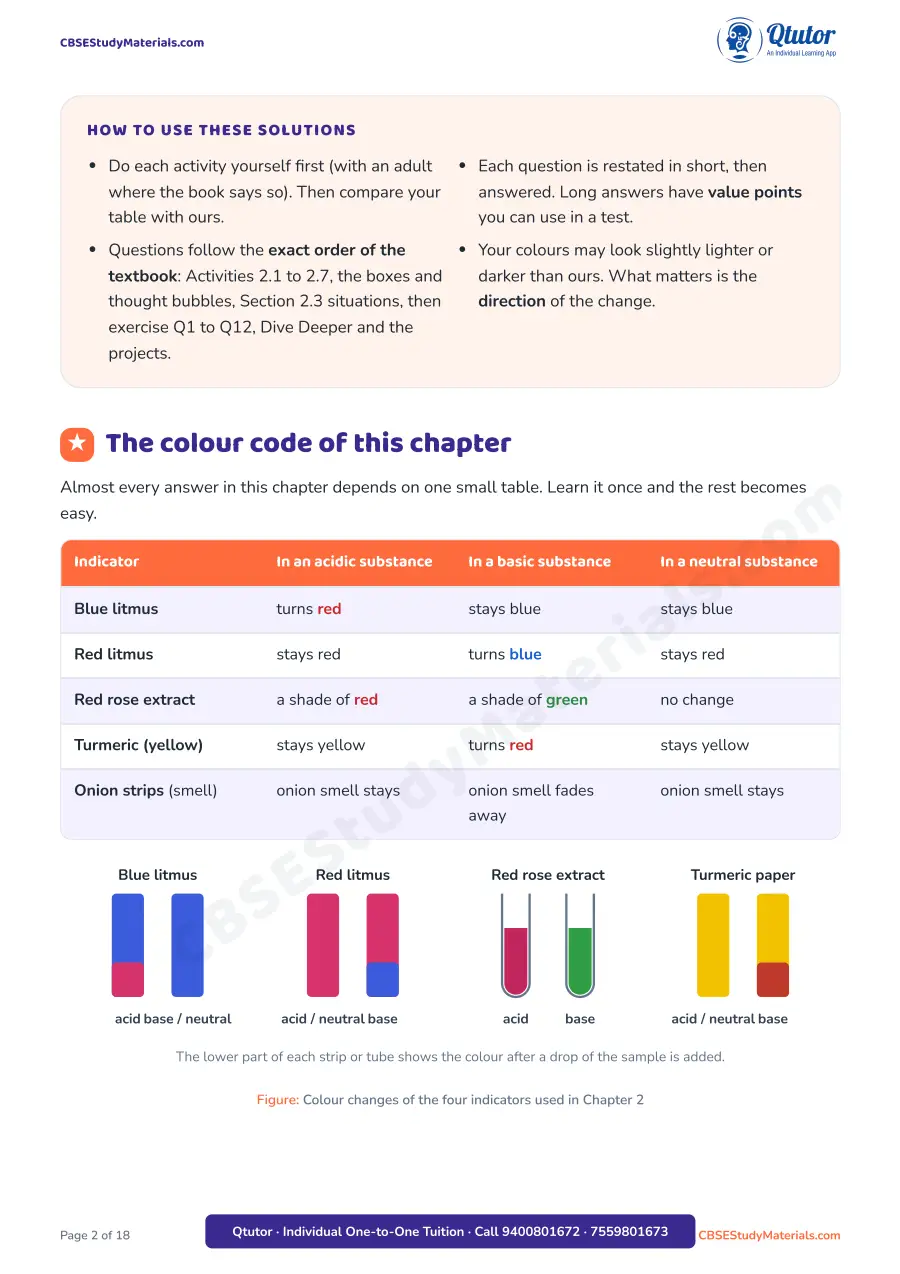
- A one-page colour code of all indicators and a quick recap before the test.
- 5 original diagrams: indicator colour strips, the Activity 2.7 test-tube sequence, Q3 strips, a natural indicator flow and the Q12 flowchart.
Structure of the PDF
| Part | What it covers | Pages |
|---|---|---|
| Cover and colour code | How to use, indicator colour table and diagram | 1-2 |
| Part A: Section 2.1 | Litmus, red rose and turmeric as indicators, Activities 2.1 to 2.6, Tables 2.1 to 2.4 | 3-10 |
| Part A: Sections 2.2 and 2.3 | Activity 2.7, neutralisation, three daily-life situations, Let us wrap up | 10-12 |
| Part B: Exercise | Let Us Enhance Our Learning Q1 to Q12 | 13-17 |
| Part C | Dive Deeper, Exploratory Projects, quick recap | 17-18 |
Exploring Substances Class 7 Important Topics
- Acidic, basic and neutral substances, and how taste and touch hint at their nature (sour acids, slippery bases)
- Litmus as an acid-base indicator and where it comes from (lichens)
- Common acids in food: citric, ascorbic, tartaric, oxalic, lactic and acetic acid
- Natural indicators: red rose extract, turmeric paper, and onion as an olfactory indicator
- Why turmeric can detect bases but cannot tell acids from neutral substances
- Neutralisation: Acid + Base → Salt + Water + Heat
- Neutralisation in daily life: ant bites, acidic and basic soil, factory waste
Exploring Substances Class 7 Questions and Answers (Sample)
Exercise Q2 (sample answer): Red litmus turns blue in A, turmeric turns red in B and red rose extract turns green in C. The answer is (iv) basic, basic and basic, because each of these colour changes happens only with a base.
Exercise Q10 (sample answer): With only turmeric paper, baking soda solution is easy to spot because it turns the paper red. Vinegar and sugar solution both leave it yellow. The solutions then use a smart second step: make red spots with baking soda solution and add the other two liquids. Vinegar neutralises the base and the spot turns yellow again, while sugar solution leaves it red.
Table 2.4 (excerpt from the PDF):
| Sample | Colour of turmeric paper |
|---|---|
| Lemon juice | No change (yellow) |
| Soap solution | Red |
| Lime water | Red |
| Salt solution | No change (yellow) |
How These NCERT Solutions Help
The chapter is activity-based, and many students lose marks because they cannot recall what colour to expect. Every observation here matches the indicator colours given in the textbook: blue litmus turns red in acids, red litmus turns blue in bases, red rose extract turns red in acids and green in bases, and turmeric turns red only in bases. The longer answers come with value points, so you know what a complete answer looks like. The HOTS-style exercise questions (blindfolded Manya, the secret message in orange juice, grape juice with baking soda) are explained step by step, not just given a one-word answer.
Who Should Use It
- Class 7 students using the Curiosity textbook who want to check their activity tables and exercise answers
- Students revising Chapter 2 before a unit test or half-yearly exam
- Parents and tutors who want a reliable, chapter-wise answer guide
How to Download the Class 7 Exploring Substances NCERT Solutions PDF
Use the button below. The PDF is premium (₹49) and opens on phones, tablets and computers. It also prints well in colour.
Exploring Substances: Acidic, Basic, and Neutral - Class 7 Science Chapter 2 NCERT Solutions (PDF · 18 pages · ₹49)
Related Resources
- Class 7 Science Chapter 2 Exploring Substances Notes: revision notes, mind map and one-page summary
- Class 7 Science Chapter 2 Exploring Substances Question Bank: important questions with answers
- Exploring Substances: Acidic, Basic, and Neutral chapter page
- All Class 7 Science study material
- Previous chapter: The Ever-Evolving World of Science
- Next chapter: Electricity: Circuits and Their Components
FAQs on Class 7 Science Chapter 2 Exploring Substances
Where can I download Class 7 Science Chapter 2 NCERT Solutions PDF? You can download it from this page using the download button. It is an 18-page PDF covering every activity and exercise question of Exploring Substances: Acidic, Basic, and Neutral.
What is the price of the Exploring Substances Class 7 NCERT Solutions PDF? It is a premium PDF priced at ₹49. The chapter notes and question bank for the same chapter are listed separately.
Which book is Exploring Substances: Acidic, Basic, and Neutral from? It is Chapter 2 of Curiosity, the Class 7 Science textbook (2026-27 edition) used in CBSE schools.
Does the PDF answer the in-text activities too, or only the exercise? Both. All seven activities, the in-text questions, thought bubbles and boxes are answered first, followed by exercise Q1 to Q12, Dive Deeper and the projects.
What colour does red rose extract show in acids and bases? It shows a shade of red in acidic substances and a shade of green in basic substances. Neutral substances cause no change.
Can turmeric paper test acids? No. Turmeric turns red only in basic substances and stays yellow in both acidic and neutral ones, so it cannot tell acids from neutral substances.
Study tip: make your own red rose or turmeric indicator at home with an adult, test five kitchen liquids, and compare your results with Tables 2.3 and 2.4 in this PDF.