Magnifying Glass - Class 8 English Chapter 14 Notes (PDF · 15 pages · ₹49) Unlock the full PDF for ₹49
Free sample: pages 1 to 3 of 15. The full PDF costs ₹49.
Can a scrap of chalk hold a myriad shells, and can an inch of moss be a forest? Class 8 English Chapter 14 Magnifying Glass says yes, and these CBSE chapter notes, based on the NCERT Poorvi textbook, explain Walter de la Mare's poem stanza by stanza in a colourful 15-page PDF.
This is a premium Chapter Notes PDF (₹49) for Class 8 English, Chapter 14 "Magnifying Glass", the poem in Unit 5 "Science and Curiosity" of the new NCERT Poorvi book (CBSE 2026-27). It is independent study material and is not an official CBSE or NCERT publication. The notes work as revision notes, a chapter summary, a word list and a set of important questions with answers in one PDF download.
Class 8 English Chapter 14 Magnifying Glass Notes: What Is Included
- Learning objectives and a "Chapter at a glance" table: poet, kind of text, unit, shape of the poem, what is magnified, big idea and tone
- A short note on the poet Walter de la Mare
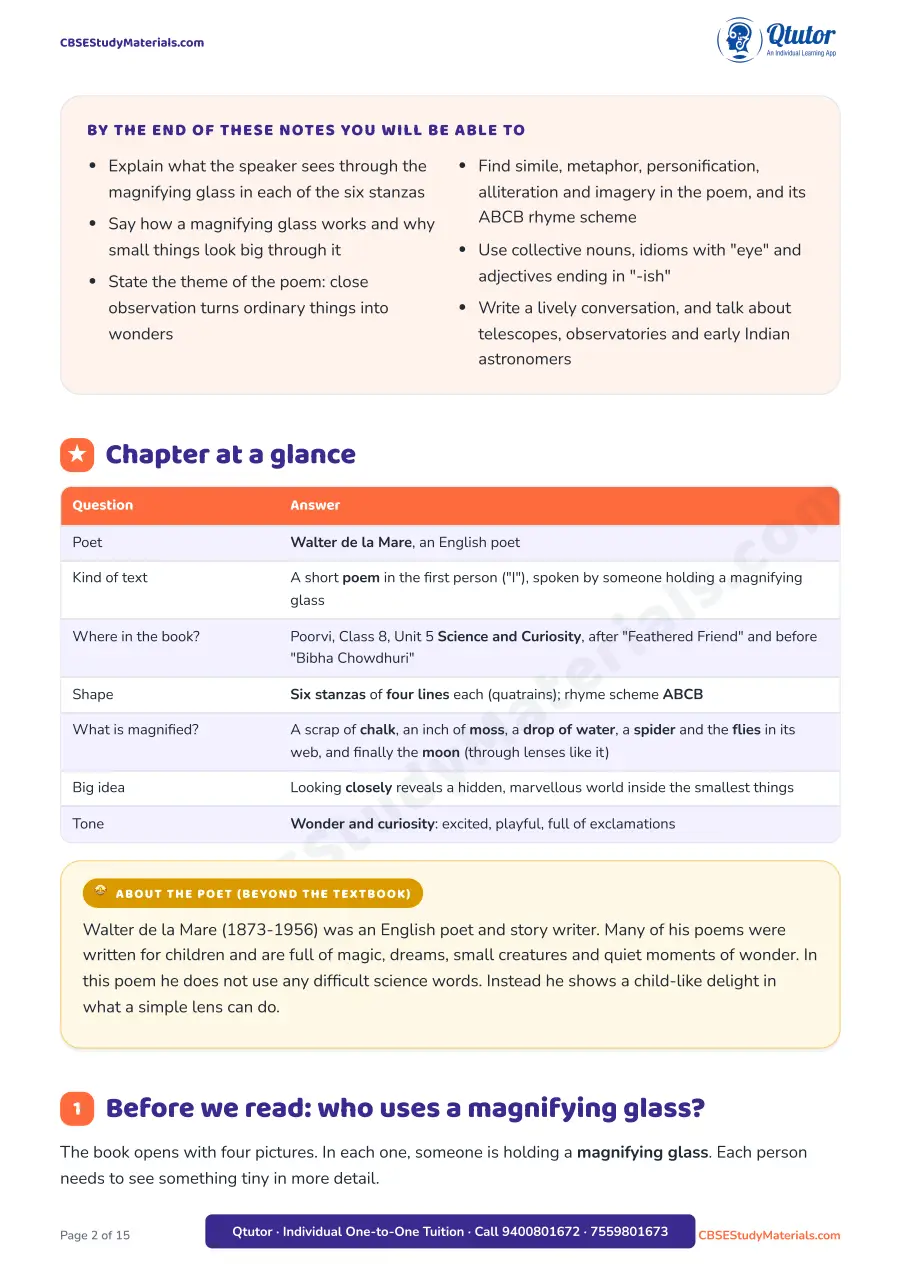
- The opening picture activity explained: the palm reader, the detective, the nature scientist and the curious girl, plus other instruments that magnify
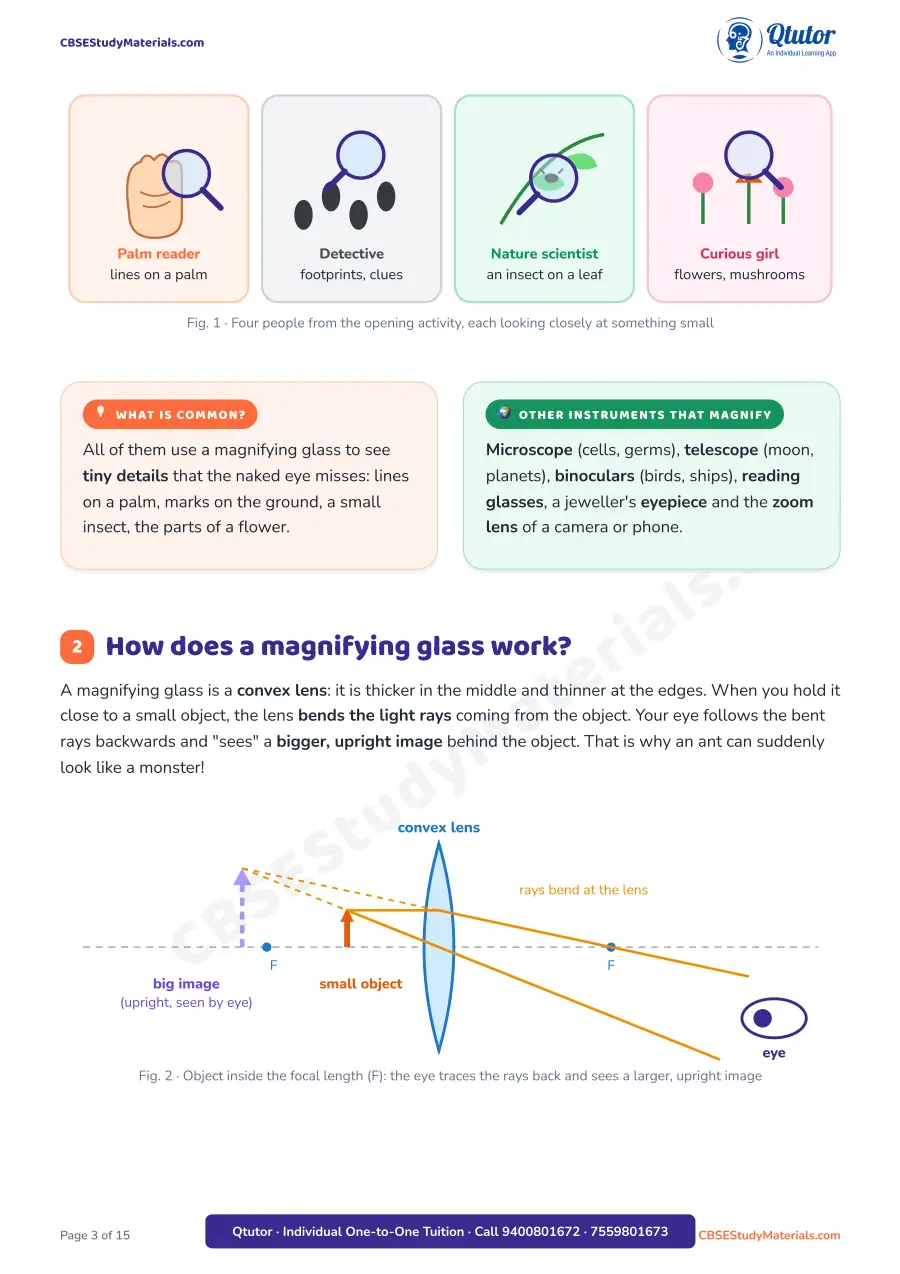
- How a magnifying glass works, with a labelled convex-lens ray diagram
- The poem explained in our own words, stanza by stanza, with one key line from each stanza and what it means
- A "small things made grand" diagram linking chalk, moss, a water drop, the spider and the moon to what each becomes
- The real science behind the images: shells in chalk, moss, life in pond water, spinnerets and the compound eyes of flies
- Notes on the speaker and the "characters" (the glass, the spider, the flies, the moon) with proof from the poem
- Theme and message, plus a "think deeper" prompt
- Form and rhyme: six quatrains, 24 lines and the ABCB rhyme scheme, shown in a diagram with all six rhyming pairs
- Poetic devices in a table: simile, metaphor, personification, alliteration, imagery, exclamation, hyperbole and the "-ish" adjective
- 18 word meanings, including myriad, deft, spinnerets, tigerish, surpass and 'twould
- Language corner: collective nouns, idioms with "eye" and adjectives with the suffix -ish
- Listening, speaking and writing help: Indian inventions from the listening task, the /f/ and /v/ sounds, and how to write a conversation
- Let us explore: low-vision aids, telescopes and observatories (with a height chart of Hanle and Mauna Kea), ancient Indian astronomers and Jantar Mantar
- A water-drop magnifier activity you can try at home
- Seven original diagrams in all, including a mind map
- "Check yourself": 12 practice questions with an answer key
- A one-page summary for last-minute revision
Structure of the PDF
| Part | What you get |
|---|---|
| Cover, objectives, chapter at a glance | The poem in seven quick answers |
| Sections 1-4 | Before we read, how a lens works, the poem stanza by stanza, the science behind the images |
| Sections 5-8 | Speaker and characters, theme and message, form and devices, words to know |
| Sections 9-11 | Collective nouns, eye idioms, -ish adjectives, listening, speaking, writing and Let us explore |
| Revision pages | Mind map, practice set, answer key and one-page summary |
Magnifying Glass Class 8 Important Topics
- What the speaker sees in each of the six stanzas, from the scrap of chalk to the moon
- The theme: the power of close observation to turn ordinary things into wonders
- The tone of wonder and curiosity, and why the poet uses exclamation marks
- The ABCB rhyme scheme and why the poem is made of quatrains
- Simile, metaphor, personification ("Magic talk"), alliteration and hyperbole
- How a convex lens makes things look bigger
- Collective nouns such as a swarm of locusts and a fleet of ships
- Idioms with "eye" and adjectives ending in -ish
- Telescopes, observatories, Āryabhaṭa, Varāhamihira, Bhāskarāchārya II and Jantar Mantar
Magnifying Glass Class 8 Important Questions (Sample)
The poetic devices, as summed up in the notes:
| Device | Example | Effect |
|---|---|---|
| Simile | a drop of water "Like hive of bees" | shows how busy and crowded the drop looks |
| Metaphor | an inch of moss is a forest | shows how vast tiny things become |
| Personification | "I can make Magic talk" | the glass seems alive and magical |
| Hyperbole | walking to the moon in an afternoon | lenses make the moon feel very near |
A sample from the practice set asks why the poet compares a drop of water to a hive of bees and not to a lake. The answer key explains that a hive suggests countless living, moving creatures in a small space, just like the tiny organisms in pond water, while a lake would only suggest size.
Another sample asks: Grandpa finds it hard to read the newspaper and to see bus numbers from far. Which low-vision aid suits each need? (Magnifying spectacles or a stand magnifier for reading; a small telescope for far-off numbers.)
How These Class 8 English Chapter 14 Notes Help
- The stanza-by-stanza explanation makes a short poem easy to understand and remember
- The device table and rhyme diagram prepare you for "pick an example" and "complete with a reason" questions
- The science boxes help you answer "why" questions with real reasons, not guesses
- The practice set and answer key let you test yourself before a class test
- The one-page summary is ideal for the night before the exam
Who Should Use This Study Material
Class 8 students using the Poorvi English textbook, especially those who find poems hard to explain in their own words. Parents and tutors can use the notes to revise the chapter quickly with a child.
How to Download the Class 8 Magnifying Glass Notes PDF
This is a premium PDF priced at ₹49. Use the download button below to get all 15 pages. It prints well in colour and is easy to read on a phone.
Magnifying Glass - Class 8 English Chapter 14 Notes (PDF · 15 pages · ₹49)
Related Resources
- Magnifying Glass Class 8 NCERT solutions: every textbook question answered in book order
- Magnifying Glass Class 8 question bank: 48 extra important questions with a full answer key
- Chapter page: Magnifying Glass, Class 8 English
- Subject page: Class 8 English study material
- Previous chapter: Feathered Friend, Class 8 English
- Next chapter: Bibha Chowdhuri: The Beam of Light that Lit the Path for Women in Indian Science, Class 8 English
FAQs on Class 8 English Chapter 14 Magnifying Glass
Where can I download Class 8 English Chapter 14 Magnifying Glass notes PDF? On this page. Use the download button to get the 15-page premium notes PDF for ₹49.
What are the important topics in Magnifying Glass Class 8? What the glass reveals in each stanza, the theme of close observation, the ABCB rhyme scheme, the poetic devices, and the vocabulary and grammar tasks on collective nouns, eye idioms and -ish adjectives.
Who wrote the poem Magnifying Glass? Walter de la Mare, an English poet. The poem is in Unit 5, Science and Curiosity, of the Class 8 Poorvi book.
What is the rhyme scheme of Magnifying Glass? ABCB. In every stanza the second and fourth lines rhyme, for example talk and chalk, trees and bees, moon and afternoon.
What is the theme of Magnifying Glass? The transformative power of close observation: when we look closely, ordinary things like chalk, moss and a drop of water turn into marvels.
Is this an official NCERT or CBSE PDF? No. It is our own study material written from the NCERT Poorvi chapter, and it is not an official CBSE or NCERT publication.
Study tip: pick one small thing at home, look at it closely for two minutes, and write four lines about it in the poem's ABCB pattern.