Exploring the Investigative World of Science Class 8 Science Ch 1 Model Question Paper (PDF · 16 pages · Free download) Download the full PDF free
You are looking at pages 1 to 3 of 16. The full PDF is free to download.
Why did two cousins frying baturas get opposite answers to the same question, and what does a thermometer that stops rising tell you? The Exploring the Investigative World of Science Class 8 Science Chapter 1 model question paper asks questions like these: it is a CBSE-style chapter test built on the NCERT Curiosity (Grade 8) textbook. It is a free 16-page PDF with a complete 50-mark paper and a full marking scheme. It is our own practice material and not an official CBSE or NCERT publication.
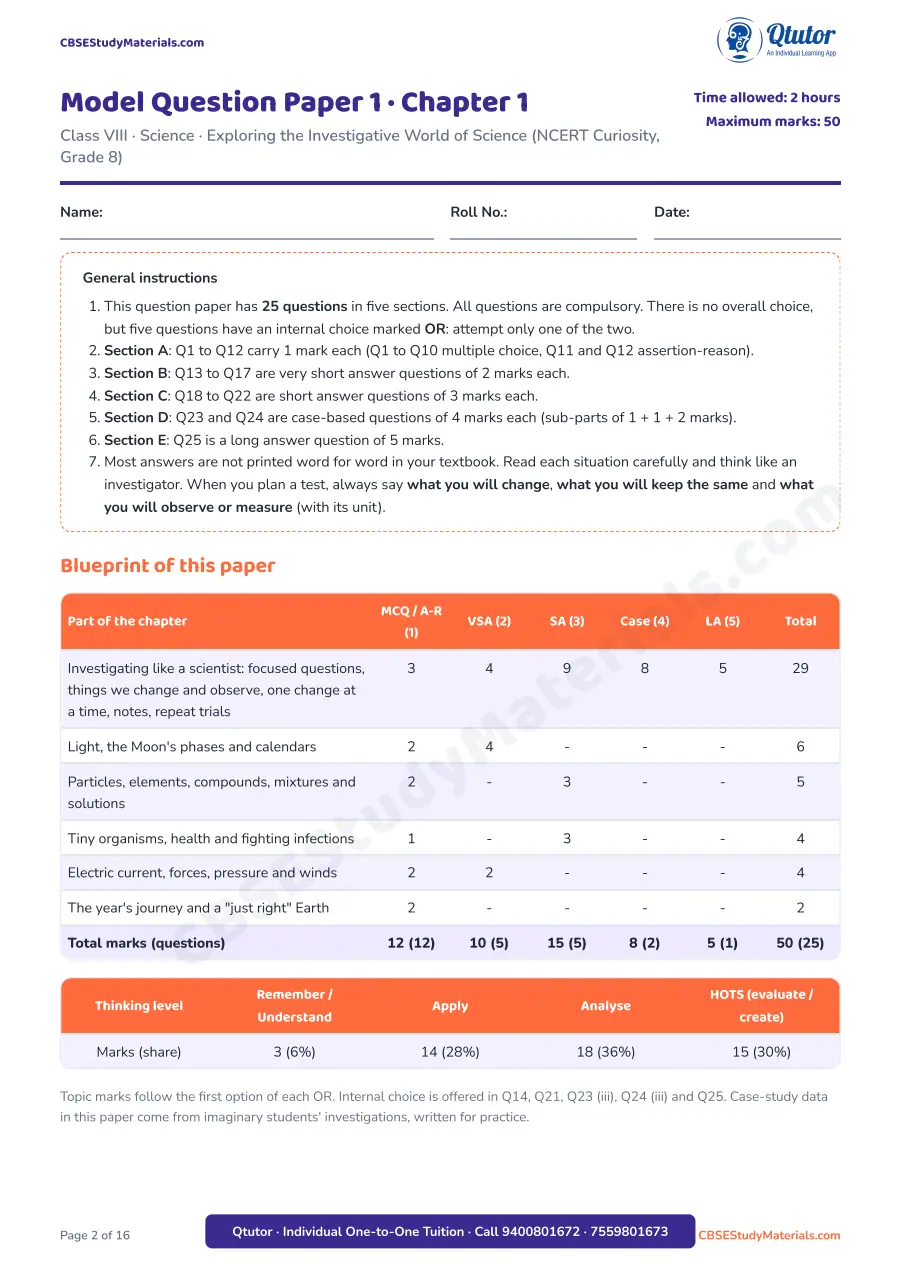
The paper is written for the CBSE 2026-27 session. It follows a recommended Class 8 pattern: Sections A to E, 2 hours, 50 marks, internal choice and a blueprint table, just like a real school test. This chapter is all about thinking like an investigator, so most questions ask you to plan fair tests, read data and judge conclusions rather than repeat lines from the book.
Class 8 Science Chapter 1 Exploring the Investigative World of Science Model Question Paper: What Is Included
- A paper header with time allowed (2 hours) and maximum marks (50), plus spaces for name, roll number and date
- General instructions that explain every section and the OR choices
- A blueprint table showing marks by part of the chapter and by question type, and a thinking-level table (remember/understand, apply, analyse, HOTS)
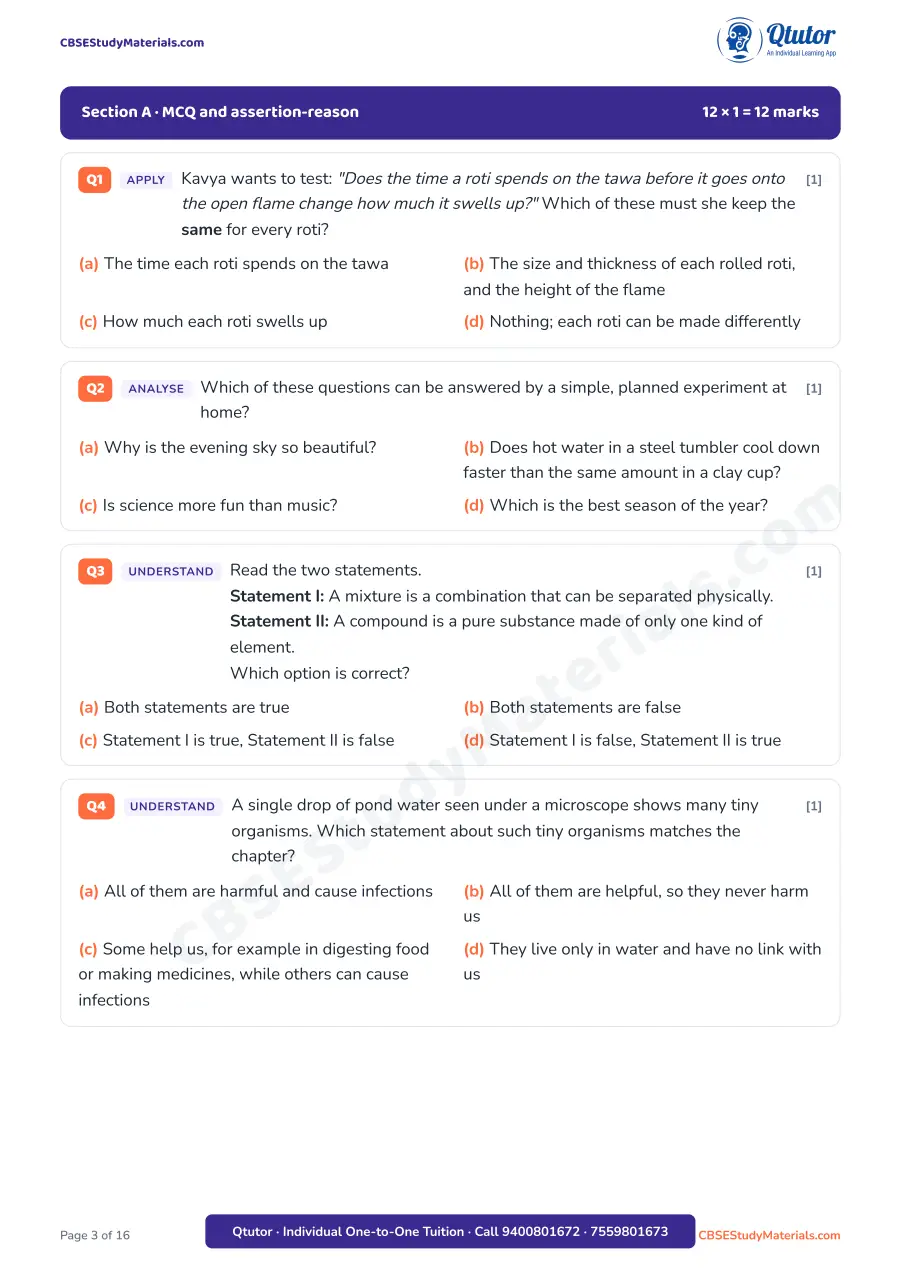
- 25 questions in five sections, with ruled answer lines
- 5 internal choices (OR) in 2-mark, 3-mark, case-based and long-answer questions
- 2 lab case studies with data: heating water minute by minute (with a line graph) and counting tiny organisms in drops of water under a microscope
- An experiment-design long answer with an original ramp diagram, and a calendar figure question on the lunar month of Chaitra
- A full answer key and marking scheme with value points and ½-mark and 1-mark steps for every question, including every OR option
Structure of the Paper
| Section | Questions | Type | Marks |
|---|---|---|---|
| A | Q1 to Q12 | 10 MCQs and 2 assertion-reason | 12 × 1 = 12 |
| B | Q13 to Q17 | Very short answer | 5 × 2 = 10 |
| C | Q18 to Q22 | Short answer | 5 × 3 = 15 |
| D | Q23 and Q24 | Case-based (1 + 1 + 2) | 2 × 4 = 8 |
| E | Q25 | Long answer (design an investigation) | 1 × 5 = 5 |
| 25 questions | 50 marks |
About 94% of the marks test applying, analysing, evaluating or designing, and only about 6% test plain remembering.
Exploring the Investigative World of Science Class 8 Important Topics Tested
The blueprint spreads the 50 marks over the whole chapter:
- Investigating like a scientist (29 marks): turning a vague question into a focused, testable one; sorting what you change from what you observe or measure; changing only one thing at a time; keeping clear notes with numbers and units; repeating trials; and spotting when a conclusion is not fair
- Light, the Moon's phases and calendars (6 marks): reflection from shiny and rough surfaces, light bending through lenses, why the Moon shines, and how watching the Moon helped people make the first calendars
- Particles, elements, compounds and mixtures (5 marks): how particles behave in solids and gases, and using the chapter's meanings of element, compound and mixture
- Tiny organisms and health (4 marks): helpful and harmful tiny organisms, and how food, exercise, medicines and vaccines help us fight infections
- Electric current, forces, pressure and winds (4 marks): heating and magnetic effects of electric current, what a force does to a moving object, and how pressure differences cause breezes, strong winds and cyclones
- The year's journey and a "just right" Earth (2 marks): the order of this year's topics and why Earth supports life
Exploring the Investigative World of Science Class 8 Important Questions (Sample from the PDF)
Section A, Q8 (Evaluate, 1 mark): Sana timed how long 200 mL of water took to start boiling, three times: 6 min 10 s, 6 min 5 s and 9 min 40 s. What is the best thing to do next? Answer: Check her notes for what was different in the third trial (for example, the flame or the lid), then repeat it.
Section C, Q20 (Analyse, 3 marks): Arnav timed three equal ice cubes melting on a steel plate (14 min), a wooden board (22 min) and a cotton cloth (31 min), but the steel plate was near a sunny window. Marking scheme: Changed: the surface; measured: time to melt in minutes (½ + ½). Two things changed together, so the result cannot be linked to the steel (1). Repeat with all three in the same place and conditions (1).
Section D, Q23 (Case-based): Kiran heated 200 mL of water on a spirit lamp and read the thermometer every minute.
| Part | Question | Answer |
|---|---|---|
| (i) | How did the rise per minute change? | It got smaller: 13 °C in the first minute, only 4 °C from minute 7 to 8 |
| (ii) | When did the reading stop rising? | From minute 8, at 98 °C, while the water boiled steadily |
| (iii) | Plan: does 400 mL take longer to boil? | Change the amount of water, measure time in minutes, keep the beaker and flame the same |
How This Model Question Paper Helps
- Real exam practice: sit the full paper in 2 hours to build speed and get used to sections, OR choices and case studies before your periodic test, half-yearly or annual exam.
- Thinking, not cramming: the questions train the investigation skills the NCERT chapter is built around.
- Honest self-checking: the marking scheme lists value points and shows where every half mark comes from, so you can mark your own paper.
Who Should Use It
- Class 8 students who have finished Chapter 1 and want a full chapter test
- Students preparing for unit tests and school exams in the CBSE 2026-27 session
- Teachers who want a printable chapter test with a marking scheme
How to Download the Class 8 Science Chapter 1 Model Question Paper PDF
Click the download button below. The PDF download is free and prints well on A4 paper. Try the paper on your own first, then check your answers with the marking scheme at the end.
Exploring the Investigative World of Science Class 8 Science Ch 1 Model Question Paper (PDF · 16 pages · Free download)
Related Resources
- Chapter page with all materials: Exploring the Investigative World of Science, Class 8 Science
- All chapters: Class 8 Science study material
- Revise first with the Exploring the Investigative World of Science Class 8 notes
- More practice: Exploring the Investigative World of Science Class 8 worksheet with answer key
- Quick recall: Exploring the Investigative World of Science Class 8 flash cards
- Next chapter: The Invisible Living World: Beyond Our Naked Eye, Class 8 Science Chapter 2
FAQs on Class 8 Science Chapter 1 Exploring the Investigative World of Science Model Question Paper
Where can I download the Class 8 Science Chapter 1 model question paper PDF? You can download it free from this page using the download button. It is a 16-page PDF with the question paper and the marking scheme.
Is the Exploring the Investigative World of Science model question paper free? Yes. Model Question Paper 1 for this chapter is completely free to download and print.
How many marks and questions are in the paper? It is a 50-mark paper with 25 questions in five sections (A to E), to be finished in 2 hours. Five questions offer an OR choice.
Does the model question paper have answers? Yes. Every question, including each OR option, has a marking-scheme answer with value points and step marks.
What are the important questions in Exploring the Investigative World of Science Class 8? Expect questions on planning a fair test, naming what you change, keep the same and measure, reading data from a table or graph, and judging whether a conclusion is fair.
Which book is Exploring the Investigative World of Science from? It is Chapter 1 of the NCERT Class 8 Science textbook Curiosity (Grade 8), followed in CBSE schools.
Is this an official CBSE question paper? No. It is an original NCERT based practice paper written in the CBSE style for revision. It is not published by CBSE or NCERT.
Study tip: in every "plan an investigation" answer, write one thing you change, the things you keep the same, and what you measure with its unit.