Journey of a River - Class 5 EVS Chapter Notes (PDF · 18 pages · ₹49) Unlock the full PDF for ₹49
Free sample: pages 1 to 3 of 18. The full PDF costs ₹49.
If you floated a paper boat at Trimbakeshwar in Maharashtra, where would it end up? Not in the nearby Arabian Sea, but about 1,465 km away in the Bay of Bengal. These Journey of a River Class 5 EVS Chapter 2 notes follow the river Godavari on that trip. The PDF is an 18-page Chapter Note for CBSE Class 5 EVS, based on the NCERT textbook Our Wondrous World (2026-27 edition).
It is a premium PDF priced at ₹49, prepared by an independent study-material team. It is not an official CBSE or NCERT publication. Think of it as NCERT based revision notes, a chapter summary and important questions in one, told in a warm, simple voice by the river itself.
Class 5 EVS Chapter 2 Journey of a River Notes: What Is Included
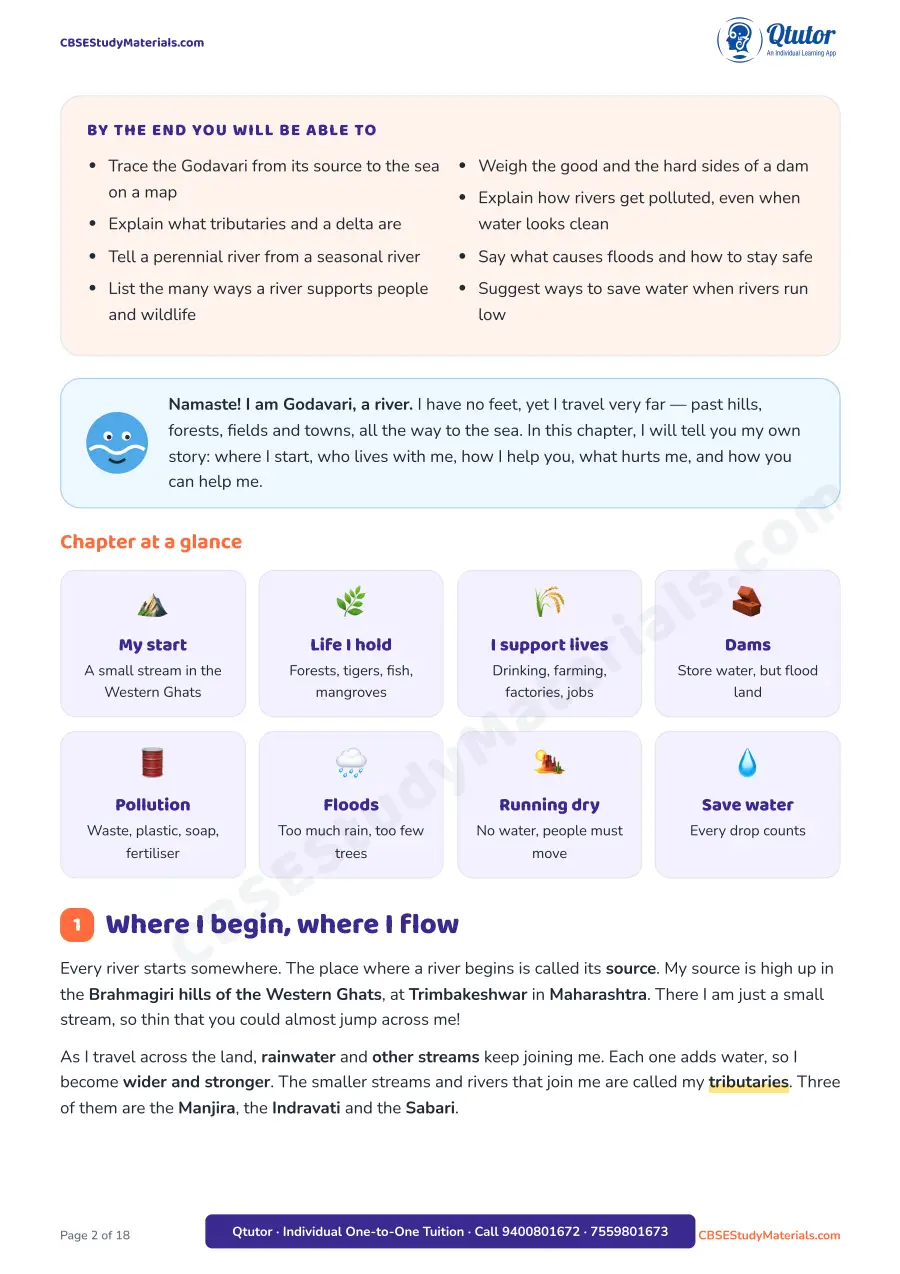
- A photo cover, eight learning goals and a "chapter at a glance" grid of the big ideas
- Eight numbered teaching sections covering every topic of the chapter
- Concept cards, definitions, "Did you know?" facts, common-mistake alerts, "Think deeper" prompts and "Try this" activities
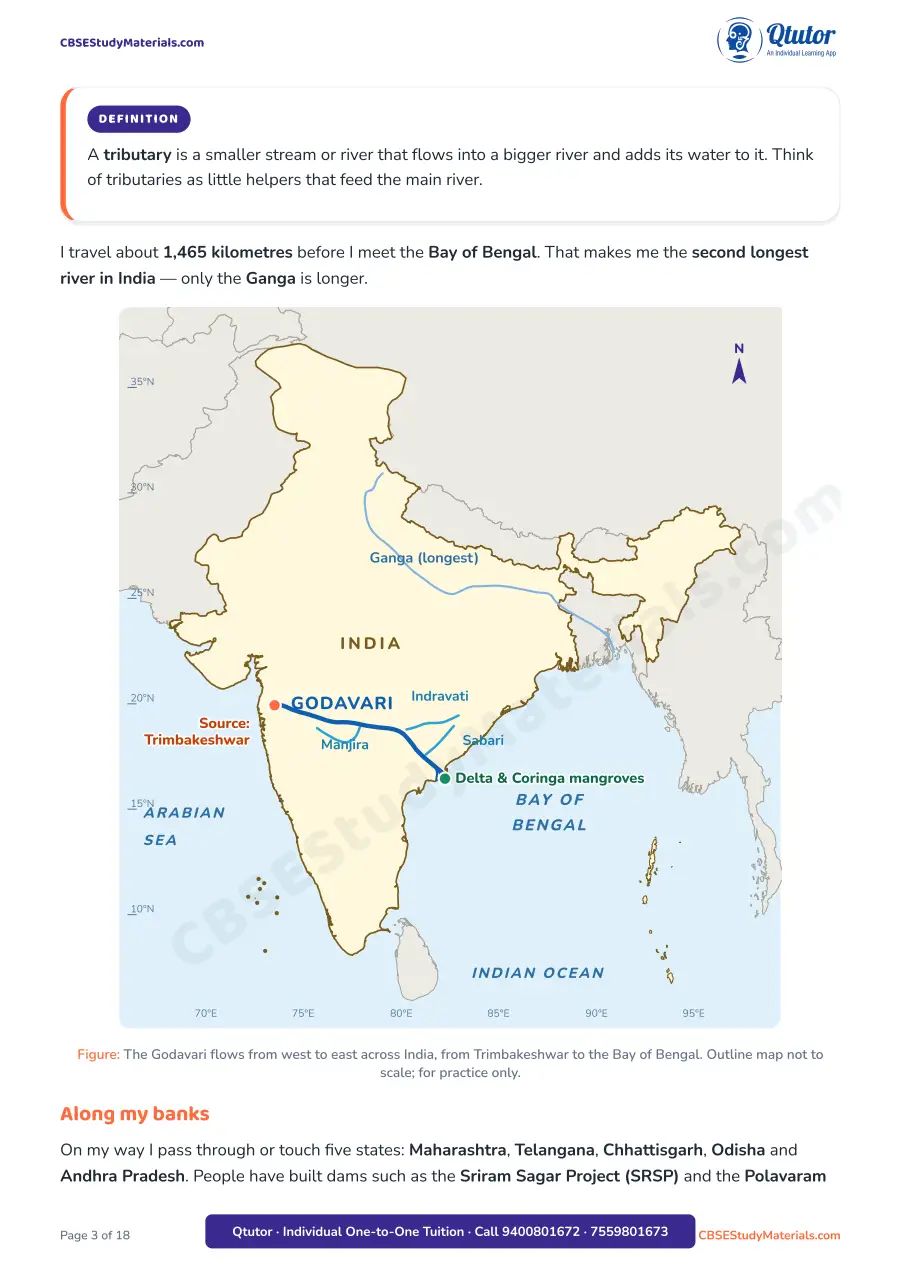
- An outline map of India with the complete official boundary, showing the Godavari from its source to its delta, its tributaries (Manjira, Indravati, Sabari) and the Ganga for comparison. It is captioned "Outline map not to scale; for practice only."
- Eight more original diagrams: a river's path from hill stream to sea, perennial vs seasonal rivers, the many uses of a river, a dam and reservoir, the sugar-and-oil dissolving experiment, the "green blanket" of fertiliser pollution, how trees reduce floods, and a mind map
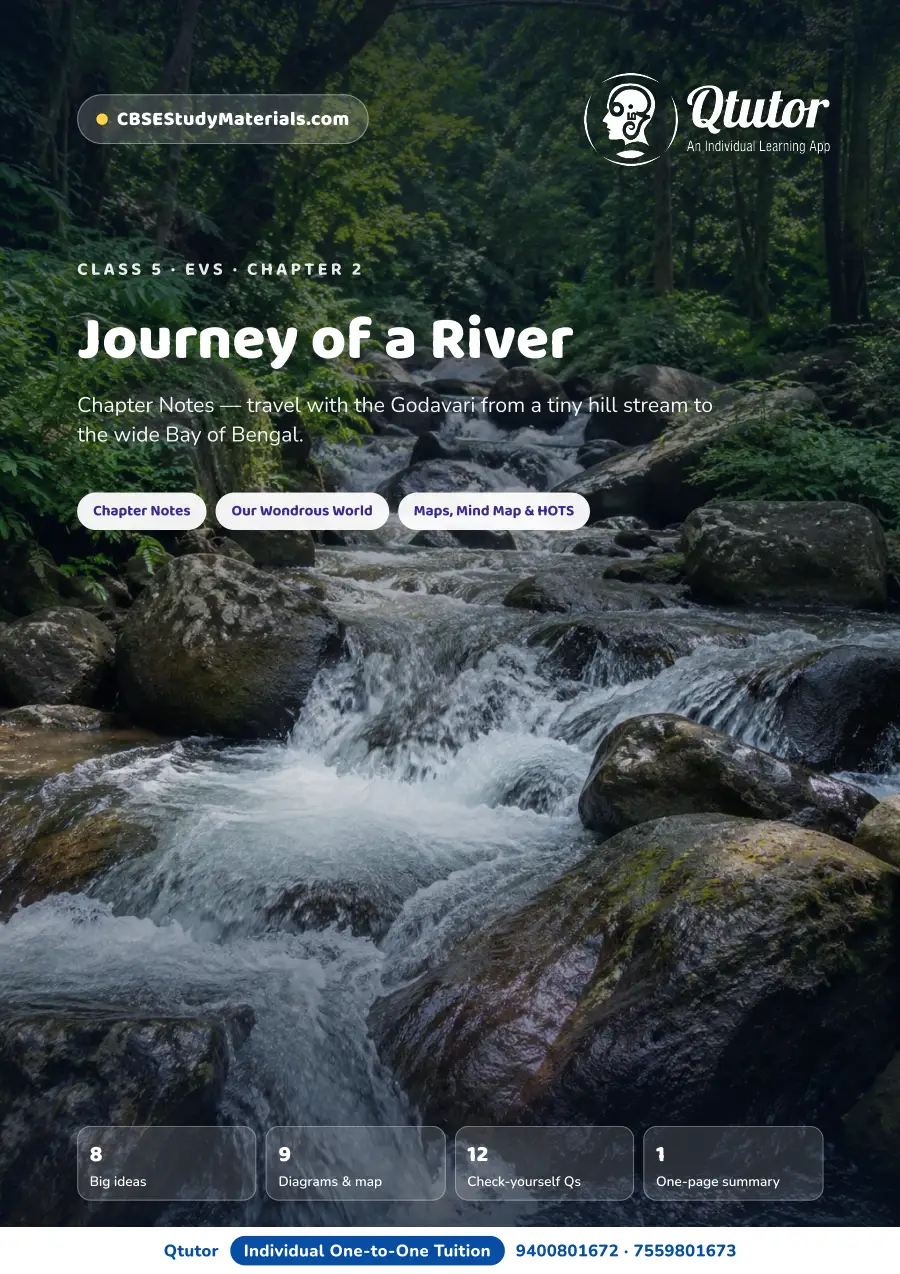
- Three photos: a hill stream, a river winding through fields on a plain, and a river meeting the sea
- Flood safety tips in a before / during / after table and a "what a flood affects" table
- A key-terms grid with 12 terms, a "fill the river story" word-bank exercise and a one-page summary for last-minute revision
- "Check yourself": 12 questions (MCQ, match, true/false, picture case, cause-effect and HOTS) with a compact answer key
Structure of the PDF
| Part | What you will find |
|---|---|
| Cover and goals | Chapter name, 8 learning goals, chapter at a glance |
| Section 1 | Where the Godavari begins and flows; tributaries; India map; states, dams and wildlife areas; Dakshina Ganga |
| Section 2 | A river's journey from source to sea; the delta and Coringa mangroves |
| Section 3 | Perennial and seasonal rivers; forests, animals and mangroves |
| Section 4 | How rivers support lives; livelihoods; ecotourism |
| Section 5 | Dams and reservoirs: the good side and the hard side |
| Section 6 | River pollution, the dissolving experiment, the "green blanket", Namami Gange |
| Section 7 | Floods, trees and flood safety; role-play |
| Section 8 | When a river runs dry; Chennai and Bengaluru; saving water |
| Revision | Key terms, mind map, fill-in exercise, one-page summary |
| Practice | 12 Check-yourself questions and answer key |
Journey of a River Class 5 Important Topics
- Source and tributaries: the Godavari begins as a small stream in the Brahmagiri hills of the Western Ghats at Trimbakeshwar. Rainwater and smaller streams called tributaries join it and make it wider and stronger.
- Length and mouth: it travels about 1,465 km to the Bay of Bengal and is India's second longest river after the Ganga. It is called Dakshina Ganga.
- Along its banks: Maharashtra, Telangana, Chhattisgarh, Odisha and Andhra Pradesh; the Sriram Sagar Project and Polavaram Dam; Kawal Tiger Reserve, Pench National Park and Coringa Wildlife Sanctuary.
- Perennial and seasonal rivers: a perennial river flows all year; a seasonal river has water mainly in the rainy season.
- Delta and mangroves: near the sea the river splits into many streams and forms a delta, where fresh water meets salty water at the Coringa mangrove forests.
- Rivers support lives: water for homes, schools, fields and factories through pipes and canals, and livelihoods such as farming, fishing, boating and ecotourism.
- Dams: more than 900 dams store the Godavari's water in reservoirs for dry seasons, crops and electricity, but they also flood land and make people and animals leave their homes.
- Pollution: waste, plastic and dirty water; why clear-looking water may not be safe; how fertilisers create a "green blanket" that chokes fish.
- Floods and droughts: too much rain, the role of trees, flood safety, and what happens when a river runs dry.
Journey of a River Class 5 Important Questions (Sample)
Here are three questions taken from the "Check yourself" section of the PDF:
- Riya floats a paper boat at Trimbakeshwar. If it never got stuck, which water body would it finally reach? (a) Arabian Sea (b) Bay of Bengal (c) River Ganga (d) Indian Ocean directly
Answer: (b) Bay of Bengal. The Godavari flows east across India, even though it starts near the west coast.
- A village pond near rice fields turns bright green and its fish start dying after the rains. Explain the chain of events from field to fish.
Answer: Fertiliser on the fields → rain washes it into the pond → water plants grow very fast → a green blanket covers the surface → fish cannot breathe and die.
- Arjun stirs salt into one glass of water and sand into another. Which glass looks clear, and what does this teach us about river water?
Answer: The salt glass looks clear because salt dissolves. River water can look clear and still carry dissolved harmful things.
How These Class 5 EVS Notes Help
- Concept first: every idea starts from something a child can picture, such as a paper boat, a glass of sugar water or a tap at home.
- Visual learning: the India map and eight diagrams make the river's path, the dam and the "green blanket" easy to remember.
- Thinking, not just recall: most practice questions ask children to apply, compare, predict or suggest, in line with the competency-based approach of the new NCERT books.
- Quick revision: the one-page summary and mind map cover the whole chapter at a glance before a test.
Who Should Use It
- Class 5 students studying Our Wondrous World in CBSE schools in 2026-27
- Parents who want simple study material to revise the chapter with their child
- Teachers who want a ready map and questions for class discussion
How to Download the Class 5 Journey of a River Notes PDF
Use the download button below. The PDF is ₹49 and opens on any phone, tablet or computer, and it prints well on A4 paper.
Journey of a River - Class 5 EVS Chapter Notes (PDF · 18 pages · ₹49)
Related Resources
- All Chapter 2 materials: Journey of a River Class 5 EVS chapter page
- Free full study module for the same chapter, with every textbook question answered: Journey of a River Class 5 EVS Complete Study Material
- All Class 5 EVS chapters: Class 5 EVS
- Previous chapter: Water — The Essence of Life Class 5 EVS Chapter 1 Notes, Worksheet, Flash Cards and Model Question Paper
- Next chapter: The Mystery of Food Class 5 EVS
FAQs on Class 5 EVS Chapter 2 Journey of a River
Where can I download Class 5 EVS Chapter 2 Journey of a River notes PDF? You can download it from the button on this page. It is an 18-page chapter note PDF priced at ₹49.
Is the Journey of a River Class 5 notes PDF free? No, these illustrated chapter notes cost ₹49. A separate free complete study material for the same chapter is linked above.
What are the important topics in Journey of a River Class 5? The Godavari's source, tributaries and length, perennial and seasonal rivers, the delta and Coringa mangroves, how rivers support lives, dams, river pollution, floods and saving water.
Which book is Journey of a River Class 5 from? It is Chapter 2 of Our Wondrous World, the NCERT EVS textbook for Class 5 (2026-27).
Does the PDF have a map of the Godavari? Yes. It has an outline map of India with the complete official boundary showing the Godavari from Trimbakeshwar to its delta, with the Manjira, Indravati and Sabari tributaries.
Are answers given for the important questions? Yes. All 12 "Check yourself" questions and the fill-in exercise have a compact answer key at the end.
Study tip: trace the Godavari on the map with your finger and say each stop aloud: source, tributaries, plains, delta, sea.