Diversity in the Living World - Class 6 Science Chapter 2 Notes (PDF · 18 pages · ₹49) Unlock the full PDF for ₹49
Free sample: pages 1 to 3 of 18. The full PDF costs ₹49.
Why does a camel in Ladakh have two humps while a camel in Rajasthan has only one? And why do banana leaves have straight, side-by-side veins while a hibiscus leaf has a net of them? These questions sit at the heart of Diversity in the Living World, Class 6 Science Chapter 2, and these CBSE Class 6 Science notes answer them in simple, friendly language. This is a premium 18-page chapter notes PDF (₹49) written from the NCERT Curiosity textbook (2026-27 edition). It is an independent study resource and is not an official CBSE or NCERT publication.
The notes follow the chapter in the same order as the book: the class nature walk, biodiversity, grouping, herbs, shrubs and trees, leaf venation, roots, dicot and monocot seeds, animal movement, adaptations and habitats. Every idea is explained with a picture, a table or a short story, so a Class 6 student can revise the whole chapter without feeling lost.
Class 6 Science Chapter 2 Diversity in the Living World Notes: What Is Included
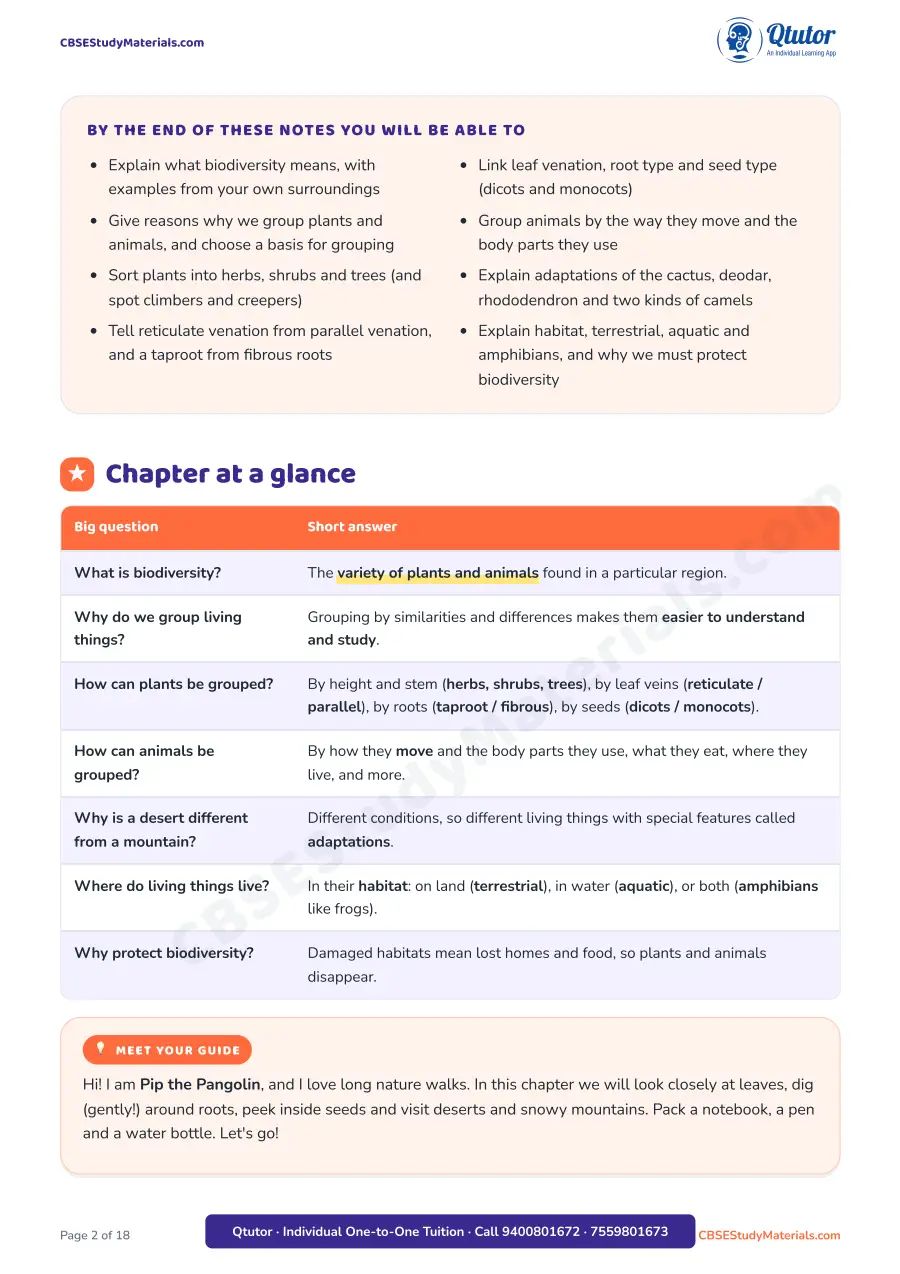
- A colourful cover and a "By the end you will be able to" list of 8 learning goals
- A "Chapter at a glance" table that answers the seven big questions of the chapter in one line each
- 9 numbered sections covering every topic of the NCERT chapter
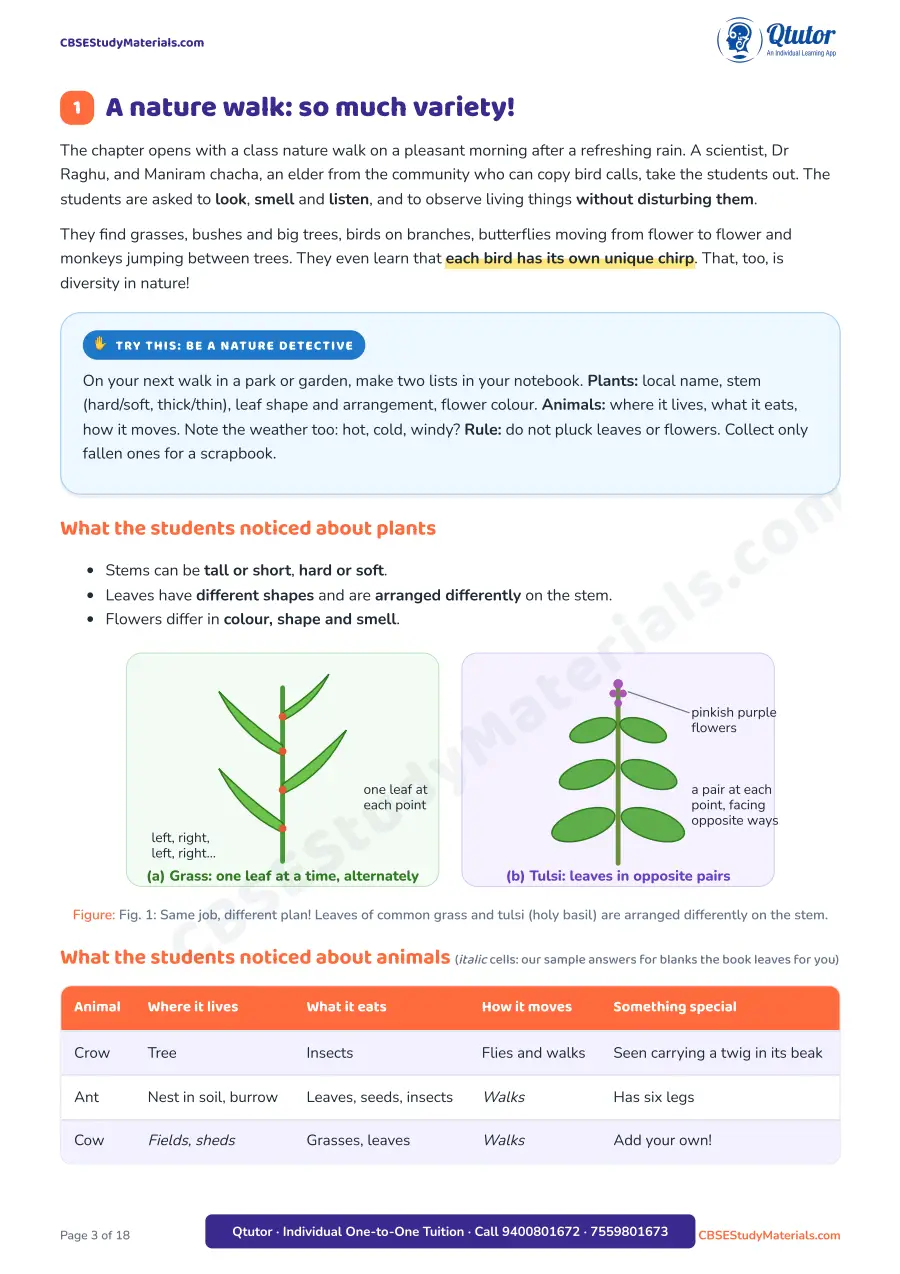
- 10 original labelled diagrams plus a mind map: leaf arrangement in grass and tulsi, bases for grouping, herb-shrub-tree comparison, reticulate and parallel venation (hibiscus, banana, grass), taproot and fibrous roots (mustard, grass), dicot and monocot seeds (chickpea, maize), animal movement (fish, goat, pigeon), cactus and deodar, hot-desert and cold-desert camels, and a habitat chart
- two real-life photos (leaves of different plants side by side, and a camel in a sandy desert), definition cards, "Common mistake" boxes, "Think deeper" prompts, "Did you know?" facts and "Try this" activities
- Comparison tables: herbs vs shrubs vs trees, dicots vs monocots, and the two kinds of camels
- A key-terms grid with 20 keywords and their meanings
- 12 "Check yourself" important questions (MCQs, data tables, case-based, error-spotting and HOTS) with a complete answer key
- A one-page summary (revision notes) with a quick comparison table and a "Before the test" checklist
Structure of the PDF
| Part | What you get |
|---|---|
| Cover and goals | Learning goals and chapter at a glance |
| Sections 1-2 | Nature walk, biodiversity, why and how we group |
| Sections 3-6 | Herbs, shrubs, trees; venation; roots; dicots and monocots |
| Section 7 | Grouping animals by movement; Janaki Ammal; Save Silent Valley |
| Sections 8-9 | Adaptations in deserts and mountains; habitats; protecting biodiversity |
| Revision | Key terms, mind map, 12 questions with answers, one-page summary |
Diversity in the Living World Class 6 Important Topics
- Biodiversity: the variety of plants and animals in a region, and how they depend on each other
- Grouping: why we group living things and why different bases can all be correct
- Herbs, shrubs and trees, plus climbers and creepers
- Leaf venation: reticulate (net-like) and parallel
- Roots: taproot and fibrous roots
- Seeds: cotyledons, dicots and monocots, and how seed type links to venation and roots
- Animal movement: legs, wings and fins
- Adaptations: cactus, deodar, rhododendron, and camels of the hot and cold deserts
- Habitat: terrestrial, aquatic and amphibians
- Protecting biodiversity: Project Tiger (1973), the Cheetah Reintroduction Project (2022), protected areas for the Great Indian Bustard, sacred groves, and the scientists Janaki Ammal and Salim Ali
Diversity in the Living World Class 6 Important Questions (Sample)
Here is the dicot and monocot comparison table from the notes:
| Feature | Dicot plants | Monocot plants |
|---|---|---|
| Cotyledons in seed | Two | One |
| Leaf venation | Reticulate (net-like) | Parallel |
| Root system | Taproot | Fibrous roots |
| Examples | Chickpea, mustard | Maize, wheat |
A sample from the "Check yourself" section:
Q. A soaked seed splits neatly into two halves. Which pair of features would you expect in the plant that grows from it? (a) parallel venation and fibrous roots (b) parallel venation and taproot (c) reticulate venation and taproot (d) reticulate venation and fibrous roots Answer: (c). Two halves means two cotyledons, so it is a dicot, and dicots generally have reticulate venation and a taproot.
A sample "Common mistake" box: "A banana leaf has a thick middle vein, so it must be reticulate." Wrong! What matters is how the other veins run. In a banana leaf they run side by side and never form a net, so its venation is parallel.
How These Notes Help
- Concept first: each idea starts from something a child can see, like a school bag, a roti or a soaked chana, before the science word appears.
- Pictures you can redraw: the venation, root and seed diagrams are drawn simply so students can copy them in their notebooks and in tests.
- Thinking, not just remembering: most questions ask students to apply ideas, read a table or explain a reason, in the competency-based style of the new NCERT books for CBSE 2026-27.
- Quick revision: the key terms, mind map and one-page summary make last-minute revision easy.
Who Should Use It
- Class 6 students studying the NCERT Curiosity science book who want clear chapter 2 notes and a chapter summary
- Parents who want to help their child revise at home
- Teachers and tutors looking for ready diagrams, important questions and a mind map for class discussion
How to Download the Class 6 Diversity in the Living World Notes PDF
Click the download button below to get the premium PDF for ₹49. It opens on phones, tablets and computers, and prints neatly on A4 paper.
Diversity in the Living World - Class 6 Science Chapter 2 Notes (PDF · 18 pages · ₹49)
Related Resources
- Diversity in the Living World chapter page
- Class 6 Science: all chapters
- Class 6 Science Chapter 2 NCERT Solutions
- Class 6 Science Chapter 2 Question Bank
- Previous chapter: The Wonderful World of Science
- Next chapter: Mindful Eating: A Path to a Healthy Body
FAQs on Class 6 Science Chapter 2 Diversity in the Living World
Where can I download Class 6 Science Chapter 2 Diversity in the Living World notes PDF? You can download it from this page using the download button. It is an 18-page premium PDF priced at ₹49.
What are the important topics in Diversity in the Living World Class 6? Biodiversity, grouping, herbs, shrubs and trees, reticulate and parallel venation, taproot and fibrous roots, dicots and monocots, animal movement, adaptations, habitats and protecting biodiversity.
What is the price of the Diversity in the Living World Class 6 notes PDF? It is a premium PDF priced at ₹49. It includes 10 diagrams, a mind map, 12 important questions with answers and a one-page summary.
Which book is Diversity in the Living World Class 6 from? It is Chapter 2 of the NCERT Class 6 Science textbook "Curiosity", used by CBSE schools in 2026-27. These notes are NCERT based but are not an official NCERT or CBSE publication.
What is the difference between dicots and monocots in Class 6 Science? Dicot seeds have two cotyledons, and the plants generally have reticulate venation and a taproot (chickpea). Monocot seeds have one cotyledon, and the plants generally have parallel venation and fibrous roots (maize, wheat).
Why do camels of Rajasthan and Ladakh look different? Hot-desert camels have long legs and wide hooves for sand and one hump. Cold-desert camels have shorter legs for mountains, two humps and long hair for cold winters. These features are adaptations.
Study tip: pick any five plants near your home, look at one leaf of each, and guess their root type before checking. It is the fastest way to remember this chapter.