Surdas ke Pad Class 10 Hindi Chapter 1 Notes PDF (Free) (PDF · 18 pages · Free download) Download the full PDF free
You are looking at pages 1 to 3 of 18. The full PDF is free to download.
Why do the gopis call Uddhav "बड़भागी" (very lucky) when they actually mean the opposite? These CBSE Class 10 Hindi Chapter 1 Surdas ke Pad notes, based on the NCERT textbook Kshitij, explain that sting in the very first line and then walk through all four pads one line at a time.
This is a free, 18-page Chapter Notes PDF for Surdas ke Pad (सूरदास के पद), Class 10 Hindi Course A, Chapter 1, from the NCERT book Kshitij Bhag 2 (CBSE 2026-27). The revision notes are NCERT based and written in Hindi (Devanagari), so they also serve as Class 10 Hindi Chapter 1 notes in Hindi. The PDF is a study aid prepared independently and is not an official CBSE or NCERT publication. It covers the poet, the Bhramargeet background, line-by-line meanings of all four pads, bhavarth and kavya-saundarya for each, solutions to the textbook prashn-abhyas, a mind map, a one-page chapter summary and a board-pattern practice set with answers.
Class 10 Hindi Chapter 1 Surdas ke Pad Notes: What Is Included
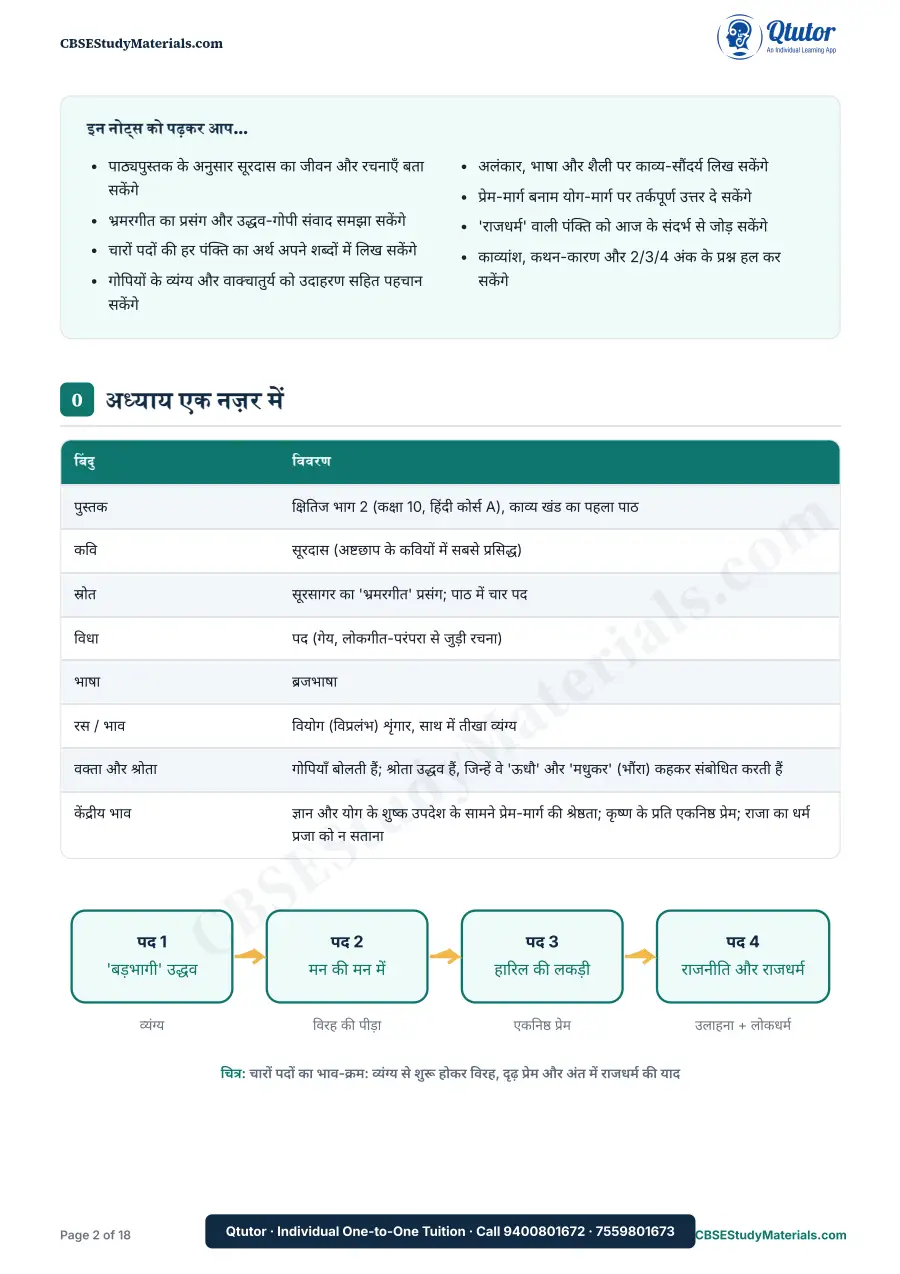
- अध्याय एक नज़र में (Chapter at a glance): book, poet, source (Sursagar's Bhramargeet), form, language (Brajbhasha), rasa, speaker and listener, and the central idea in one table, plus a diagram of how the mood moves across the four pads
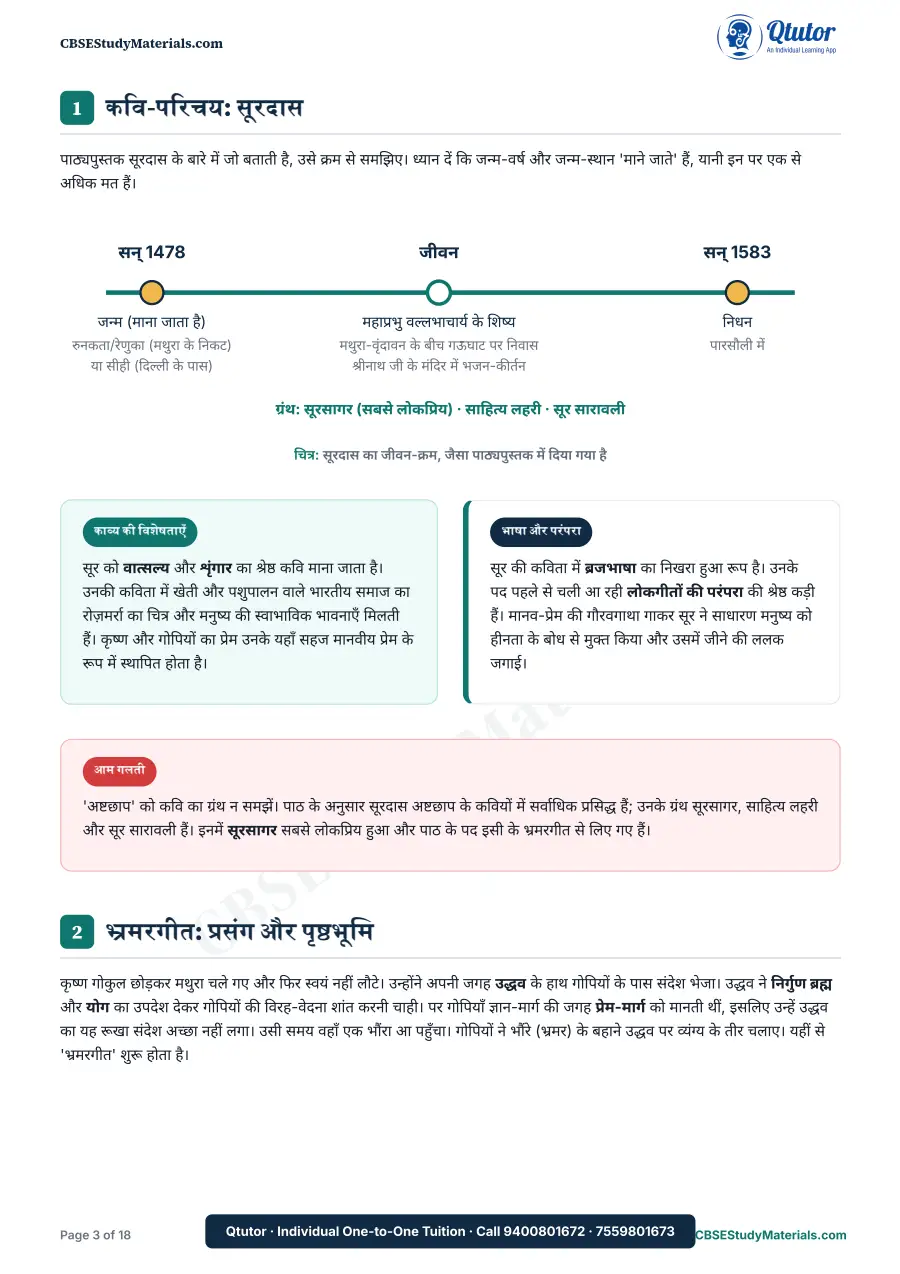
- कवि-परिचय (About the poet): Surdas as the textbook presents him, with a timeline figure: birth year 1478 as commonly accepted, the two views on his birthplace, disciple of Vallabhacharya, the best-known poet of the Ashtachhap, his three works and his death at Parsauli in 1583
- भ्रमरगीत प्रसंग (Background): why Krishna sent Uddhav, what Uddhav preached (nirgun brahm and yog), and how the arrival of a bee (bhramar) set off the gopis' sarcasm, with a flow diagram
- चारों पदों की व्याख्या (All four pads explained): every line of each pad quoted on its own, followed by its meaning in simple Hindi and the key word meanings
- भावार्थ and काव्य-सौंदर्य for each pad: a full paraphrase and the poetic devices (upma, roopak, drishtant, punrukti prakash, anupras, vyangya) with the exact phrase from the pad
- Figures: lotus leaf, oil pot and ant-on-jaggery comparisons; the haaril bird and its stick; a balance of "rajneeti" versus "rajdharma"; the gopis' changing state of mind in pad 2
- समग्र काव्य-सौंदर्य: one table of alankars with examples and an identification tip, plus the features of the gopis' vakchaturya and of Sur's Bhramargeet
- शब्दार्थ: 32 word meanings from the chapter's shabd-sampada
- प्रश्न-अभ्यास के हल: answers to all 15 textbook questions in our own words, with hints for the open-ended ones
- One-page summary, a mind map, common-mistake boxes, "think deeper" prompts and a real-life link
- Board-pattern practice: 16 questions in the Hindi Course A style with value-point answers
Structure of the PDF
| Section | What you get |
|---|---|
| Cover and objectives | What you will be able to do after reading |
| 0. Chapter at a glance | Summary table and mood-flow diagram |
| 1. Kavi parichay | Timeline, works, features of Sur's poetry |
| 2. Bhramargeet | Background, flow diagram, pad-wise theme table |
| 3 to 6. Pads 1 to 4 | Line-by-line meaning, bhavarth, kavya-saundarya, figure |
| 7. Kavya-saundarya | Alankar table, vakchaturya, Bhramargeet features |
| 8. Shabdarth | 32 word meanings |
| 9. Mind map | Whole chapter on one diagram |
| 10. Prashn-abhyas | All 15 textbook questions answered |
| 11. One-page summary | Last-minute revision sheet |
| 12. Practice and answers | Kavyansh MCQs, assertion-reason, 2, 3 and 4 mark questions |
Surdas ke Pad Class 10 Important Topics
- Vyangya in "ऊधौ, तुम हौ अति बड़भागी" and the lotus-leaf and oil-pot examples
- "मन की मन ही माँझ रही": hope of Krishna's return, and why the yog message made the separation worse
- "मरजादा न लही": how the line is commonly interpreted (marked as interpretation, since the textbook gives only the word meaning)
- "हमारैं हरि हारिल की लकरी": the haaril bird, man-kram-vachan devotion, yog as "करुई ककरी"
- "हरि हैं राजनीति पढ़ि आए": Krishna's "politics" and the gopis' definition of rajdharma
- Prem marg versus gyan and yog marg
- Brajbhasha, geyata and the main alankars of the four pads
Surdas ke Pad Class 10 Important Questions (Sample)
From the line-by-line section (Pad 3):
> सुनत जोग लागत है ऐसौ, ज्यौं करुई ककरी। > योग की बात सुनते ही हमें ऐसा लगता है मानो कड़वी ककड़ी खा ली हो।
An assertion-reason item from the practice set:
> कथन (A): योग-संदेश सुनकर गोपियों का विरह शांत हो गया। > कारण (R): गोपियाँ कृष्ण के लौटने की अवधि के सहारे व्यथा सह रही थीं। > Answer: (घ) A is false (the separation burned more, "बिरह दही"), R is true.
From the alankar table:
| अलंकार | उदाहरण |
|---|---|
| उपमा | ज्यौं जल माहँ तेल की गागरि; गुर चाँटी ज्यौं पागी; ज्यौं करुई ककरी |
| रूपक | प्रीति-नदी; हरि हारिल की लकरी |
| पुनरुक्ति प्रकाश | सुनि-सुनि; कान्ह-कान्ह |
How These Surdas ke Pad Notes Help
The chapter is short, but board questions on it are sharp: a kavyansh with five MCQs, or 2-mark questions asking you to explain a line or name its alankar. Quoting each line separately with its meaning right below means you can revise one pad in a few minutes and answer "explain this line" questions in your own words. The kavya-saundarya cards give the exact phrase for every device, so you are not guessing in the alankar MCQ. The prashn-abhyas answers are written to board length, and the practice set follows the CBSE Hindi Course A typology: kavyansh MCQs, statement-selection items, assertion-reason, 2-mark and 3-mark answers and a 4-mark writing task with an internal choice. Every answer has value points so you can mark yourself.
Who Should Use It
- Class 10 students in Hindi Course A preparing Kshitij Chapter 1 for class tests and the CBSE 2026-27 board exam
- Students who find Brajbhasha hard and want a plain-Hindi meaning of each line
- Teachers and parents who want a ready chapter summary, important questions and answers for revision
How to Download the Class 10 Surdas ke Pad Notes PDF
This study material is free. Use the download button below to get the full 18-page PDF.
Surdas ke Pad Class 10 Hindi Chapter 1 Notes PDF (Free) (PDF · 18 pages · Free download)
Related Resources
- All study material for this chapter: Surdas ke Pad, Class 10 Hindi
- Every Class 10 Hindi chapter: Class 10 Hindi
FAQs on Class 10 Hindi Chapter 1 Surdas ke Pad
Where can I download Class 10 Hindi Chapter 1 Surdas ke Pad notes PDF? On this page. Click the download button to get the free 18-page PDF with line-by-line meanings, solved prashn-abhyas and practice questions.
Which book is Surdas ke Pad Class 10 from? It is Chapter 1 of Kshitij Bhag 2, the NCERT Hindi Course A textbook for Class 10. The four pads come from the Bhramargeet section of Surdas's Sursagar.
What are the important topics in Surdas ke Pad Class 10? The vyangya in "बड़भागी", the lotus-leaf and oil-pot examples, the effect of Uddhav's yog message, the haaril-ki-lakdi image, the gopis' vakchaturya and the idea of rajdharma in the fourth pad.
Are these Surdas ke Pad notes in Hindi? Yes. All content is in Hindi (Devanagari), with each Brajbhasha line followed by its meaning in simple modern Hindi.
Does the PDF include NCERT question answers for Surdas ke Pad? Yes. All 15 prashn-abhyas questions, including the rachna aur abhivyakti ones, are answered in our own words.
Is the Surdas ke Pad notes PDF free? Yes, this Chapter 1 notes PDF is free to download.
How many pads are there in Surdas ke Pad Class 10? Four. They begin with "ऊधौ, तुम हौ अति बड़भागी", "मन की मन ही माँझ रही", "हमारैं हरि हारिल की लकरी" and "हरि हैं राजनीति पढ़ि आए".
Study tip: read each pad aloud once, then cover the meaning and try to explain every line in your own words before checking.