Electricity: Circuits and their Components - Class 7 Science Chapter Notes (PDF · 18 pages · ₹49) Unlock the full PDF for ₹49
Free sample: pages 1 to 3 of 18. The full PDF costs ₹49.
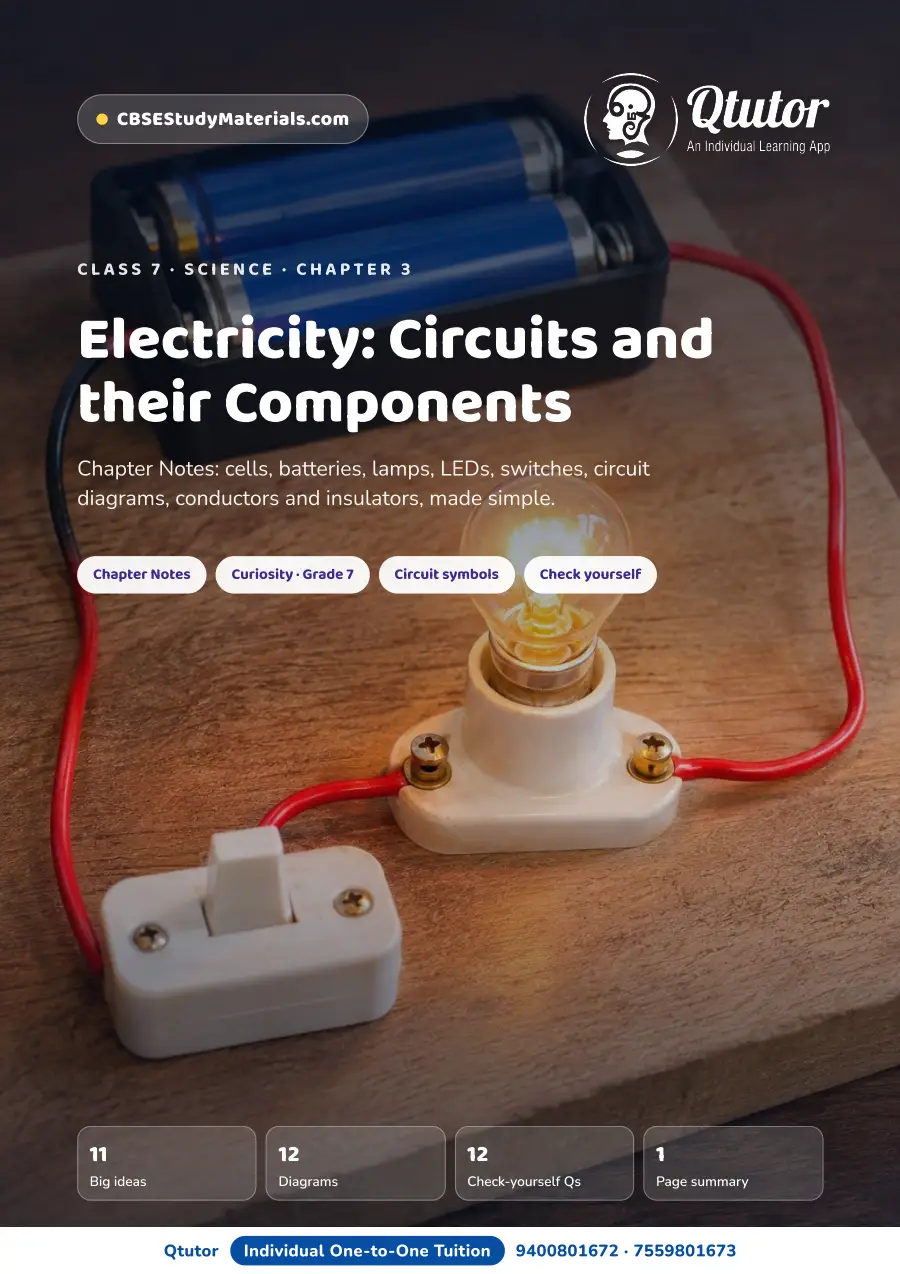
Why does a torch lamp glow when you slide its switch one way, and why does an LED stay dark when you swap its two wires? These Class 7 Science Chapter 3 Electricity: Circuits and their Components notes, NCERT based and written for CBSE 2026-27, answer such questions with clear pictures, correct circuit symbols and short, friendly explanations.
This is a premium 18-page Chapter Notes PDF that follows the NCERT Curiosity textbook (Grade 7). The PDF costs ₹49. It is a study aid prepared independently and is not an official CBSE or NCERT publication. The revision notes are written for 12-year-olds in a warm, simple voice, with a friendly guide called Jugnu the firefly, twelve original diagrams, a mind map, a one-page summary and 12 important questions with answers.
Class 7 Science Chapter 3 Electricity Notes: What Is Included
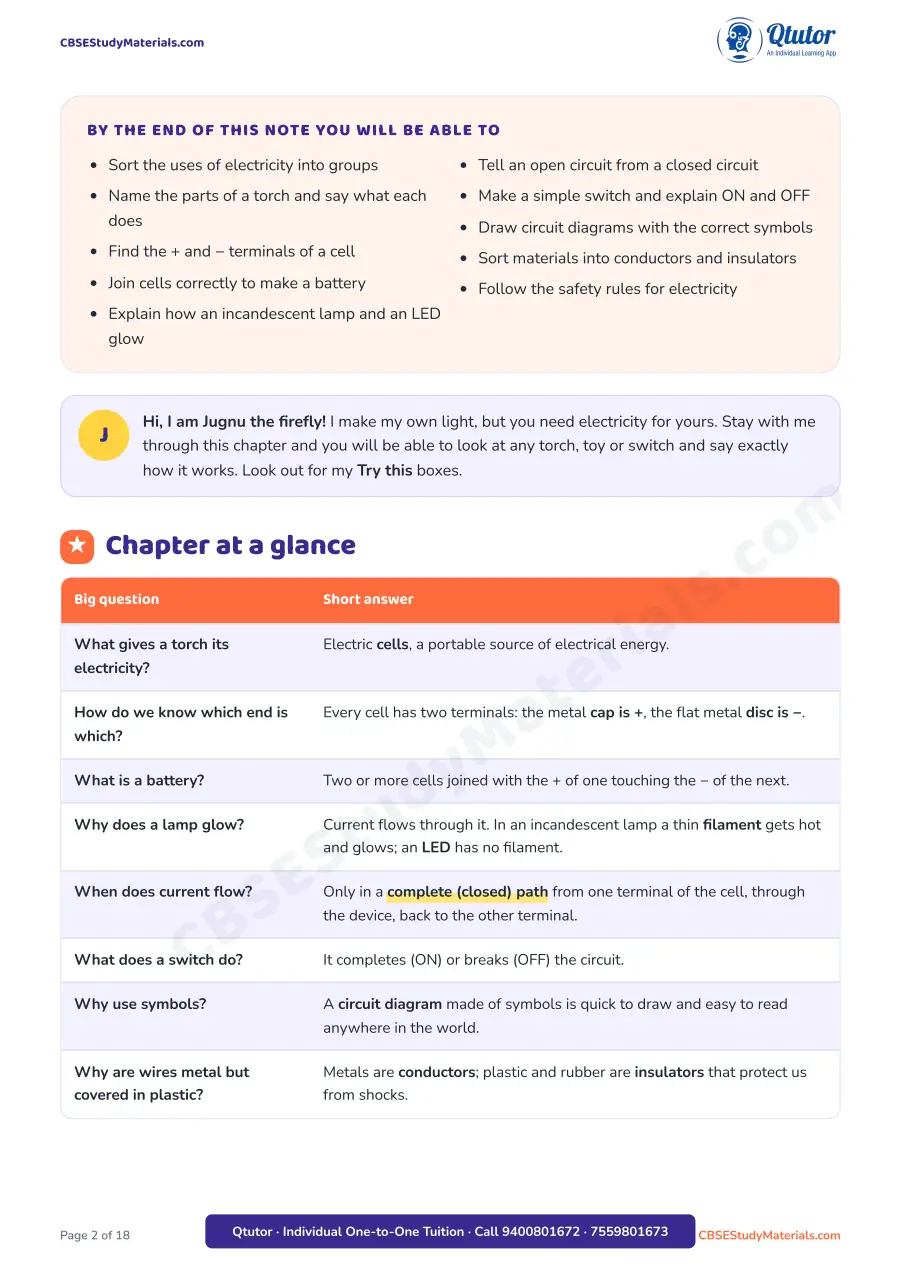
- A "Chapter at a glance" table that answers eight big questions in one line each
- 11 numbered sections covering every topic of the chapter, with definition, big-idea, did-you-know, common-mistake, real-life, worked-example and "Try this" cards
- Original labelled drawings: the parts of a torch, an electric cell and its terminals, cells joined into a battery (in a line and side by side), an incandescent lamp, an LED, four cell-and-lamp arrangements, an LED glowing and not glowing, a home-made switch in OFF and ON positions, and a conduction tester
- A full circuit symbols table (cell, battery, lamp, LED, switch ON, switch OFF, wire) drawn the way the NCERT book draws them, with a "remember" hint for each
- Circuit diagrams of an open circuit, a closed LED circuit with current arrows, and a torch
- A conductors and insulators results table, plus safety rules and the difference between DC and AC
- A 12-term key-terms grid, a mind map and a one-page summary for last-minute revision
- 12 "Check yourself" questions (MCQ, assertion-reason, diagram-based, case-based, HOTS and what-if) with a compact answer key
Structure
| Part | What it covers |
|---|---|
| Cover, objectives, chapter at a glance | Learning goals and the big questions of the chapter |
| Sections 1-2 | Uses of electricity, safety, the parts of a torch |
| Sections 3-5 | Electric cell, battery, incandescent lamp and LED |
| Sections 6-8 | Electrical circuit, direction of current, making an LED glow, the electric switch |
| Sections 9-11 | Circuit diagrams and symbols, conductors and insulators, cells in our lives |
| Key terms, mind map, one-page summary | Quick revision pages |
| Check yourself and answer key | 12 questions with answers |
Electricity: Circuits and their Components Class 7 Important Topics
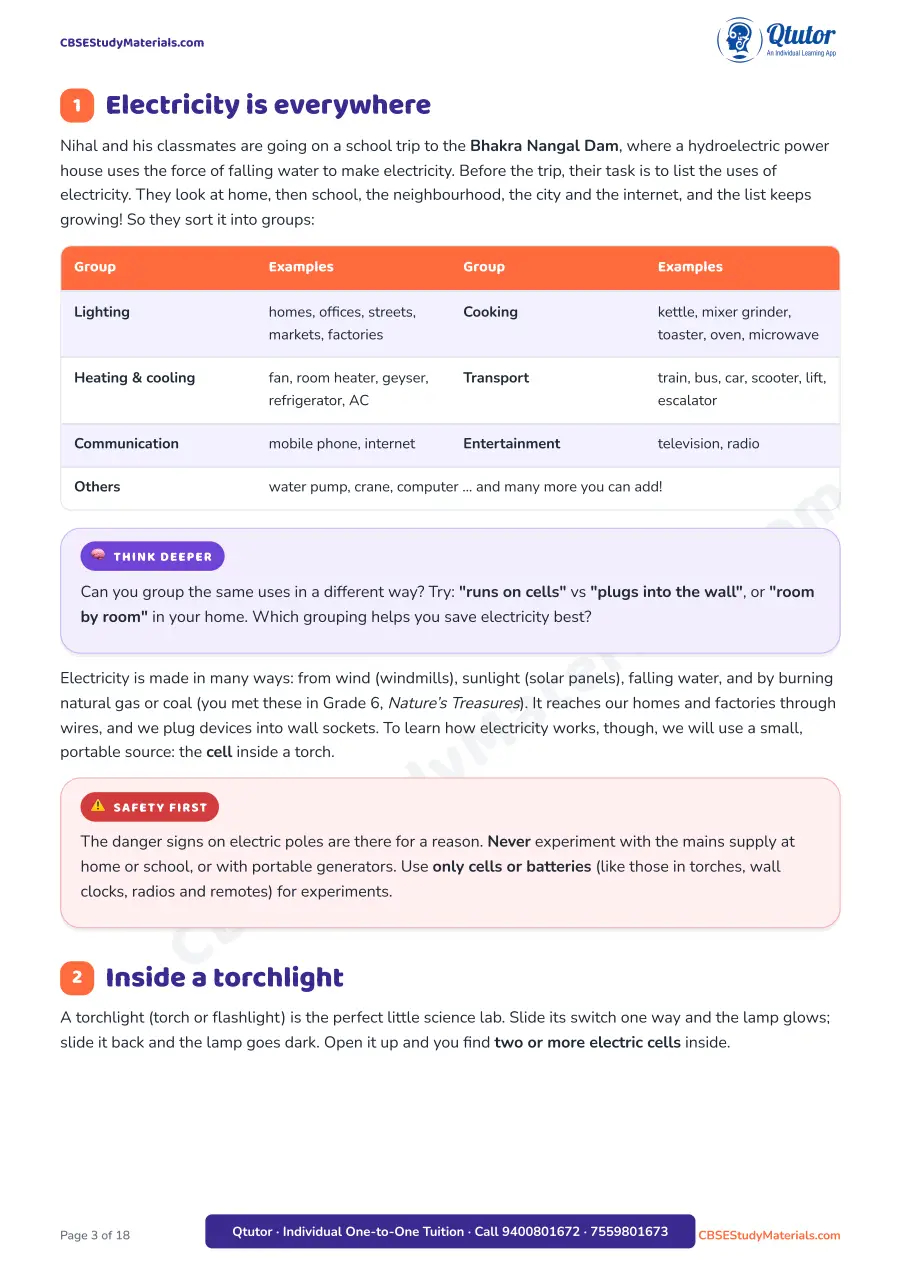
- Uses of electricity grouped as lighting, cooking, heating and cooling, transport, communication and entertainment
- Why experiments must use only cells or batteries, never the mains supply
- The electric cell as a portable source of electrical energy: metal cap is the positive terminal, flat metal disc is the negative terminal
- A battery: two or more cells with the + terminal of one joined to the − terminal of the next, and how side-by-side cells are joined by a metal strip
- The incandescent lamp: glass bulb, filament, thick support wires, metal case and metal tip as the two terminals
- The LED: no filament, longer wire positive, shorter wire negative, current in one direction only
- The electrical circuit as a complete path, the direction of current from + to −, and why a fused lamp does not glow
- The electric switch: ON means a closed circuit, OFF means an open circuit, and a switch can be placed anywhere
- Circuit diagrams and standard symbols, including how to read the long line of a cell and the triangle of an LED
- Conductors and insulators, why copper is used for wires, and why plastic, rubber and ceramics cover them
- Electrical safety, Direct Current (DC) from cells and Alternating Current (AC) from wall sockets
Class 7 Electricity Circuits Important Questions (Sample)
Diagram-based: A battery is drawn with its long line on the left, the switch is ON, and the LED's triangle points from right to left. Will the LED glow?
Answer from the PDF: No. Current leaves the + terminal, goes up the left wire and along the top from left to right. The LED points against the current, so no current passes. Turn the LED (or the battery) around.
Assertion-reason: Assertion: Electric wires in our homes are covered with plastic. Reason: Plastic lets electric current flow easily. Answer: The assertion is true but the reason is false, because plastic is an insulator.
A sample from the comparison table in the notes:
| Feature | Incandescent lamp | LED |
|---|---|---|
| Filament | Yes, a thin wire that glows | No filament |
| Terminals | Metal case and metal tip | Long wire (+) and short wire (−) |
| Does the way you connect it matter? | No | Yes, current passes only one way |
How These Notes Help
The chapter is full of activities with cells, lamps, LEDs and switches, and many students lose marks because they mix up the + and − ends or draw symbols wrongly. These notes keep each idea next to a picture, show both the real object and its symbol, and point out common mistakes such as reversing a cell in a torch or thinking an LED is broken when it is only connected the wrong way round. The worked example explains exactly why some cell-and-lamp arrangements glow and others do not, and the one-page summary lets students revise the whole chapter in a few minutes before a test.
Who Should Use It
- Class 7 students studying the new NCERT Curiosity science book under CBSE
- Students who want NCERT based notes with clear diagrams and correct circuit symbols
- Parents and tutors looking for a ready chapter summary and important questions for revision
- Teachers who want a printable handout on circuits, switches, conductors and insulators
How to Download the Class 7 Science Chapter 3 Notes PDF
This is a premium PDF download priced at ₹49. Use the button below to get the full 18-page Chapter Notes PDF.
Electricity: Circuits and their Components - Class 7 Science Chapter Notes (PDF · 18 pages · ₹49)
Related Resources
- Class 7 Science Chapter 3 Electricity: Circuits and their Components chapter page
- Class 7 Science Chapter 3 NCERT Solutions PDF
- Class 7 Science Chapter 3 Question Bank PDF
- Previous chapter: Exploring Substances: Acidic, Basic, and Neutral
- Next chapter: The World of Metals and Non-metals
- All Class 7 Science study material
FAQs on Class 7 Science Chapter 3 Electricity: Circuits and their Components
Where can I download Class 7 Science Chapter 3 Electricity: Circuits and their Components notes PDF? You can download it from this page. It is a premium 18-page PDF priced at ₹49.
What are the important topics in Electricity: Circuits and their Components Class 7? The electric cell and its terminals, batteries, incandescent lamps and LEDs, electrical circuits and the direction of current, switches, circuit diagrams and symbols, and conductors and insulators.
What is the price of the Class 7 Electricity Circuits notes PDF? It is a premium PDF priced at ₹49. It includes 12 original diagrams, a mind map, a one-page summary and 12 questions with answers.
Which book is Electricity: Circuits and their Components Class 7 from? It is Chapter 3 of the NCERT Science textbook Curiosity for Grade 7, used in CBSE schools for 2026-27.
Do the notes show the correct circuit symbols? Yes. The notes include a symbols table for the electric cell, battery, electric lamp, LED, switch in ON and OFF positions and wire, drawn the way the textbook shows them, along with ready circuit diagrams.
Are the answers to the check-yourself questions included? Yes. All 12 questions have answers in a compact answer key at the end of the PDF.
Study tip: every time you draw a circuit, trace the path with your finger from the + terminal back to the − terminal; if your finger has to jump a gap, the lamp will not glow.