The Wit that Won Hearts - Class 8 English Chapter Notes (PDF · 17 pages · Free download) Download the full PDF free

You are looking at pages 1 to 3 of 17. The full PDF is free to download.
Why would a clever poet carry a plate of paddy seeds into a royal court to fix a quarrel between a king and a queen? This free PDF of The Wit that Won Hearts Class 8 English Chapter 1 notes explains exactly how Tenali Rama did it, for the CBSE 2026-27 session and the new NCERT Poorvi textbook (Unit 1: Wit and Wisdom). It is a 17-page set of revision notes and study material, free to download, prepared independently; it is not an official CBSE or NCERT publication.
The notes follow the chapter in the same order as the book: the warm-up riddles, the setting in the Vijayanagara court, the story itself, the characters, Rama's plan, the themes, the word meanings and then the language work from the exercises (expressions, sound words, compound words, "if" sentences, intonation, the narrative essay and limericks). Everything is written in short, friendly sentences for Class 8 students.
Class 8 English Chapter 1 The Wit that Won Hearts Notes: What Is Included
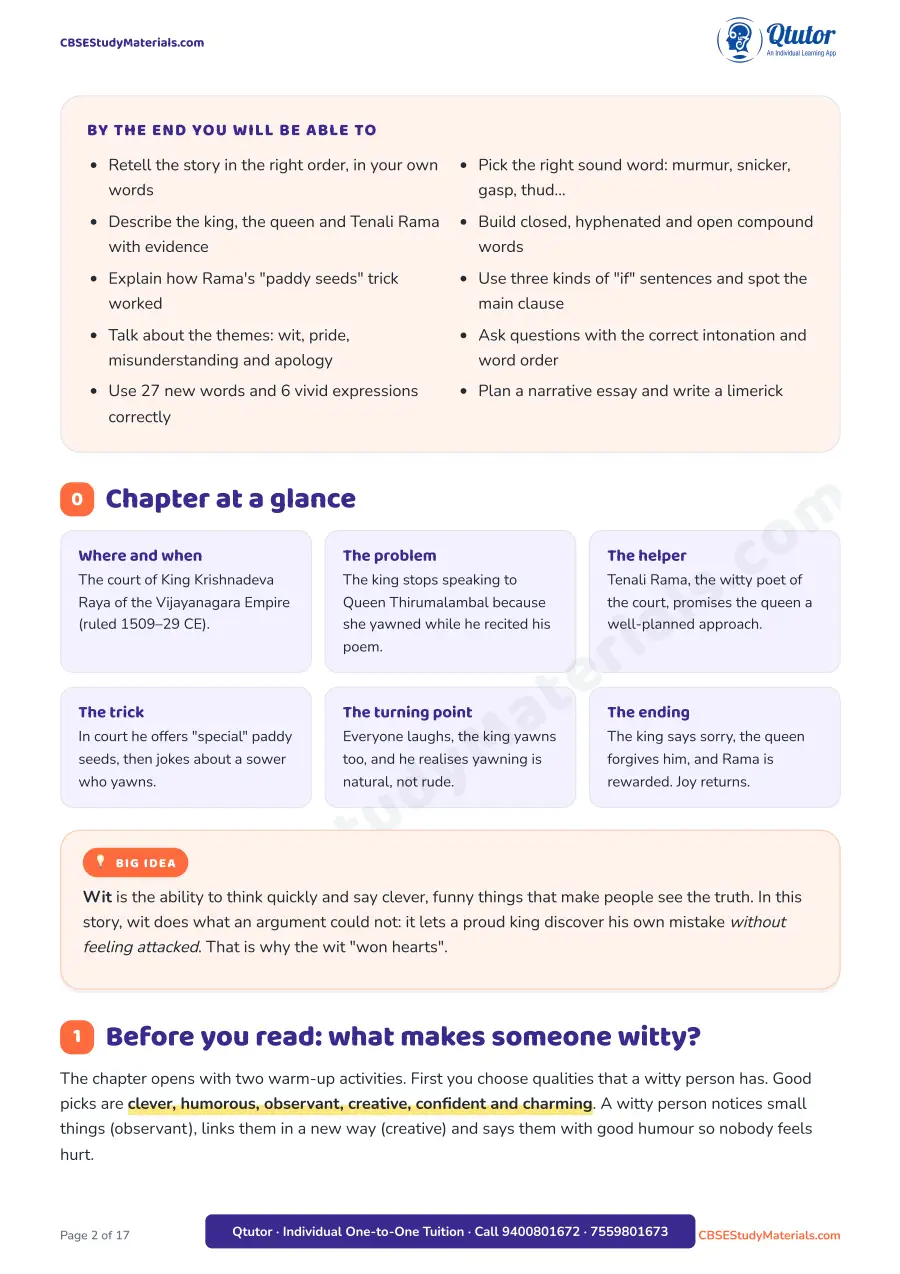
- A cover, learning goals and a "chapter at a glance" panel with six boxes (where and when, the problem, the helper, the trick, the turning point, the ending)
- 10 numbered sections written in simple language
- A chapter summary as seven short scenes, in our own words, plus a "plot mountain" diagram
- A character table for the king, Queen Thirumalambal, Tenali Rama and the courtiers, with evidence from the story
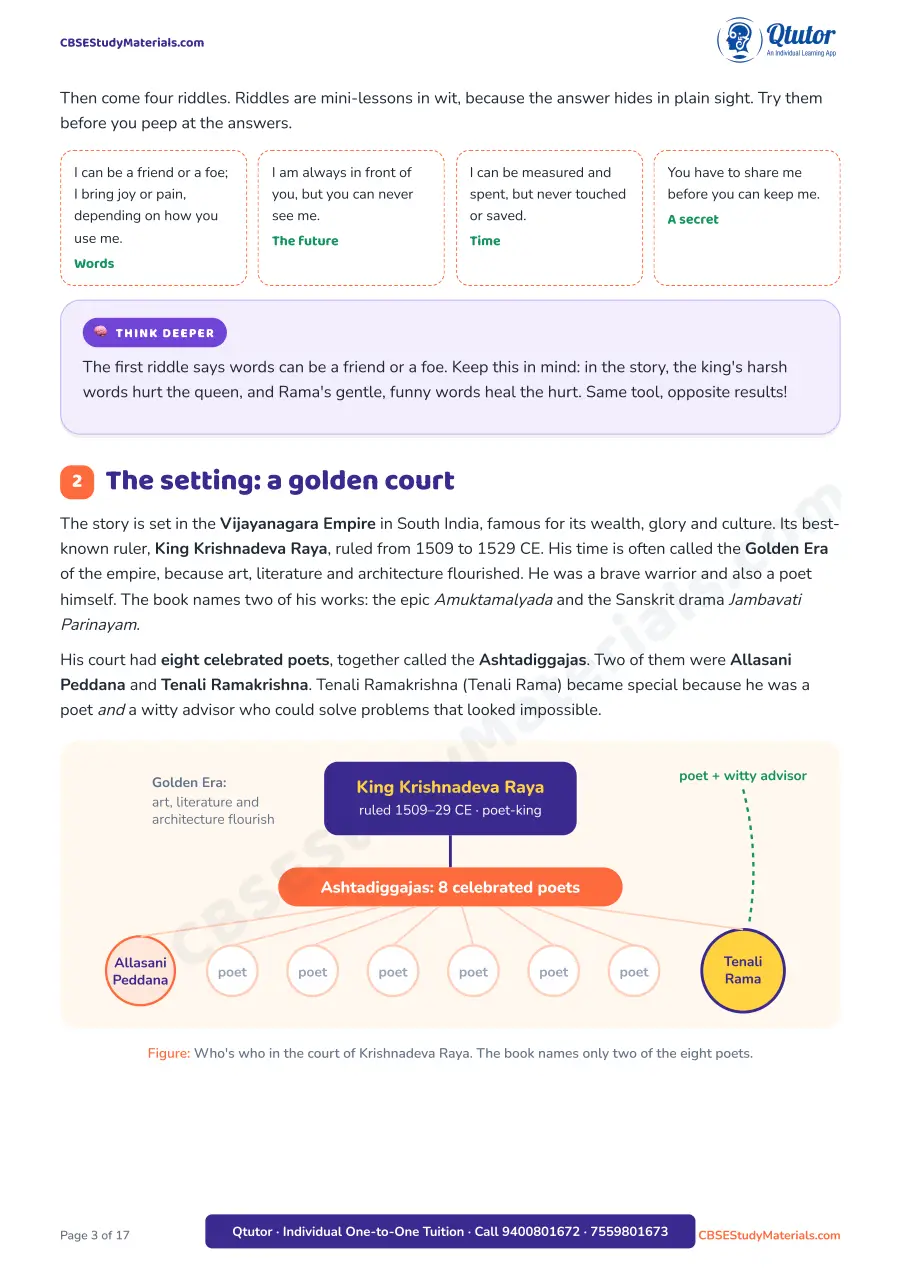
- 8 original diagrams: the court and the Ashtadiggajas, the plot mountain, a character map, Rama's analogy (seed story vs real story), compound word types, the conditional ladder, rising and falling intonation, and a mind map
- 2 real photos inside: a carved wooden throne and a brass oil lamp with sweets, to set the royal scene
- 5 short key lines from the story with what each one shows
- Themes and the message of the story, with "Think deeper", "Common mistake", "Did you know?" and real-life cards
- A word wall of all 27 margin words with simple meanings
- Vocabulary from the exercises: 6 vivid expressions with fresh examples, 10 sound words, and the three types of compound words
- Grammar: the three kinds of if-sentences used in the story, main and subordinate clauses, and common mistakes
- Speaking, listening and writing tips: intonation, question word order, the narrative essay checklist and how a limerick works
- A practice set of 14 important questions (MCQ, assertion-reason, extract-based, short answer and HOTS) with an answer key
- A one-page summary for last-minute revision
Structure of the PDF
| Part | What you get |
|---|---|
| Cover and goals | Learning goals, chapter at a glance, the big idea of wit |
| Sections 1-2 | Warm-up riddles, Vijayanagara and the court of Krishnadeva Raya |
| Sections 3-6 | The story in seven scenes, characters, Rama's plan, key lines, themes |
| Sections 7-8 | Word meanings, expressions, sound words, compound words |
| Sections 9-10 | If-clauses (conditionals), listening, intonation, narrative essay, limerick |
| Revision | Mind map |
| Practice | 14 Check-yourself questions and answer key |
| Summary | One-page summary |
The Wit that Won Hearts Class 8 Important Topics
- The setting: the Vijayanagara Empire in its Golden Era under King Krishnadeva Raya (ruled 1509-29 CE), his works, and the eight court poets called the Ashtadiggajas, including Allasani Peddana and Tenali Ramakrishna.
- The quarrel: why a tired queen's yawn during the king's poem led to weeks of silence.
- Rama's strategy: the "special" paddy seeds, the joke about a sower who yawns, and how the king realised his mistake by himself.
- Characters: a proud but honest king, a patient and forgiving queen, a witty and tactful Tenali Rama, and mocking courtiers.
- Themes: wit over force, pride clouding judgement, small misunderstandings growing in silence, and the strength of saying sorry.
- Vocabulary: words such as trivial, forlorn, distraught, sceptical, unfazed and orchestrated; expressions such as "cast a shadow" and "a hush fell over"; sound words such as murmur, gasp, thud and rattle.
- Grammar: possible, imaginary and past "if" sentences, with the main clause and the subordinate clause marked.
The Wit that Won Hearts Class 8 Important Questions (Sample)
Here are three questions from the practice set in the PDF. The answers are in the answer key.
Assertion-reason: Assertion (A): Rama did not take the queen's message straight to the king. Reason (R): A direct correction might have hurt the proud king and made him more stubborn. Choose: both true and R explains A; both true but R does not explain A; A true, R false; A false, R true.
Grammar: Identify the main clause and the subordinate clause in "Our farmers would suffer if something were to go wrong", then rewrite it with the if-clause first.
HOTS: Two classmates have stopped talking after a small misunderstanding. Using Rama's method, plan in 4-5 lines how you would help them make up.
A sample from the grammar section:
| Pattern | Meaning |
|---|---|
| If + present, will + verb | possible: the condition may come true |
| If + past (were), would + verb | imaginary: a hypothetical situation |
| If + had + past participle, would have + past participle | too late: the past cannot be changed |
How These Notes Help
The story is easy to enjoy but harder to explain in an exam. The scene-by-scene retelling helps you remember the order of events. The character table gives you evidence for "describe the character" answers. The analogy diagram shows clearly why Rama's indirect method worked, which is the heart of most reflective questions. The language sections and practice set cover the book's exercise skills and exam-style questions. The one-page summary is ideal for the night before a test.
Who Should Use It
- Class 8 students studying the NCERT Poorvi English textbook in the CBSE 2026-27 session
- Students who want a chapter summary, word meanings and important questions in one place
- Parents and tutors who want printable study material for home revision
How to Download the Class 8 The Wit that Won Hearts Notes PDF
Use the download button below to get the 17-page PDF free of cost. It prints well on A4 paper and is easy to read on a phone or tablet.
The Wit that Won Hearts - Class 8 English Chapter Notes (PDF · 17 pages · Free download)
Related Resources
- All study material for this chapter: The Wit that Won Hearts chapter page
- Answers to every textbook question: Class 8 English Chapter 1 NCERT Solutions
- Extra practice with answers: Class 8 English Chapter 1 Question Bank
- All chapters: Class 8 English
- Next in the book: the poem "A Concrete Example" (coming soon)
FAQs on Class 8 English Chapter 1 The Wit that Won Hearts
Where can I download Class 8 English Chapter 1 The Wit that Won Hearts notes PDF? On this page. Use the download button to get the 17-page PDF with the story summary, word meanings, grammar notes, a mind map and a one-page summary.
Is The Wit that Won Hearts Class 8 notes PDF free? Yes. This chapter 1 notes PDF is free to download.
Which book is The Wit that Won Hearts from? It is the first chapter of Unit 1 (Wit and Wisdom) in Poorvi, the NCERT English textbook for Class 8. NCERT does not number the Poorvi chapters, so we list it as Chapter 1 because it comes first in the book.
What is the moral of The Wit that Won Hearts? Do not take offence before looking for a simple, innocent reason, and solve conflicts with kindness and wit rather than blame. The king learns that yawning is natural, admits his pride blinded him, and says sorry.
Who are the main characters in The Wit that Won Hearts Class 8? King Krishnadeva Raya of Vijayanagara, Queen Thirumalambal and Tenali Rama (Tenali Ramakrishna), the witty poet of the court. The ministers and courtiers also play a part.
What grammar is in Class 8 English Chapter 1? Conditional (if) sentences with main and subordinate clauses, compound words, sound words and vivid expressions. The notes explain each with examples and common mistakes.
Study tip: retell the story aloud in seven scenes once, then try the 14 practice questions without looking at the notes.