Solutions - Class 12 Chemistry Chapter 1 Model Question Paper (PDF · 15 pages · Free download) Download the full PDF free
You are looking at pages 1 to 3 of 15. The full PDF is free to download.
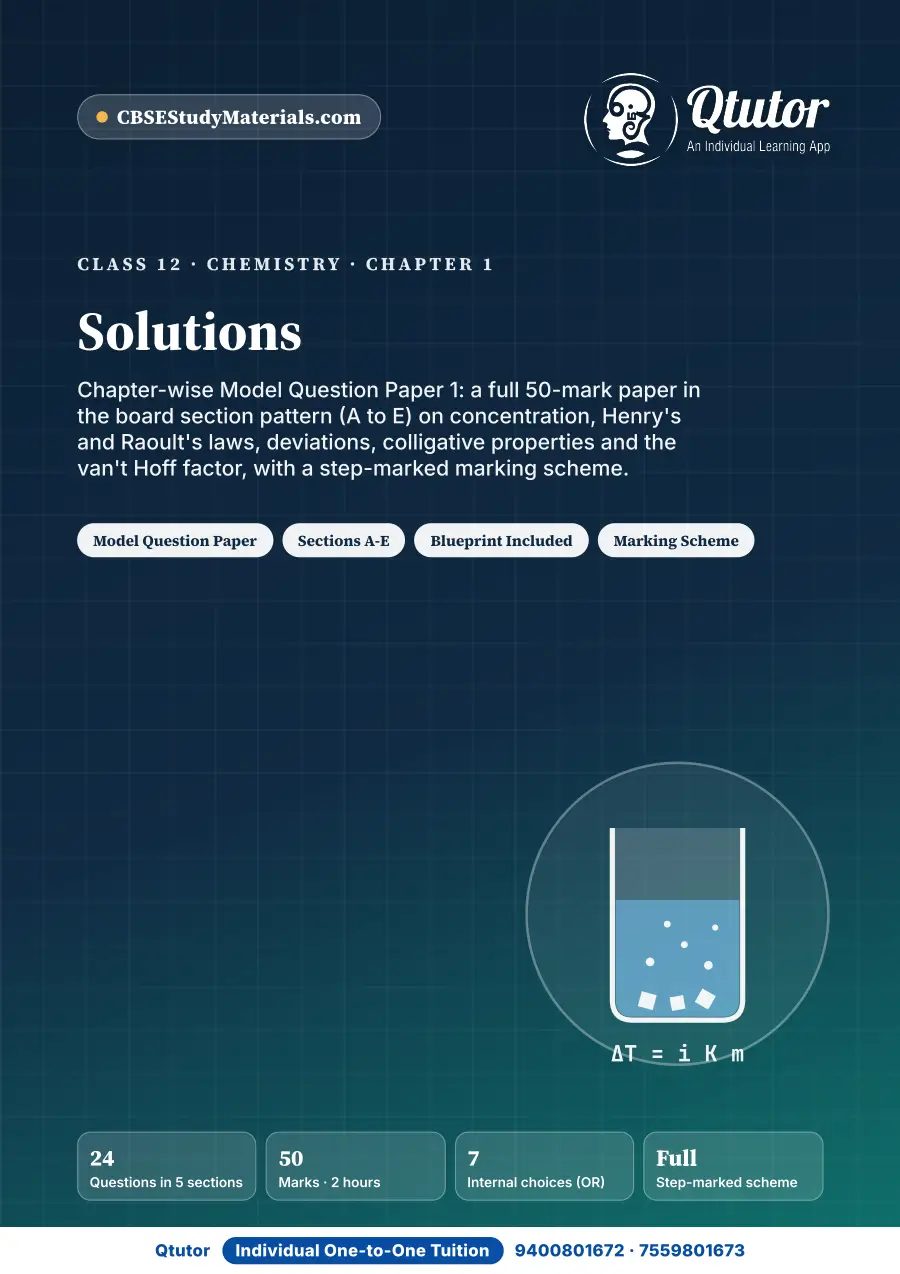
A soft-drink plant must keep 2.2 g of carbon dioxide dissolved in every 300 mL bottle. What CO2 pressure does it need above the liquid? That is one of the questions in this free Solutions Class 12 model question paper: a 15-page CBSE Class 12 Chemistry Chapter 1 model question paper PDF built on the rationalised NCERT Chemistry Part I textbook for CBSE 2026-27. It is an independent practice paper with a complete marking scheme, not an official CBSE or NCERT publication.
The paper follows the board section pattern (Sections A to E) scaled down to one chapter: 24 questions for 50 marks, to be finished in 2 hours. Most questions are application, data and case based, so it works as a timed chapter test once your revision notes are done, and the step-marked answer key shows exactly where marks are earned or lost.
Class 12 Chemistry Chapter 1 Solutions Model Question Paper: What Is Included
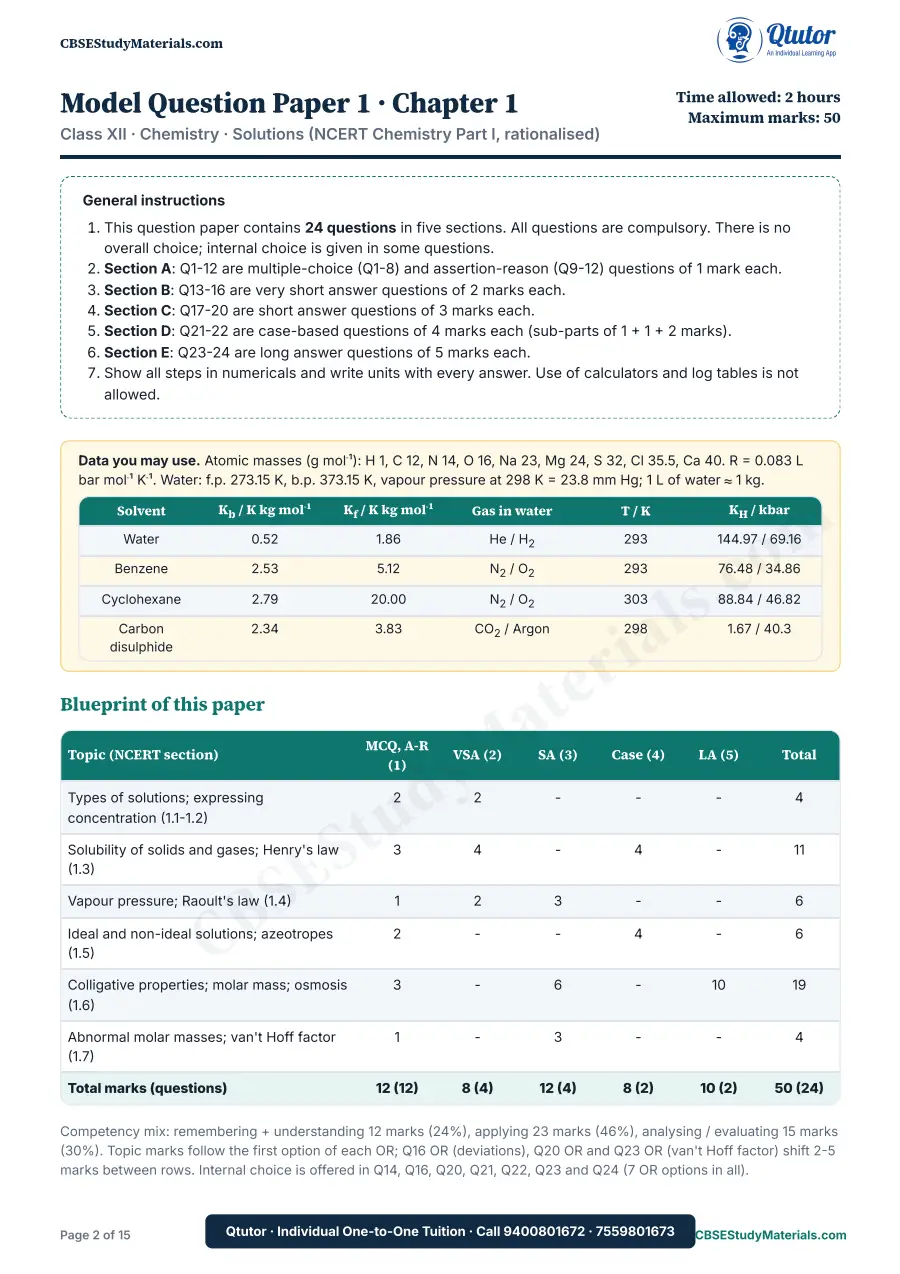
- A cover, the paper heading (time allowed 2 hours, maximum marks 50) and board-style general instructions
- A data box with atomic masses, R, the Kb and Kf values of water, benzene, cyclohexane and carbon disulphide, and Henry's law constants from NCERT Table 1.2
- A blueprint table that maps every mark to an NCERT section and question type, plus the competency mix
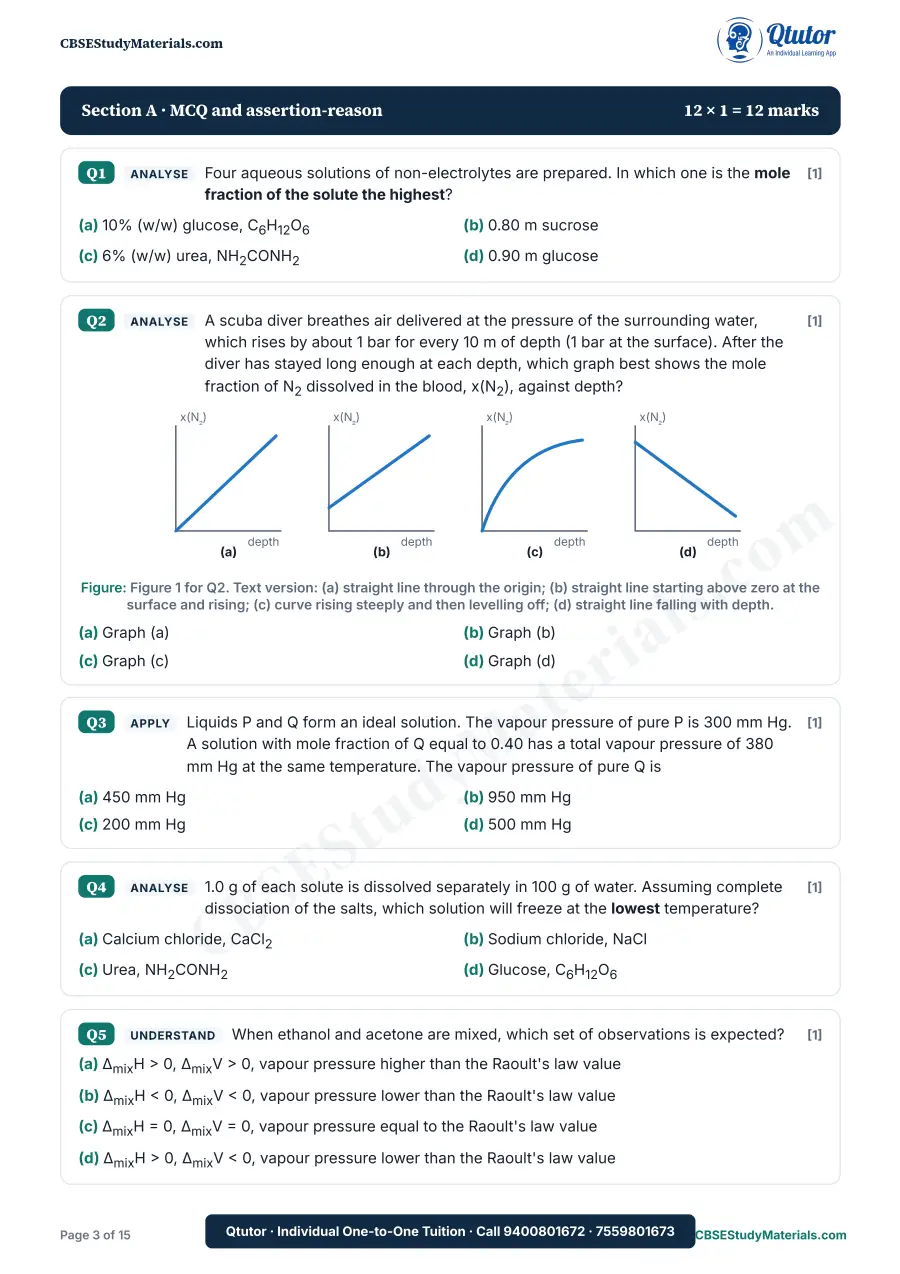
- Section A: 8 MCQs (including a graph item and a Statement I / Statement II item) and 4 assertion-reason questions
- Section B: 4 very short answer questions of 2 marks; Section C: 4 short answer questions of 3 marks
- Section D: 2 case-based questions (a soft-drink bottling passage and an acetone-chloroform data set) with 1 + 1 + 2 sub-parts
- Section E: 2 long answer questions of 5 marks
- 7 internal choices (OR), answer-writing lines after every question, two data figures in the paper and two worked figures in the key
- A full answer key and marking scheme with value points and ½-mark steps, and a "where marks are lost" box
Structure of the Solutions Class 12 Question Paper
| Section | Question type | Questions | Marks |
|---|---|---|---|
| A | MCQ and assertion-reason | Q1-12 | 12 × 1 = 12 |
| B | Very short answer | Q13-16 | 4 × 2 = 8 |
| C | Short answer | Q17-20 | 4 × 3 = 12 |
| D | Case-based | Q21-22 | 2 × 4 = 8 |
| E | Long answer | Q23-24 | 2 × 5 = 10 |
| Total | 24 questions | 50 marks |
The answer key and marking scheme start on a new page, so you can attempt the paper first and check later.
Solutions Class 12 Important Topics Covered
- Types of solutions (gaseous, liquid and solid) and concentration terms: mass %, mole fraction, molarity and molality
- Solubility of solids (effect of temperature, Le Chatelier's principle) and of gases; Henry's law p = KH x and its uses
- Vapour pressure of liquid solutions, Raoult's law for volatile and non-volatile components, vapour composition yi = pi/ptotal
- Ideal and non-ideal solutions, positive and negative deviations, signs of ΔmixH and ΔmixV, minimum- and maximum-boiling azeotropes
- Colligative properties: relative lowering of vapour pressure, elevation of boiling point, depression of freezing point, osmotic pressure, reverse osmosis
- Molar mass from colligative properties, abnormal molar masses and the van't Hoff factor i for dissociation and association
Solutions Class 12 Important Questions (Sample)
Section A, graph item. A scuba diver breathes air at the pressure of the surrounding water, which rises by about 1 bar for every 10 m. Which graph shows the mole fraction of N2 dissolved in blood against depth? The answer is the straight line that starts above zero at the surface, because x = p/KH and the pressure is already 1 bar at the surface.
Section C, Q18. 2.56 g of sulphur in 100 g of CS2 raises the boiling point by 0.234 K. The marking scheme works it out as M = 2.34 × 2.56 × 1000⁄0.234 × 100 = 256 g mol−1, so the molecule is S8, and the same solution would freeze 0.383 K lower than pure CS2.
Section D, Q22 (data from NCERT). For acetone and chloroform at 328 K:
| x(acetone) | 0.360 | 0.508 |
|---|---|---|
| Measured ptotal / mm Hg | 562.1 | 580.4 |
| Raoult's law ptotal / mm Hg | 672.0 | 688.2 |
The measured values lie below Raoult's law (negative deviation), and at x = 0.360 the vapour has the same composition as the liquid, which marks the maximum-boiling azeotrope.
How This Model Question Paper Helps
Every numerical has been recalculated, and each answer shows the formula, the substitution and the final value with its unit, which is how board examiners award step marks. The blueprint shows where the 50 marks come from, so after checking your script you can see whether you lost marks on Henry's law, Raoult's law or colligative properties. The questions are written fresh for this paper rather than copied from the NCERT exercises, so they test whether you can apply the ideas, not whether you remember a solved example.
Who Should Use This Paper
- CBSE Class 12 students who have finished the Solutions chapter and want a timed chapter test
- Students preparing for unit tests, pre-boards and the CBSE 2026-27 board exam who want board-pattern practice
- Teachers and tutors who need a ready chapter-wise question paper with a marking scheme for class tests
How to Download the Class 12 Chemistry Chapter 1 Model Question Paper PDF
The PDF is free. Use the download button below, print it or open it on a tablet, set a 2-hour timer and write your answers in the lines provided before you open the marking scheme.
Solutions - Class 12 Chemistry Chapter 1 Model Question Paper (PDF · 15 pages · Free download)
Related Resources
- Class 12 Chemistry Chapter 1 Solutions: all study material
- Solutions Class 12 Chemistry Chapter 1 Notes
- Solutions Class 12 Chemistry Chapter 1 Worksheet
- Solutions Class 12 Chemistry Chapter 1 Flash Cards
- Solutions Class 12 Competency-Based Question Bank
- Solutions Class 12 Chapter-wise Question Paper with Answer Key
- Next chapter: Class 12 Chemistry Chapter 2 Electrochemistry
- All Class 12 Chemistry study material
FAQs on Class 12 Chemistry Chapter 1 Solutions Model Question Paper
Where can I download the Class 12 Chemistry Chapter 1 Solutions model question paper PDF? On this page. Click the download button to get the 15-page PDF with the full paper and its marking scheme.
Is the Solutions Class 12 model question paper free? Yes, this model question paper and its marking scheme are free to download.
How many marks and questions are in this paper? It has 24 questions for 50 marks in Sections A to E (12 + 8 + 12 + 8 + 10 marks), with a suggested time of 2 hours and 7 internal choices.
Does the paper include answers and a marking scheme? Yes. Every question has a worked answer with value points and ½-mark steps, MCQ and assertion-reason keys, and two worked figures.
What are the important questions in Solutions Class 12? Board papers often test Henry's law numericals, Raoult's law and vapour composition, deviations and azeotropes, molar mass from ΔTb, ΔTf or osmotic pressure, and van't Hoff factor problems. This paper has questions on each of these.
Which book is Solutions Class 12 from? It is Chapter 1 of the NCERT Class 12 Chemistry Part I textbook (rationalised edition). The paper uses the NCERT data tables for Kb, Kf and KH.
Is this an official CBSE sample paper? No. It is an independent practice paper that follows the CBSE board section pattern for Chemistry.
Study tip: attempt the paper in one sitting, then redo only the questions where you lost step marks a week later.