Playing with Constructions Class 6 Maths Chapter 8 Notes PDF (PDF · 18 pages · ₹49) Unlock the full PDF for ₹49
Free sample: pages 1 to 3 of 18. The full PDF costs ₹49.
Why does a compass draw a perfect circle every time, and how can two small arcs find the top of a roof without any guessing? These Playing with Constructions Class 6 Maths Chapter 8 notes answer such questions with clear, labelled drawings. They are CBSE revision notes written from the NCERT Ganita Prakash textbook for 2026-27, in simple language that a Class 6 student can follow alone.
This is a premium 18-page Chapter Notes PDF (₹49) for Class 6 Mathematics, Chapter 8 "Playing with Constructions". It is independent, NCERT based study material and is not an official CBSE or NCERT publication. The notes follow the book section by section, from 8.1 Artwork to 8.6 Points Equidistant from Two Given Points, and every length and angle in them was checked by calculation.
Class 6 Maths Chapter 8 Playing with Constructions Notes: What Is Included
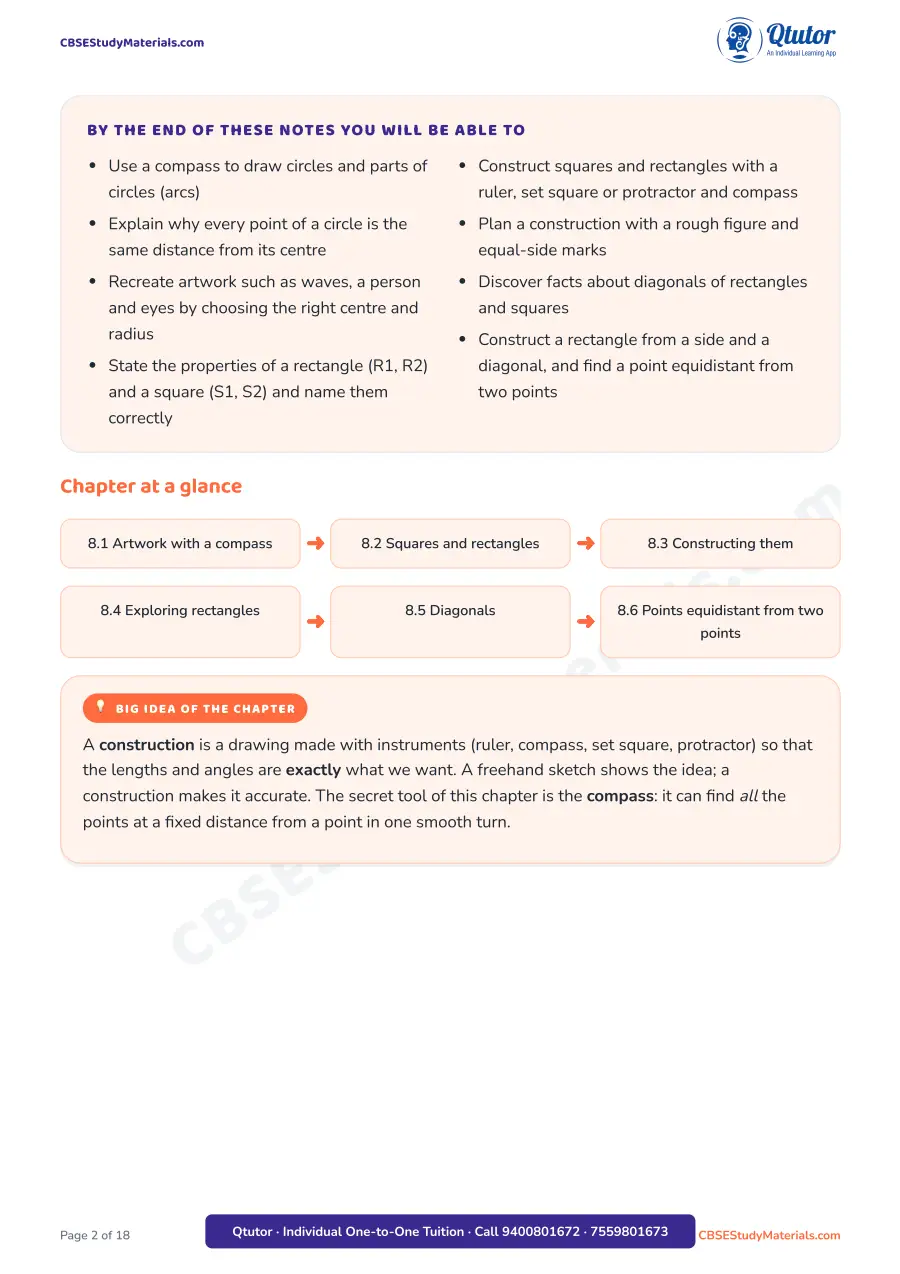
- A cover, eight learning goals and a "Chapter at a glance" flow of the six sections
- 10 numbered topics covering the whole chapter, each with concept cards, worked steps and "Think deeper" prompts
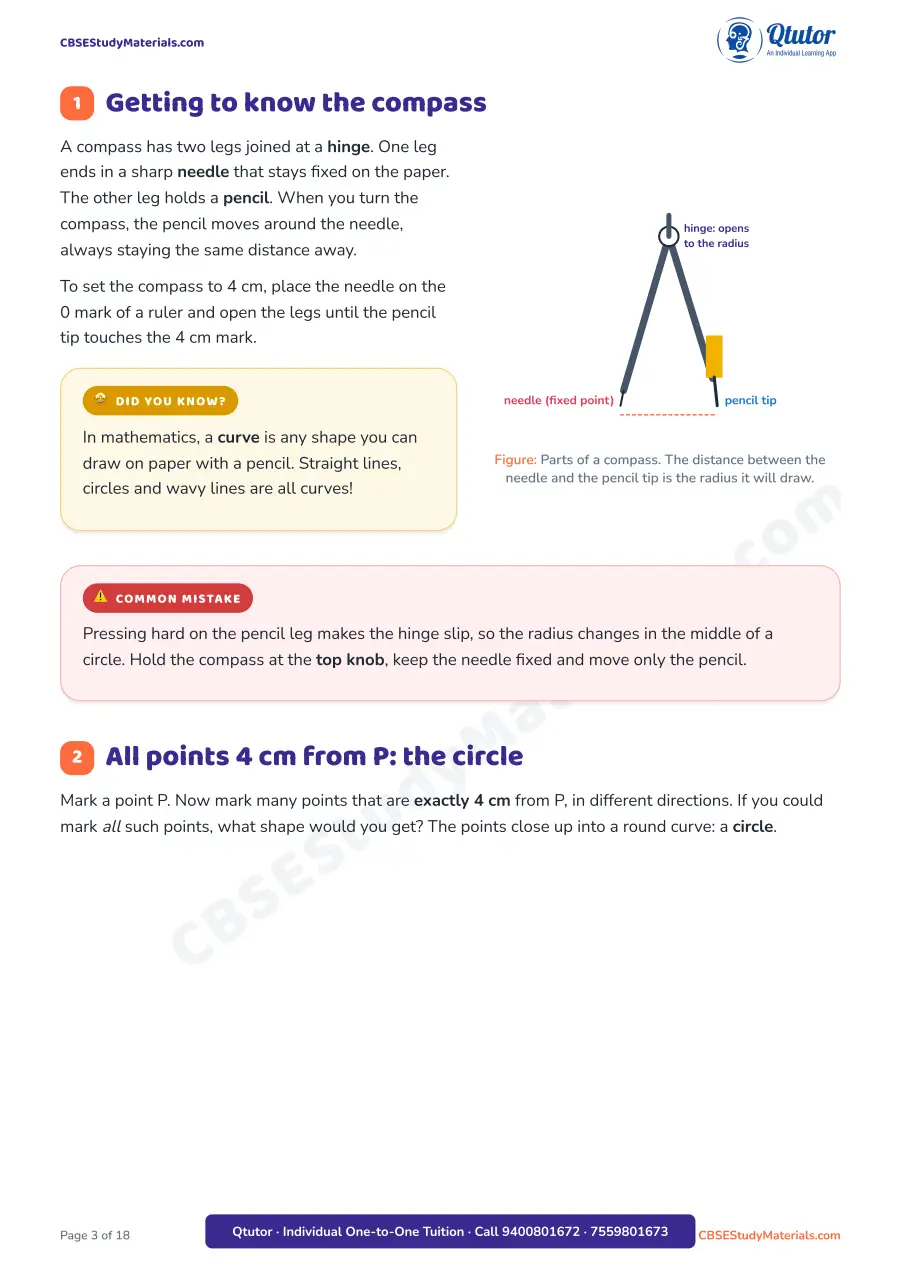
- More than 20 original drawings: compass parts, the circle as all points 4 cm from P, A Person, Wavy Wave, Eyes, labelled rectangles, a dot-grid check, square and rectangle construction steps, the X–Y exploration, squares inside rectangles, diagonals with all eight angles, the House and a rhombus
- Common mistake boxes (slipping compass, 60° at the wrong corner, wrong rectangles for two or three squares)
- Real-life links such as how carpenters check a door frame with its diagonals
- A key-terms grid with 12 words and their meanings
- A colourful mind map of the chapter
- "Check yourself": 12 thinking questions with a compact answer key
- A one-page summary for last-minute revision
Structure of the Notes PDF
| Part | What you get |
|---|---|
| Topics 1–3 | Compass, circle, centre, radius, arcs; artwork: Person, Wavy Wave, Eyes |
| Topics 4–5 | Properties R1, R2, S1, S2; naming rules; rotated shapes; constructing a square and rectangles |
| Topics 6–7 | The X–Y exploration in a 7 cm × 4 cm rectangle; planning with rough figures; squares inside rectangles |
| Topics 8–9 | Diagonals of rectangles and squares; constructing rectangles from an angle split or a side and a diagonal |
| Topic 10 | Points equidistant from two points: the House, and four equal sides without a square |
| Revision | Key terms, mind map, 12 questions with answers, one-page summary |
Playing with Constructions Class 6 Important Topics
- All points at the same distance from a point form a circle; the distance is the radius
- Choosing the centre and radius for curves in artwork (radius = AB ÷ 4 for the wavy wave)
- Rectangle properties R1 and R2, square properties S1 and S2, and correct names such as ABCD or ADCB
- Why a rotated square is still a square, and how to check squares on a dot grid by counting steps
- Constructing a square of side 6 cm and rectangles such as 6 cm × 4 cm and 10 cm × 2 cm
- Why four right angles force opposite sides to be equal
- Shortest and longest distance between points on opposite sides of a rectangle
- Rectangles that split into two or three identical squares, and copying lengths with a compass
- Equal diagonals, and why a diagonal halves the corner angles only in a square
- Rectangles from a 60°/30° split or from a 5 cm side and 7 cm diagonal
- Finding a point at a given distance from two points with two arcs
Playing with Constructions Class 6 Important Questions (Sample)
Wavy wave: on a central line AB = 8 cm, two half circles share AB, so AX = 4 cm and the compass radius is 2 cm. On AB = 12 cm the radius becomes 3 cm.
X–Y exploration in rectangle ABCD with AB = 7 cm and BC = 4 cm:
| X from A | Y from B | XY |
|---|---|---|
| 1 cm | 1 cm | 7 cm |
| 5 mm | 3 cm | about 7 cm 4 mm |
| at A | at C | about 8.1 cm (the diagonal) |
Check yourself, Q8: In a rectangle a diagonal makes 35° with one side at a corner. What angle does it make with the other side? Answer: 90° − 35° = 55°.
How These Notes Help
Constructions are learnt by doing, but many students get stuck on where to put the compass tip. These notes show the tip, the radius and the order of steps in every drawing, and explain why each step works. The "Think deeper" boxes build the habit of reasoning, for example why every square is a rectangle or how folding shows that the diagonals are equal. The chapter summary on the last page puts all the rules on a single sheet for quick revision before a class test.
Who Should Use It
- Class 6 students using Ganita Prakash who want neat, picture-based notes for Chapter 8
- Students who missed a construction class and need the steps explained slowly
- Parents and tutors looking for NCERT based explanations and extra important questions for CBSE 2026-27
How to Download the Class 6 Playing with Constructions Notes PDF
This is a premium PDF download priced at ₹49. Use the button below; the file prints well on A4 and is easy to read on a phone.
Playing with Constructions Class 6 Maths Chapter 8 Notes PDF (PDF · 18 pages · ₹49)
Related Resources
- Playing with Constructions Class 6 NCERT Solutions PDF
- Playing with Constructions Class 6 Question Bank PDF
- Class 6 Maths Chapter 8 Playing with Constructions chapter page
- All Class 6 Mathematics study material
- Previous chapter: Fractions (Class 6 Maths Chapter 7)
- Next chapter: Symmetry (Class 6 Maths Chapter 9)
FAQs on Class 6 Maths Chapter 8 Playing with Constructions
Where can I download Class 6 Maths Chapter 8 Playing with Constructions notes PDF? You can buy and download it on this page for ₹49. It is a 18-page premium PDF with labelled drawings, a mind map, 12 questions with answers and a one-page summary.
What are the important topics in Playing with Constructions Class 6? The compass and circle, artwork with arcs, properties of squares and rectangles, constructing them, the X–Y exploration, diagonals, and finding a point equidistant from two given points.
Which book is Playing with Constructions Class 6 from? It is Chapter 8 of Ganita Prakash, the NCERT Class 6 Mathematics textbook used in CBSE schools for 2026-27.
Do the notes show the construction steps with figures? Yes. The square, the 60°/30° rectangle, the side-and-diagonal rectangle and the House are shown step by step with labelled drawings.
Are these notes NCERT based? Yes. They follow the current NCERT chapter section by section, but they are written in our own words and are not an official NCERT publication.
What is the radius for the wavy wave on an 8 cm line? 2 cm. The two half circles share the 8 cm line, so each sits on 4 cm and its radius is half of that.
Study tip: draw a quick rough figure and mark equal sides before every construction, and the steps will almost write themselves.