Introduction to Macroeconomics - Class 12 Economics Chapter 1 Notes (PDF · 16 pages · Free download) Download the full PDF free
You are looking at pages 1 to 3 of 16. The full PDF is free to download.
Between 1929 and 1933, unemployment in the USA jumped from 3 per cent to 25 per cent and total output fell by about a third, and that shock is where Class 12 Economics Chapter 1, Introduction to Macroeconomics, begins its story. This free 16-page CBSE chapter notes PDF covers the whole NCERT chapter "Introduction" from Introductory Macroeconomics in crisp, exam-ready revision notes with original diagrams, a mind map, a one-page summary and board-pattern important questions with answers.
It is NCERT based study material for CBSE 2026-27, written in our own words. It is not an official CBSE or NCERT publication.
Class 12 Economics Chapter 1 Introduction to Macroeconomics Notes: What Is Included
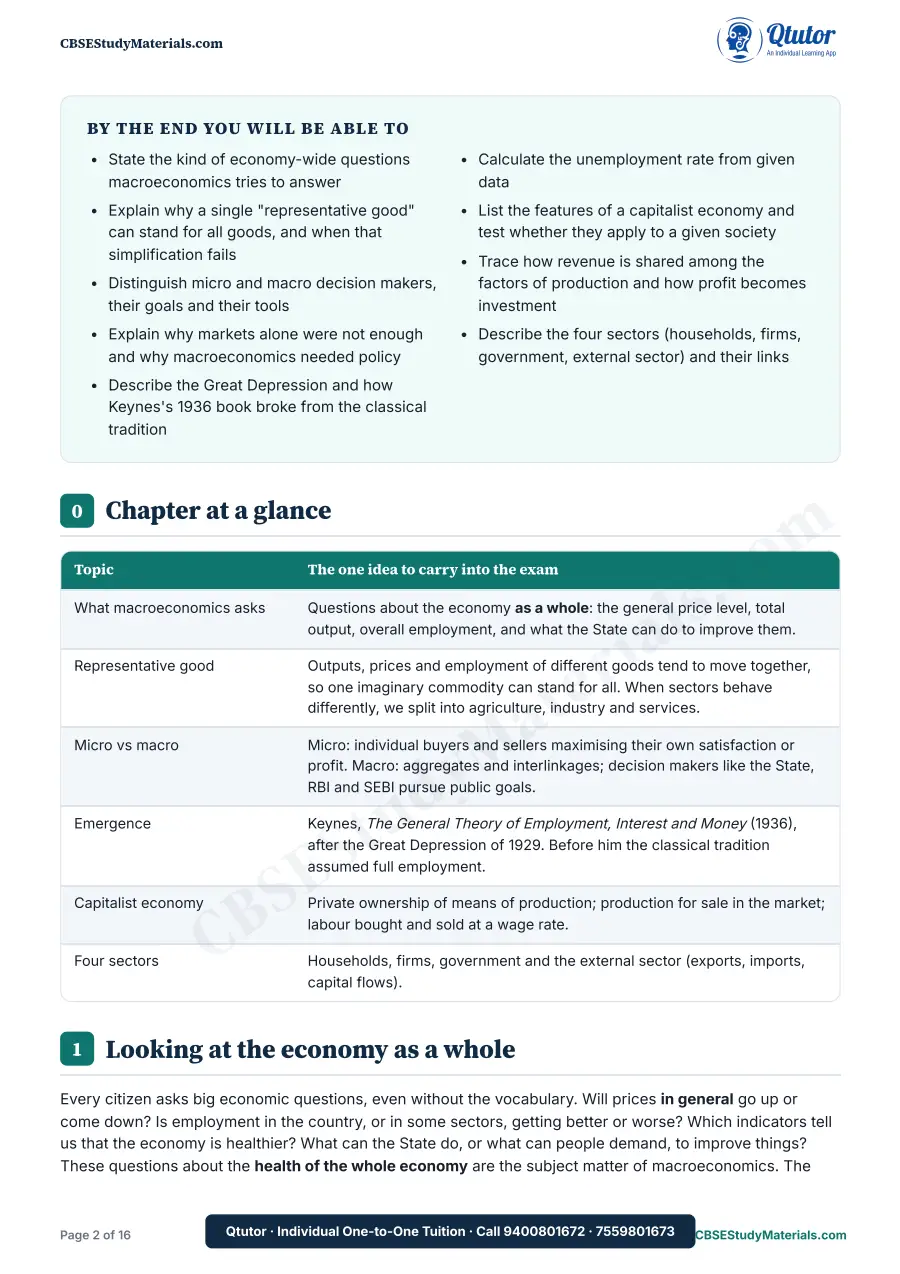
- A cover, learning objectives and a "chapter at a glance" table that gives the one idea to remember from each topic
- Five numbered topic sections that follow the NCERT chapter in order
- Concept cards, definitions, "did you know" boxes on Adam Smith and J. M. Keynes, real-life links, common mistakes and "think deeper" prompts
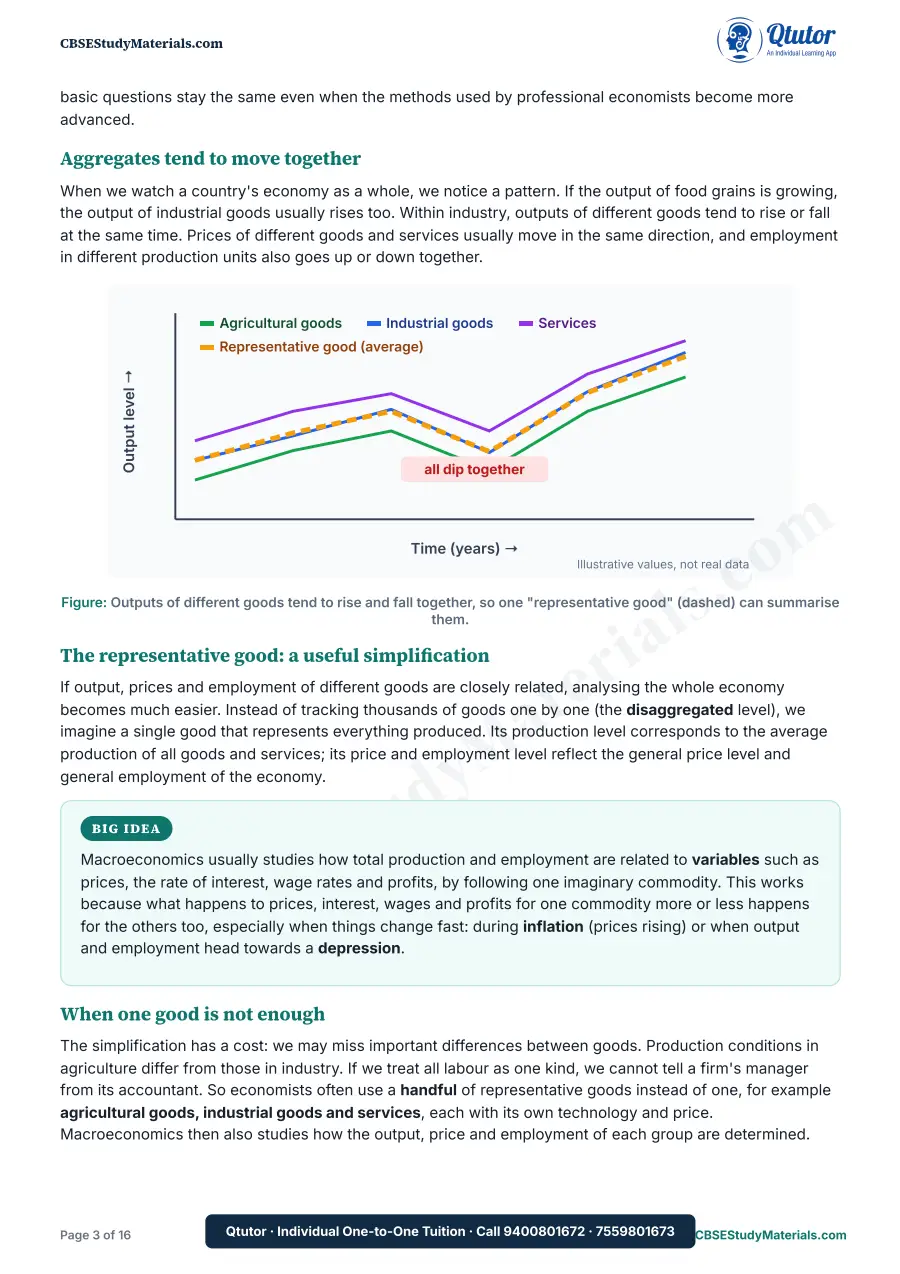
- 6 original figures: aggregates moving together, the micro and macro lens, the Great Depression in numbers, how revenue is shared among the factors of production, the four-sector diagram, and a full mind map
- A worked example on calculating the unemployment rate, with the most common wrong method explained
- A comparison table of microeconomics and macroeconomics
- A timeline from 1776 to 1936
- A 24-term key terms grid
- A one-page chapter summary for last-minute revision
- "Check yourself": 12 board-pattern important questions (MCQ, assertion-reason, sequence, data-based, case-based, 3-, 4- and 6-mark) with a marking-scheme style answer key
Structure of the Notes
| Part | What you get |
|---|---|
| Cover and objectives | Nine learning outcomes for the chapter |
| Chapter at a glance | Six-row table of key ideas |
| Section 1 | Looking at the economy as a whole; the representative good |
| Section 2 | Microeconomics vs macroeconomics; economic agents; RBI and SEBI as macro decision makers |
| Section 3 | Emergence of macroeconomics: classical tradition, Great Depression, Keynes |
| Section 4 | The capitalist economy: entrepreneurs, factors of production, profit and investment |
| Section 5 | The four sectors: households, firms, government, external sector |
| Revision | Mind map, key terms, one-page summary |
| Practice | 12 questions and answer key |
Introduction to Macroeconomics Class 12 Important Topics
The economy as a whole. Macroeconomics asks economy-wide questions: will prices in general rise, is employment improving, what can the State do? The notes explain why outputs, prices and employment of different goods tend to move together, so that one imaginary "representative good" can stand for all of them, and when economists split the economy into agricultural goods, industrial goods and services instead.
Micro vs macro. Economic agents, why even a large company is "micro", General Equilibrium, and the three reasons economists went beyond Adam Smith's self-interest view: missing markets, markets that fail to reach equilibrium, and social goals such as employment, education, health and defence. Macro decision makers such as the State, the RBI and SEBI pursue public goals set by law or the Constitution.
Emergence of macroeconomics. The classical tradition assumed full employment. The Great Depression of 1929 proved otherwise, and Keynes's The General Theory of Employment, Interest and Money (1936) looked at the economy in its entirety, giving birth to macroeconomics as a separate branch.
The capitalist economy. Entrepreneurs, land, labour and capital; revenue paid out as rent, interest and wages; profit ploughed back as investment expenditure; the three features of a capitalist economy; and why the analysis may not fit peasant-family farming or tribal societies.
Four sectors. Households, firms, government and the external sector (exports, imports and capital flows), and how they are linked.
Introduction to Macroeconomics Class 12 Important Questions (Sample)
A data-based MCQ from the "Check yourself" set:
> In a district, 18 lakh people are working, 2 lakh are not working but are looking for jobs, and 5 lakh are neither working nor looking for work. The unemployment rate is: (a) 8% (b) 10% (c) 11.1% (d) 28%
Answer key: (b) 10%, because 2⁄18 + 2 × 100 = 10%. The 5 lakh not looking for work are left out, and 11.1% is the trap you get by dividing by those working only.
From Section 4, the revenue identity used in the case-based question (the figure in the notes uses illustrative amounts):
$Profit = Revenue − (Rent + Interest + Wages)$
| Revenue | Rent (land) | Interest (capital) | Wages (labour) | Profit (entrepreneur) |
|---|---|---|---|---|
| ₹50 lakh | ₹5 lakh | ₹7 lakh | ₹26 lakh | ₹12 lakh |
Illustrative amounts, not real data.
An assertion-reason item:
> Assertion (A): A very large company is still treated as a micro economic agent. Reason (R): It acts in the interest of its own shareholders, which need not be the interest of the country as a whole.
Both are true and R correctly explains A.
How These Revision Notes Help
- The chapter is short in the textbook, but board questions test understanding, not recall. The notes turn each idea into something you can apply: identifying a macro decision, testing whether a society is capitalist, tracing a household's links to all four sectors.
- Figures make abstract ideas concrete, from the bars showing the Depression to the arrows between the four sectors.
- Common mistakes are named, such as using the wrong denominator in the unemployment rate.
- Answers follow marking-scheme style with value points, so you can see how marks are awarded.
Who Should Use It
Class 12 students starting Introductory Macroeconomics, students revising before unit tests, pre-boards and the CBSE board exam, and teachers or parents who want a clean chapter summary and a ready question set for this chapter.
How to Download the Class 12 Introduction to Macroeconomics Notes PDF
The PDF is free. Use the download button below to save it and study offline or print it.
Introduction to Macroeconomics - Class 12 Economics Chapter 1 Notes (PDF · 16 pages · Free download)
Related resources
FAQs on Class 12 Economics Chapter 1 Introduction to Macroeconomics
Where can I download Class 12 Economics Chapter 1 Introduction to Macroeconomics notes PDF? On this page. The 16-page notes PDF is free; use the download button above.
Is the Introduction to Macroeconomics notes PDF free? Yes. Chapter 1 notes are free to download.
Which book is Introduction to Macroeconomics Class 12 from? It is Chapter 1, "Introduction", of the NCERT textbook Introductory Macroeconomics for Class 12 Economics.
What are the important topics in Class 12 Economics Chapter 1? The difference between micro and macroeconomics, the representative good, the Great Depression and Keynes, the features of a capitalist economy, factors of production and their incomes, and the four sectors of an economy.
How is the unemployment rate calculated in Class 12 Macroeconomics Chapter 1? Divide the number of people not working but looking for jobs by the total of people working and people looking for jobs, then multiply by 100.
Who is called the father of macroeconomics in Class 12 Economics? The chapter does not use that title, but it links the subject to John Maynard Keynes: macroeconomics emerged as a separate branch of economics after he published The General Theory of Employment, Interest and Money in 1936.
Does the PDF have important questions with answers? Yes. It has 12 board-pattern questions, from 1-mark MCQs and assertion-reason items to a 6-mark long answer, with a marking-scheme style answer key.
Study tip: learn the four sectors by drawing the arrows between them from memory; if you can draw it, you can answer any question on interlinkages.