New Beginnings: Cities and States - Class 7 Social Science Chapter 4 NCERT Solutions (PDF · 12 pages · ₹49) Unlock the full PDF for ₹49
Free sample: pages 1 to 3 of 12. The full PDF costs ₹49.
Which four mahājanapadas were the most powerful, and which modern cities stand on their old capitals? Rājagṛiha is today's Rajgir, Śhrāvastī is Shravasti, Kauśhāmbī lies near Prayagraj and Ujjayinī is Ujjain. That is one of the answers worked out in this New Beginnings: Cities and States Class 7 Social Science Chapter 4 NCERT Solutions PDF for CBSE students using the NCERT textbook Exploring Society: India and Beyond (Part I, 2026-27).
This is a 12-page premium PDF priced at ₹49. It answers every in-text question and every end-of-chapter question of Chapter 4, in the same order and with the same labels as the textbook. It is an independent study resource and is not an official CBSE or NCERT publication.
Class 7 Social Science Chapter 4 NCERT Solutions: What Is Included
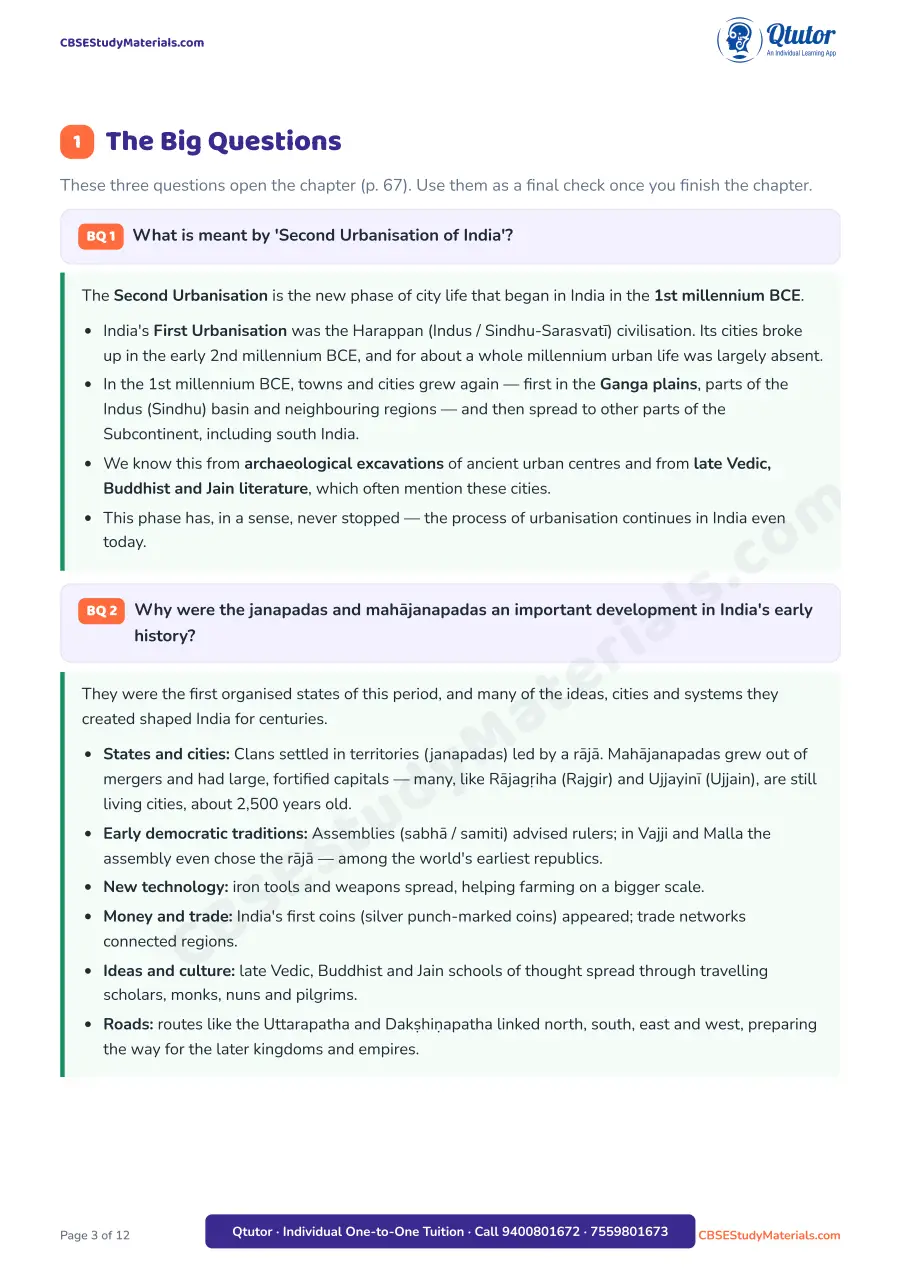
- The Big Questions 1–3 from the chapter opening: the meaning of the 'Second Urbanisation of India', why the janapadas and mahājanapadas mattered, and the systems of governance they evolved.
- Think About It (p. 70): why so many mahājanapadas grew up in the Ganga plains.
- Let's Explore (p. 70): capitals of Magadha, Kosala, Vatsa and Avanti matched with today's cities, and the comparison with the Mahābhārata map from Grade 6 (11 common names).
- Let's Explore (p. 74): the full Yes / No table comparing the First and Second Urbanisation (Ganga plains, monasteries, literature, trade, warfare, copper / bronze, iron), with a reason for every cell.
- Let's Explore (p. 76): why a complex society divides itself into groups, and a grouped list of professions of the 1st millennium BCE.
- Think About It (p. 78): a model reflection on inequality and why equality is desirable.
- Questions and activities 1–4 (p. 81): Kauṭilya's advice compared with today, how rulers were chosen, sources a historian would use, and why iron metallurgy mattered.
- Four original diagrams: a timeline from 1900 BCE to 300 BCE, a schematic sketch of the mahājanapadas and their capitals, a varṇa and jāti chart, and a labelled fortified capital (rampart, narrow gateway, moat).
- A one-minute chapter summary at the start and a quick-recap box at the end.
Structure of the PDF
| Part | What you get |
|---|---|
| Cover and how-to-use | List of every question answered, with textbook page numbers |
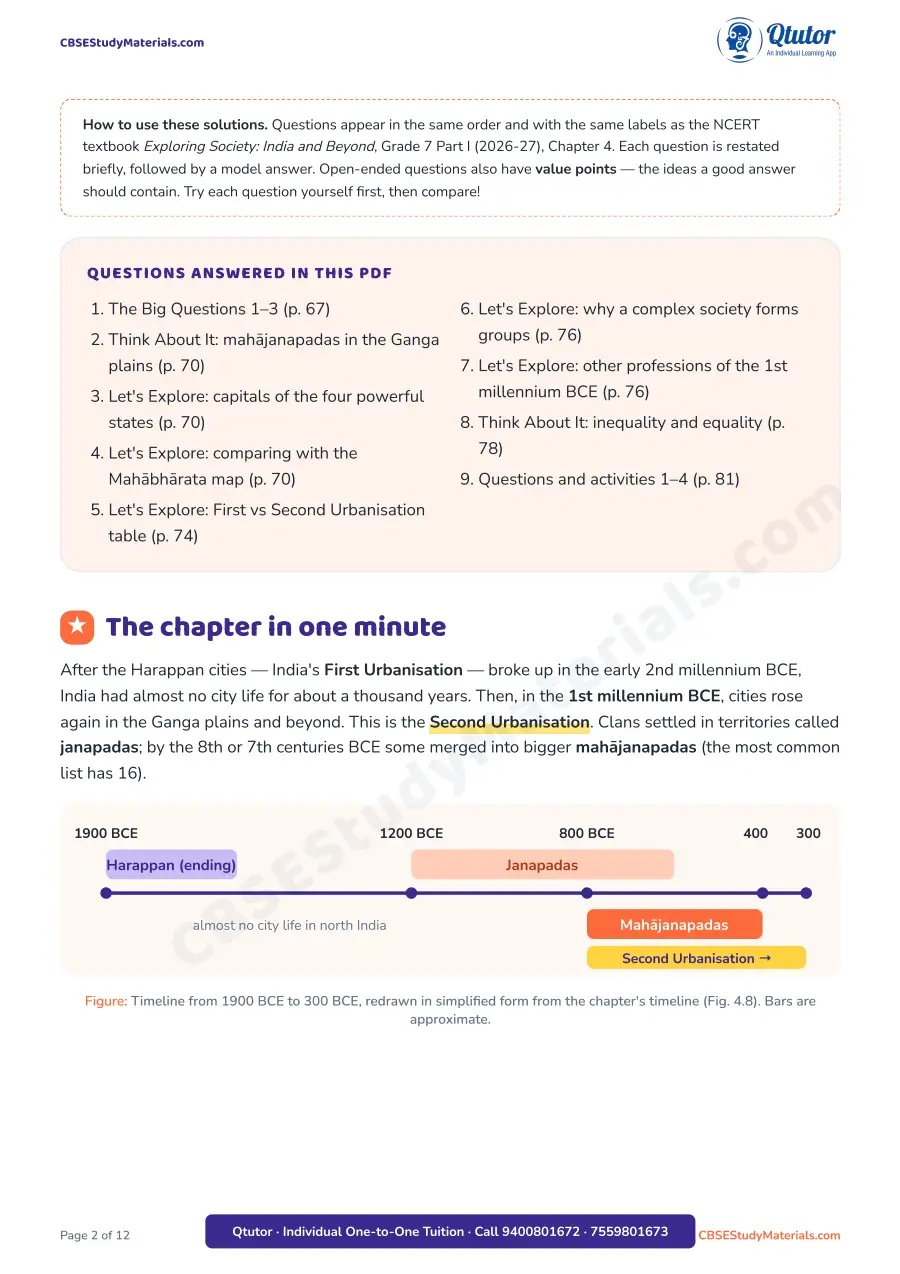
| The chapter in one minute | Short summary with timeline diagram |
| Section 1: The Big Questions | BQ 1–3 with value points and a monarchy vs gaṇa table |
| Section 2: In-text questions | T 1, E 1–E 5, T 2 with tables, map sketch and chart |
| Section 3: Questions and activities | Q1–Q4 with model answers, tables and a flow diagram |
| Quick recap | Seven key points for last-minute revision |
New Beginnings: Cities and States Class 7 Important Topics
The solutions cover the whole chapter as it appears in the 2026-27 NCERT book:
- The end of the Harappan 'First Urbanisation' and the rise of the 'Second Urbanisation' in the 1st millennium BCE.
- Janapadas (clans settled in a territory under a rājā) and the 16 mahājanapadas, from Gandhāra in the northwest to Anga in the east and Aśhmaka near the Godavari.
- Fortified capitals with moats and narrow gateways, many of which are still living cities.
- Early democratic traditions: sabhā and samiti, monarchies such as Magadha, Kosala and Avanti, and the gaṇas or sanghas of Vajji and Malla, often called early republics.
- Iron metallurgy, silver punch-marked coins and the spread of late Vedic, Buddhist and Jain thought.
- The varṇa–jāti system and how it changed over time.
- The Uttarapatha and Dakṣhiṇapatha routes, Śhiśhupalgarh in Kalinga, and the Chola, Chera and Pānḍya kingdoms of the south.
Class 7 Chapter 4 Important Questions (Sample Answers)
Sample 1, Let's Explore (p. 70): Magadha's capital was Rājagṛiha (Rajgir, Bihar); Kosala's was Śhrāvastī (Shravasti, Uttar Pradesh); Vatsa's was Kauśhāmbī (near Prayagraj); Avanti's was Ujjayinī (Ujjain, Madhya Pradesh).
Sample 2, the comparison table (p. 74):
| Feature | First Urbanisation | Second Urbanisation |
|---|---|---|
| Ganga plains | No | Yes |
| Trade | Yes | Yes |
| Copper / bronze | Yes | Yes |
| Iron | No | Yes |
Sample 3, Question 4 (p. 81): Iron tools allowed farming on a bigger scale, which produced surplus food to feed people who did not farm, such as rulers, soldiers, traders and craftspeople. Iron weapons were lighter and sharper than bronze ones, helping states defend themselves and expand.
How These NCERT Solutions Help
- You can check your own answers against complete model answers written in simple language for Class 7.
- Value points show what a full answer should contain, which is useful for class tests and school exams.
- Tables and diagrams turn long ideas into quick revision material.
- Open-ended questions such as the inequality reflection and the Kauṭilya discussion have model answers you can adapt to your own ideas.
Who Should Use It
- Class 7 students studying CBSE Social Science (History) from the new NCERT book.
- Parents and tutors who want reliable answers to check homework.
- Teachers who want a ready answer key for the chapter's in-text activities.
How to Download the Class 7 New Beginnings: Cities and States NCERT Solutions PDF
Use the button below. This is a premium PDF priced at ₹49, and you can keep it on your phone or print it for revision.
New Beginnings: Cities and States - Class 7 Social Science Chapter 4 NCERT Solutions (PDF · 12 pages · ₹49)
Related Resources
- Chapter page: New Beginnings: Cities and States
- Class 7 Social Science Chapter 4 Notes: revision notes, chapter summary and mind map for the same chapter
- Class 7 Social Science Chapter 4 Question Bank: extra MCQs, short-answer, long-answer and source-based questions with answers
- All Class 7 Social Science study material
- Previous chapter: Climates of India
- Next chapter: The Rise of Empires
FAQs on Class 7 Social Science Chapter 4 New Beginnings: Cities and States
Where can I download Class 7 Social Science Chapter 4 NCERT Solutions PDF? On this page. Use the download button to get the 12-page premium PDF for ₹49.
Does this PDF answer all the questions in New Beginnings: Cities and States? Yes. It answers the three Big Questions, all Think About It and Let's Explore prompts, and Questions and activities 1–4, in textbook order.
Which book is New Beginnings: Cities and States from? It is Chapter 4 of the NCERT textbook Exploring Society: India and Beyond, Grade 7 Part I, used in CBSE schools for 2026-27.
What is the Second Urbanisation in Class 7 Chapter 4? It is the new phase of city life that began in the 1st millennium BCE in the Ganga plains and nearby regions, after the Harappan cities (the First Urbanisation) had disappeared.
Which mahājanapadas were not monarchies? Vajji (Vṛijji) and Malla. Their assemblies took decisions through discussion or vote and even selected the rājā, so they are often called early republics.
Is this an official NCERT solution? No. It is an independent study resource written from the current NCERT textbook. It is not published by CBSE or NCERT.
Study tip: read each question aloud, answer it in your own words, and only then check the model answer and value points.