Patterns in Mathematics - Class 6 Maths Chapter 1 Worksheet (PDF · 13 pages · Free download) Download the full PDF free
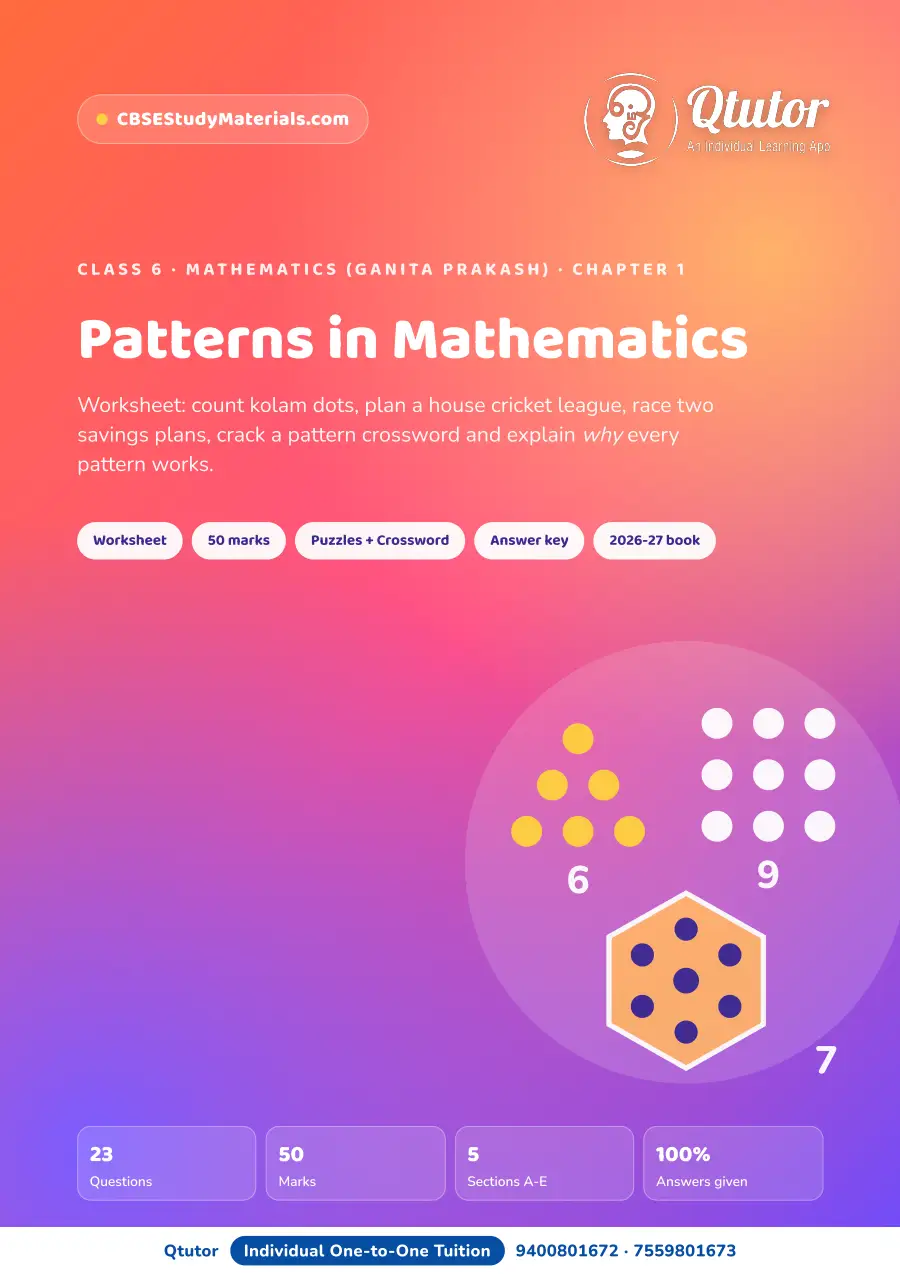
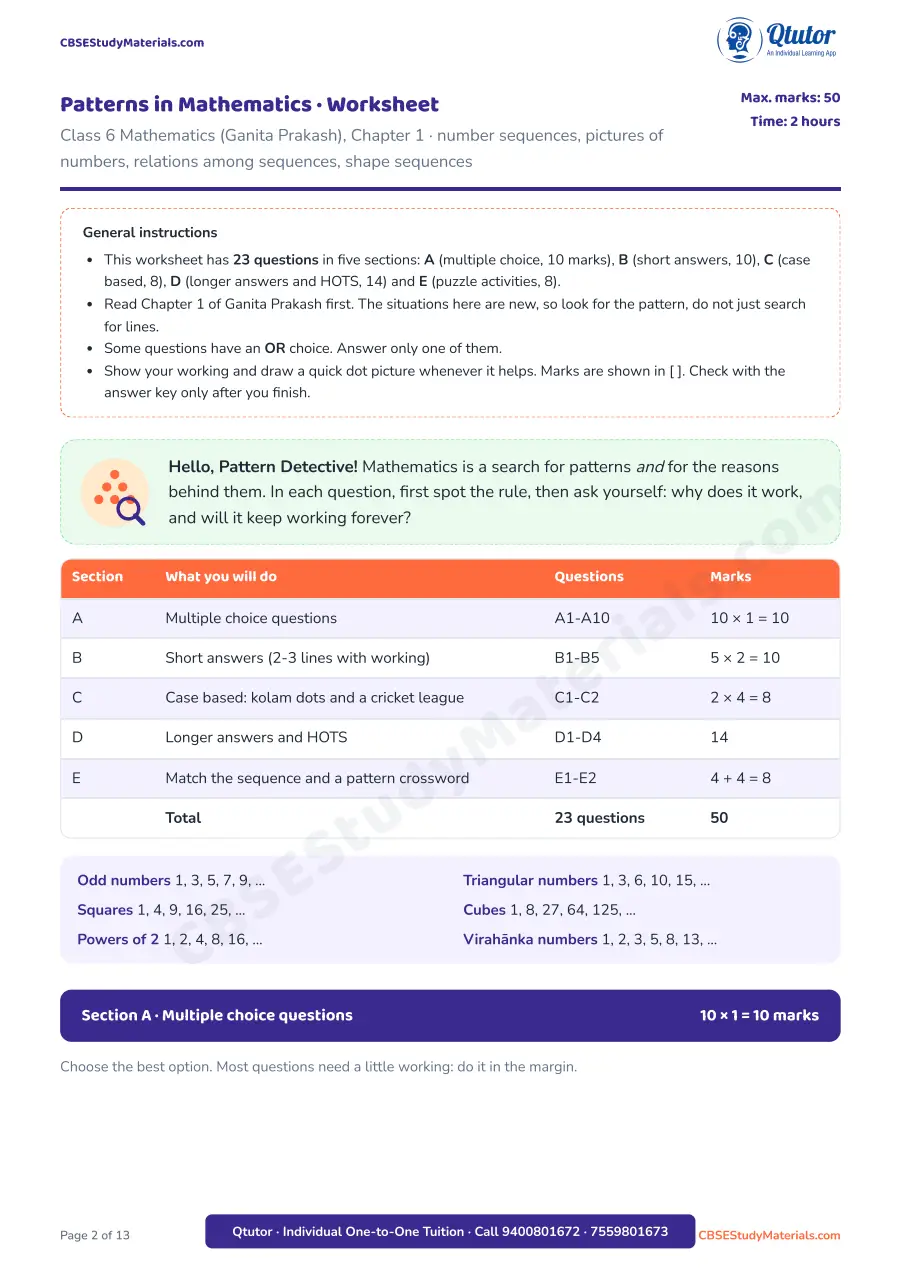
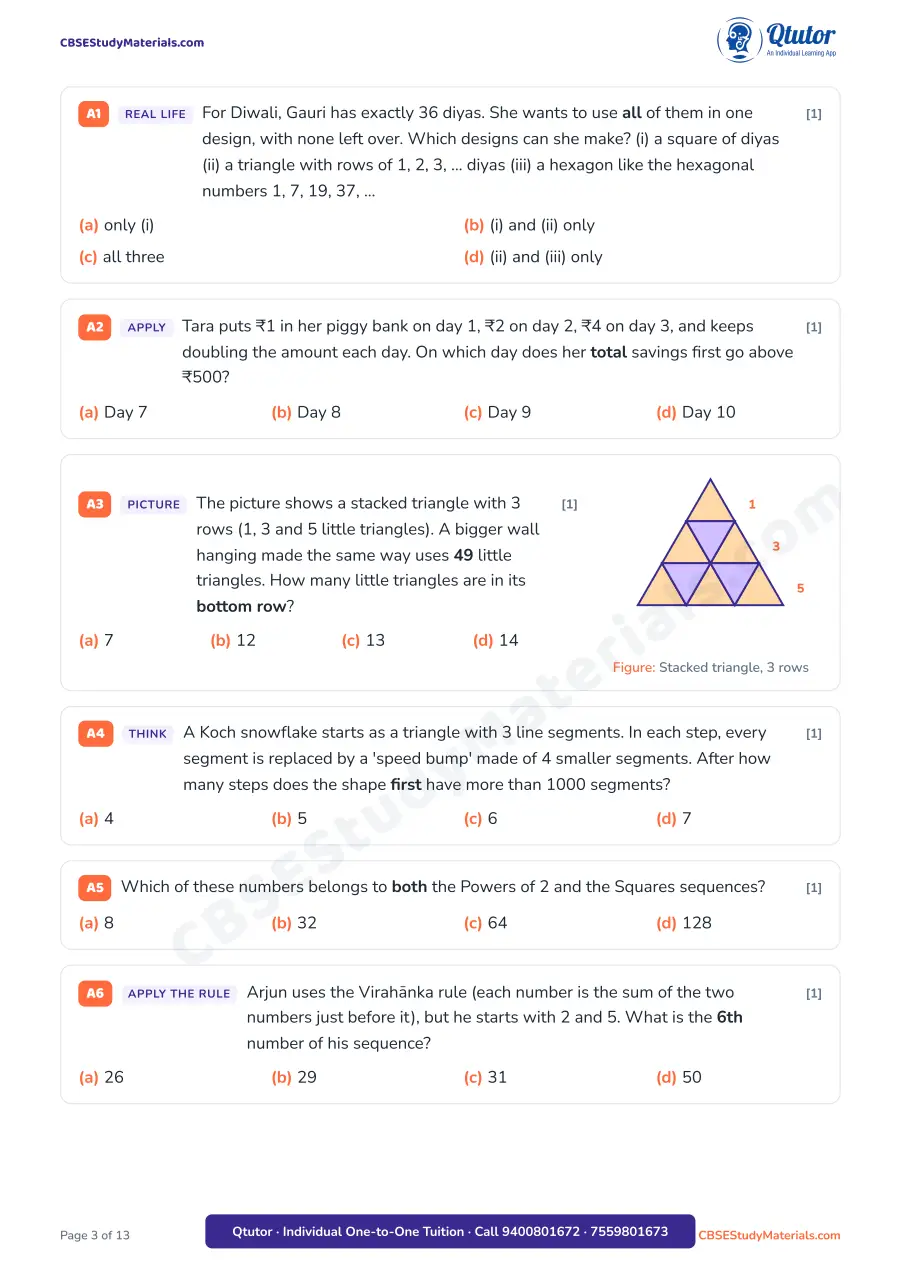
You are looking at pages 1 to 3 of 13. The full PDF is free to download.
Gauri has exactly 36 diyas for Diwali. Can she use all of them in a square, in a triangle, or in a hexagon? Questions like this open the Patterns in Mathematics Class 6 Maths Chapter 1 worksheet, a free 13-page PDF for CBSE students using the NCERT Ganita Prakash textbook. The worksheet has 23 questions for 50 marks with a full answer key, and it is not an official CBSE or NCERT publication.
This worksheet is NCERT based and follows the CBSE 2026-27 book, but the situations are new. Students count kolam dots, plan a house cricket league, compare two savings plans and solve a pattern crossword. Every question asks them to spot a rule and then explain why it works, which is exactly what the chapter is about. It works well as practice after reading the chapter, as a class test, or as a quick revision sheet before a periodic test.
Class 6 Maths Chapter 1 Patterns in Mathematics Worksheet: What Is Included
- A cover page, general instructions and a section-wise marks table (50 marks, 2 hours)
- A quick reference box with six key sequences: odd numbers, triangular numbers, squares, cubes, powers of 2 and Virahānka numbers
- Section A: 10 multiple choice questions, most of them set in small real-life situations
- Section B: 5 short answer questions, including error spotting and "check the claim" items
- Section C: 2 case-based sets: hexagonal kolam dot designs and a round-robin house league
- Section D: 4 longer answers and HOTS questions, including a picture proof and a 10-day savings plan comparison
- Section E: a match-the-sequence activity and an 8-word pattern crossword
- Answer lines after every question for writing working
- A complete answer key on a new page, with value points and marks for each step, plus the solved crossword
- Original, colourful diagrams: a stacked triangle, kolam dot hexagons, a league diagram, a 4 × 4 dot square read along slanted lines, and the crossword grid
Structure of the Worksheet
| Section | Question type | Questions | Marks |
|---|---|---|---|
| A | Multiple choice | A1-A10 | 10 × 1 = 10 |
| B | Short answer | B1-B5 | 5 × 2 = 10 |
| C | Case based | C1-C2 | 2 × 4 = 8 |
| D | Long answer and HOTS | D1-D4 | 3 + 3 + 3 + 5 = 14 |
| E | Match and crossword | E1-E2 | 4 + 4 = 8 |
| Total | 23 | 50 |
Patterns in Mathematics Class 6 Important Topics Covered
- What mathematics is: the search for patterns and for the reasons behind them; number theory and geometry
- Number sequences from Table 1 of the chapter: counting, odd and even numbers, triangular numbers, squares, cubes, Virahānka numbers, powers of 2 and powers of 3
- Visualising sequences with dot pictures, including hexagonal numbers 1, 7, 19, 37, …
- Relations among sequences: adding odd numbers gives squares, adding up and down gives squares, adding powers of 2 and adding 1, triangular numbers times 6 plus 1, and adding hexagonal numbers to get cubes
- Shape sequences: regular polygons, complete graphs, stacked squares, stacked triangles and the Koch snowflake, and the number sequences hidden in them
Patterns in Mathematics Class 6 Important Questions (Sample)
A2 (MCQ, 1 mark). Tara puts ₹1 in her piggy bank on day 1, ₹2 on day 2, ₹4 on day 3 and keeps doubling. On which day does her total savings first go above ₹500? The key lists the running totals 1, 3, 7, 15, 31, 63, 127, 255, 511, so the answer is day 9.
C1 (case based, 4 marks). Meenakshi draws kolam designs with dots in hexagons, and each design adds a new ring. Students find the dots in Design 4 (37), use the ring pattern 6, 12, 18, 24 to get Design 5 (61), and discover that the first four designs together use 1 + 7 + 19 + 37 = 64 = 4 × 4 × 4 dots, a cube.
D4 (HOTS, 5 marks). A school fair runs for 10 days. Plan A gives ₹10 more each day; Plan B doubles each day starting from ₹1.
| Day | 6 | 7 | 8 |
|---|---|---|---|
| Plan A (₹) | 60 | 70 | 80 |
| Plan B (₹) | 32 | 64 | 128 |
Students find that Plan B overtakes on day 8, then use chapter patterns for the totals: 10 × 55 = 550 for Plan A and 1024 − 1 = 1023 for Plan B.
How This Worksheet Helps
The chapter keeps asking "why does this happen?" and this worksheet does the same. Instead of only continuing sequences, students test claims ("every cube is also a square"), find mistakes in a classmate's notebook, and explain a picture proof for 1 + 2 + 3 + 4 + 3 + 2 + 1 = 16 that works for a square of any size. Reverse questions, such as finding the last odd number when the total is 400, build real understanding rather than memory. The answer key shows the working and the marks for each step, so students can check themselves and parents or teachers can mark quickly.
Who Should Use It
- Class 6 students who have read Chapter 1 and want fresh practice, important questions and a self-test
- Teachers who need a ready class test or homework sheet for the first chapter of Ganita Prakash
- Parents looking for free Class 6 Maths study material with answers
How to Download the Class 6 Patterns in Mathematics Worksheet PDF
The PDF download is free. Use the button below, print it on A4 paper, and give your child about two hours to finish it before opening the answer key.
Patterns in Mathematics - Class 6 Maths Chapter 1 Worksheet (PDF · 13 pages · Free download)
Related Resources
- Patterns in Mathematics chapter page
- All Class 6 Mathematics resources
- Patterns in Mathematics Class 6 notes: revision notes and chapter summary to read before the worksheet
- Patterns in Mathematics Class 6 NCERT solutions for the textbook Figure it Out questions
- Patterns in Mathematics Class 6 question bank for more practice by question type
FAQs on Class 6 Maths Chapter 1 Patterns in Mathematics
Where can I download the Class 6 Maths Chapter 1 Patterns in Mathematics worksheet PDF? You can download it free from this page using the download button. It is a 13-page PDF with 23 questions and a full answer key.
Is the Patterns in Mathematics Class 6 worksheet free? Yes. This Chapter 1 worksheet is free to download, print and use in class or at home.
Does the worksheet have answers? Yes. The answer key starts on a new page and gives the answer, the working and the marks for each step of every question, along with the solved crossword.
Which book is Patterns in Mathematics Class 6 from? It is Chapter 1 of Ganita Prakash, the NCERT Mathematics textbook for Class 6. This worksheet follows the 2026-27 edition.
What are the important topics in Patterns in Mathematics Class 6? Number sequences such as triangular numbers, squares, cubes, powers of 2 and Virahānka numbers, dot pictures of numbers, relations among sequences, and shape sequences such as regular polygons, complete graphs and the Koch snowflake.
Are there case-based questions in this worksheet? Yes. Section C has two case-based sets, one on hexagonal kolam dot designs and one on a house cricket league, each with sub-parts worth 1, 1 and 2 marks.
How is this worksheet different from the question bank? The worksheet is a timed 50-mark test with five sections and an activity section, while the question bank is a larger collection of questions sorted by type for extra practice.
Study tip: when a sequence puzzles you, draw the dots first; the picture usually shows you both the rule and the reason.