Describing Motion Around Us - Class 9 Physics Chapter 4 Flash Cards (PDF · 12 pages · Free download) Download the full PDF free
You are looking at pages 1 to 3 of 12. The full PDF is free to download.
A car covers exactly 15 m in every second for 10 seconds. Is its motion uniform? Most students say yes, and that is the trap on card 12. This free PDF of Describing Motion Around Us Class 9 Physics Chapter 4 flash cards turns the CBSE Class 9 Science chapter from the new NCERT textbook Exploration into 45 question-and-answer cards. It is a 12-page, print-and-cut revision set for the CBSE 2026-27 session, prepared as independent, NCERT based study material; it is not an official CBSE or NCERT publication.
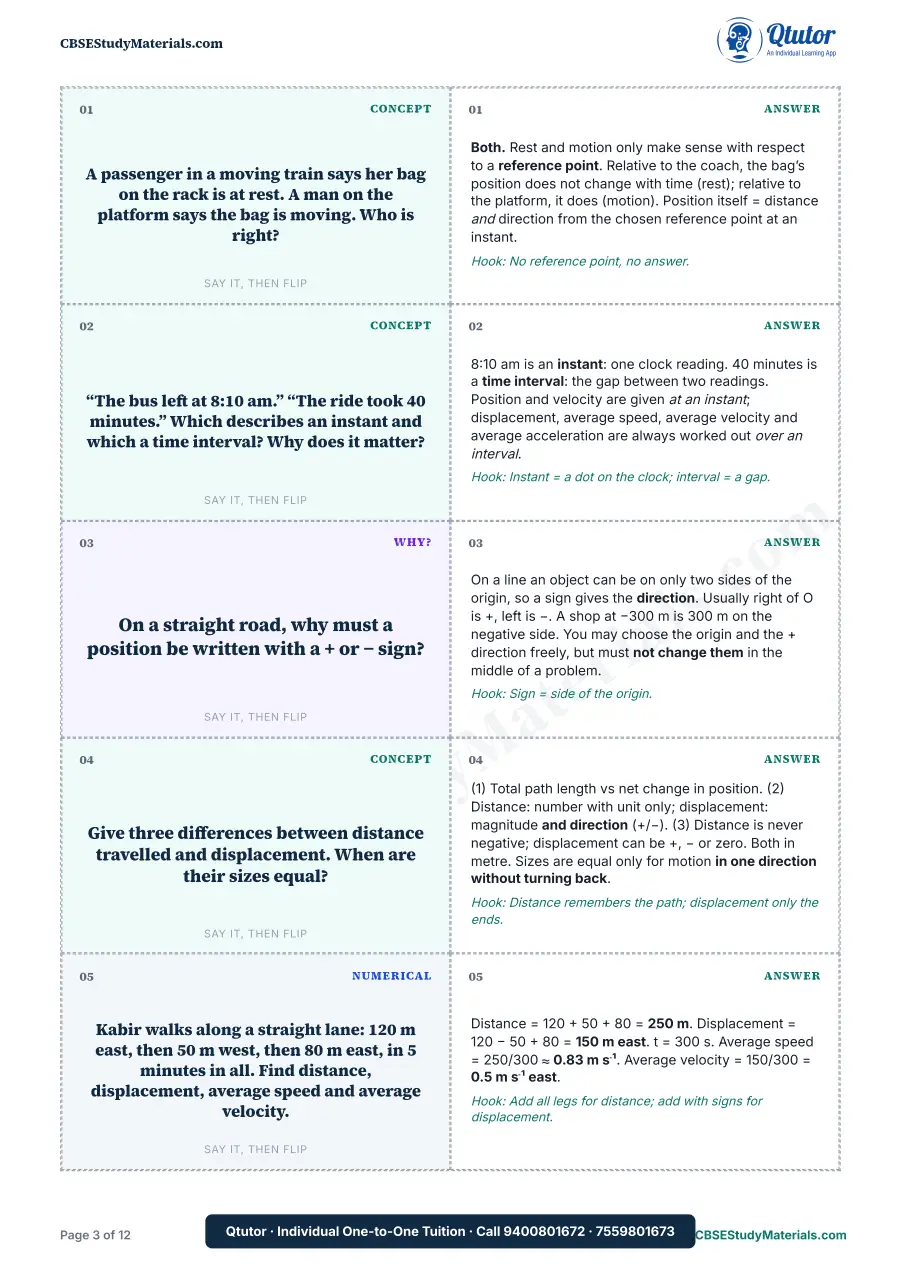
Each card has a front (a question, a graph to read, a wrong statement to correct or a step to fill in) and a back (a crisp answer, worked numbers where needed and a one-line memory hook). Think of it as revision notes in card form: a chapter summary you test yourself on instead of reading.
Class 9 Physics Chapter 4 Flash Cards: What Is Included
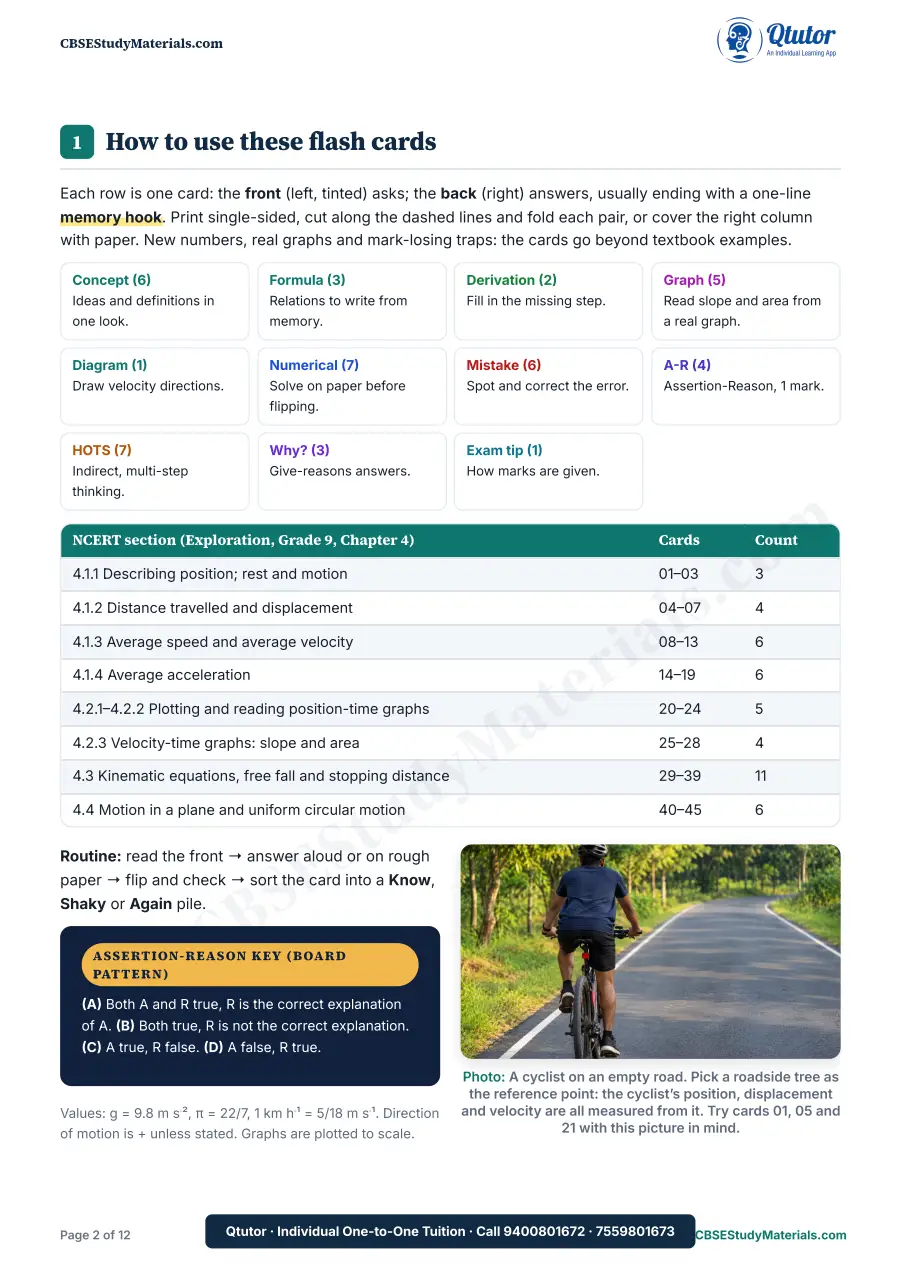
- 45 flash cards, five to a page, front beside back, with dashed cut lines
- 6 Concept, 3 Formula and 3 Why? cards: reference point, instant vs time interval, distance vs displacement, average speed and velocity, average acceleration, motion in one, two and three dimensions
- 5 Graph cards and 1 Diagram card with graphs plotted to scale: reading velocity from position-time graphs, slope and area of velocity-time graphs, matching p-t shapes to v-t shapes, and velocity directions on a merry-go-round
- 7 Numerical and 7 HOTS cards, every number recomputed: free fall, a ball on a ramp, braking from 20 m/s, reaction plus braking distance, and speeds on a merry-go-round
- 6 Spot-the-mistake cards on the errors that cost marks, such as averaging two speeds or using the wrong sign for braking
- 4 Assertion-Reason cards in the CBSE board format, 2 Derivation cards and 1 Exam tip card on step marking
- A one-page formula sheet, a 3-pass revision plan and a tick-box self-check
The cards use fresh numbers and situations, so they do not repeat our chapter notes or worksheet for this chapter. Want more flash cards? A second Describing Motion Around Us flash-card set is also available on the site.
Structure of the Describing Motion Around Us Flash Cards PDF
| Pages | What you get |
|---|---|
| 1 | Cover |
| 2 | How to use the cards, card-type key, NCERT section map, A-R answer key, values used |
| 3–11 | 45 flash cards (front and back side by side) |
| 12 | Formula sheet, 3-pass plan, self-check list |
Describing Motion Around Us Class 9 Important Topics
The cards follow the NCERT sections in order:
- Position, reference point, rest and motion (4.1.1)
- Distance travelled and displacement, including a bouncing ball and the rule |displacement| ≤ distance (4.1.2)
- Average speed and average velocity, uniform and non-uniform motion, the 5/18 conversion (4.1.3)
- Average acceleration, its direction, and three ways velocity can change (4.1.4)
- Position-time graphs: slope as velocity, rest, moving back towards the origin (4.2.1–4.2.2)
- Velocity-time graphs: slope as acceleration, area as displacement (4.2.3)
- Kinematic equations for constant acceleration, free fall and stopping distance (4.3)
- Motion in a plane and uniform circular motion (4.4)
Describing Motion Around Us Class 9 Important Questions (Sample)
Card 09 (Mistake). Riya rides 30 km at 60 km/h and returns at 40 km/h. "Average speed = 50 km/h." The fix: the two legs take 0.5 h and 0.75 h, so the average speed is 60 ÷ 1.25 = 48 km/h, and the average velocity for the round trip is zero.
Card 34 (HOTS). A car at 20 m/s brakes uniformly and stops in 50 m. How much of the 50 m is used to slow from 20 to 10 m/s?
| Step | Working |
|---|---|
| Acceleration | a = dfrac0 − 2022 × 50 = −4 m/s² |
| 20 → 10 m/s | s = dfrac102 − 2022(−4) = 37.5 m |
| Meaning | Three-quarters of the stopping distance goes in losing the first half of the speed |
Card 37 (Assertion-Reason). A: A body starting from rest with constant acceleration covers distances in the ratio 1 : 3 : 5 in successive seconds. R: The distance from the start is proportional to the square of the time. Answer: (A), both true and R explains A, because the totals 1 : 4 : 9 give the differences 1 : 3 : 5.
How These Flash Cards Help
- Graph skills: six cards make you read real graphs, not just recall rules, which is how board case and data questions are set.
- Fewer careless errors: the Mistake cards target sign errors, unit slips and averaging speeds.
- Board pattern practice: the A-R cards use the four standard options, and the numericals show formula, substitution and answer with unit.
- Fast revision: the whole deck takes about 25 minutes once you know it, ideal the night before a test.
Who Should Use It
Class 9 students revising Chapter 4 of the CBSE Science (Physics) syllabus before unit tests, half-yearly and annual exams; students who have finished the chapter notes and want quick self-testing; and parents or teachers who want ready question-and-answer cards for oral quizzes.
How to Download the Class 9 Describing Motion Around Us Flash Cards PDF
The PDF is free. Use the download button below, print single-sided on A4, and cut along the dashed lines.
Describing Motion Around Us - Class 9 Physics Chapter 4 Flash Cards (PDF · 12 pages · Free download)
Related Resources
- Class 9 Physics Chapter 4 Describing Motion Around Us: all resources
- Describing Motion Around Us Class 9 chapter notes
- More flash cards: another Describing Motion Around Us Class 9 flash-card set
- Describing Motion Around Us Class 9 worksheet
- Describing Motion Around Us competency-based model question paper
- Describing Motion Around Us competency and application question bank
- Next chapter: How Forces Affect Motion (Class 9 Physics)
- All Class 9 Physics study material
FAQs on Class 9 Physics Chapter 4 Describing Motion Around Us Flash Cards
Where can I download Class 9 Physics Chapter 4 Describing Motion Around Us flash cards PDF? On this page. The 12-page PDF is a free download: use the download button above.
Is the Describing Motion Around Us flash cards PDF free? Yes. This flash-card set is free.
What are the important topics in Describing Motion Around Us Class 9? Distance and displacement, average speed and velocity, average acceleration, position-time and velocity-time graphs, the kinematic equations, stopping distance and uniform circular motion. Each has its own block of cards.
Which book is Describing Motion Around Us Class 9 from? It is Chapter 4 of the NCERT Class 9 Science textbook Exploration (2026-27). The site lists it under Class 9 Physics.
Do the flash cards have answers? Yes. Every card has its answer on the back, with full working for the numericals and the correct option with a reason for the A-R cards.
Are these flash cards enough for the exam? They are for revision and self-testing. Learn the chapter from the notes first, practise the worksheet, then use the cards to check what you remember.
Study tip: sort the cards into Know, Shaky and Again piles, and redo only the last two piles after two days.