Gol (गोल) Class 6 Hindi Chapter 2 Notes: Summary, Shabdarth, Question Answers (PDF · 17 pages · ₹49) Unlock the full PDF for ₹49
Free sample: pages 1 to 3 of 17. The full PDF costs ₹49.
Why did Major Dhyan Chand promise "revenge" to the player who hit him on the head with a hockey stick, and then score six goals instead? These notes retell that 1933 match in four simple picture panels and use it to explain the big lesson of the chapter: a person who does wrong is always afraid that wrong will come back to him.
This is a premium 17-page Chapter Notes PDF (₹49) for Gol (गोल), Class 6 Hindi Chapter 2, from the NCERT Malhar textbook for CBSE 2026-27. These NCERT based revision notes are written in Hindi (Devanagari), so they also work as Class 6 Hindi Chapter 2 notes in Hindi, with English-friendly headings on this page. The PDF is a study aid prepared independently and is not an official CBSE or NCERT publication. It covers the chapter summary, the author, word meanings, key lines, character sketch, the memoir form, grammar, the "Dandi or Gotha" game, writing practice, a mind map and 12 practice questions with an answer key.
Gol Class 6 Hindi Chapter 2 Notes: What Is Included
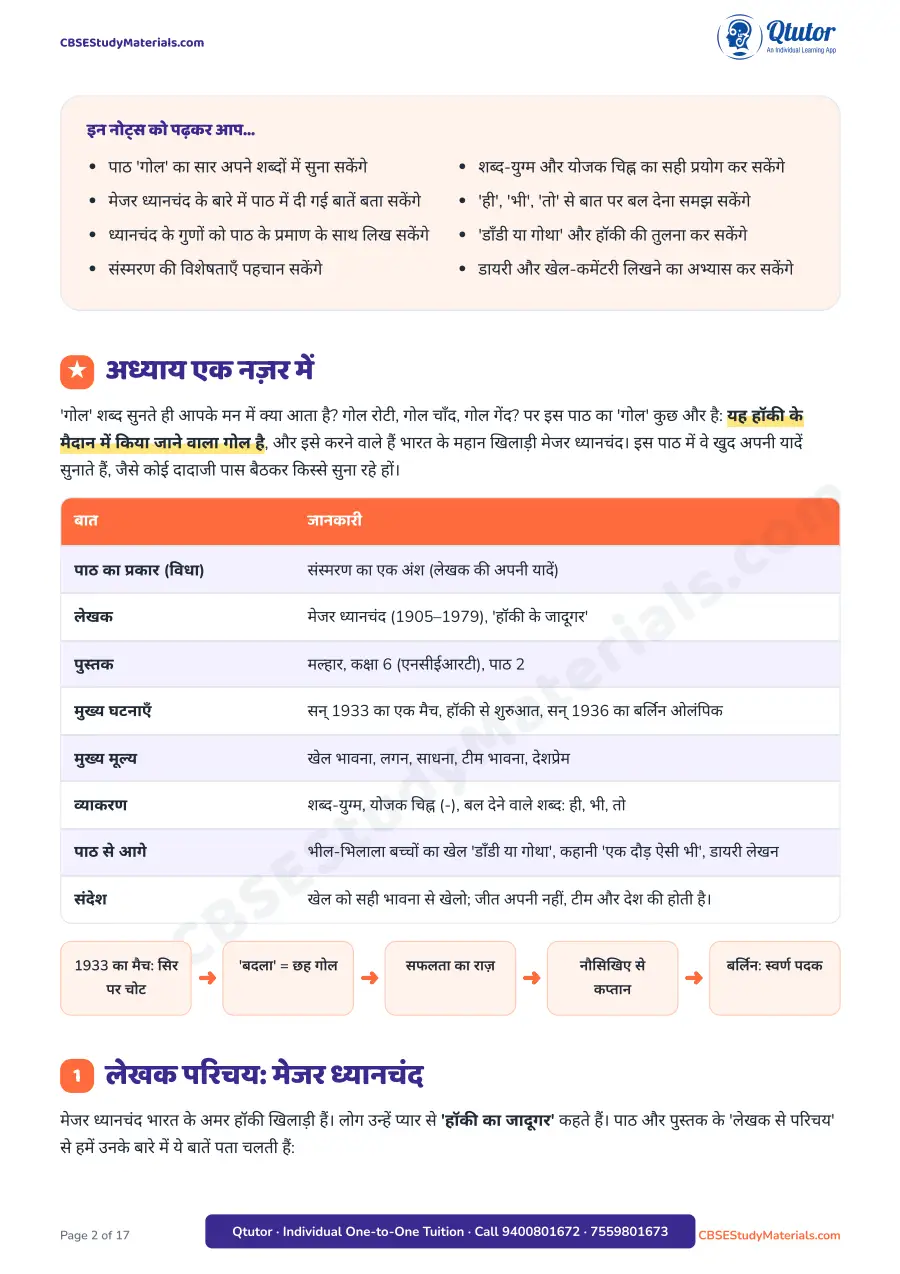
- अध्याय एक नज़र में (Chapter at a glance): a one-page table with the genre (संस्मरण), author, main events, values, grammar topics and message, plus a flow of the story
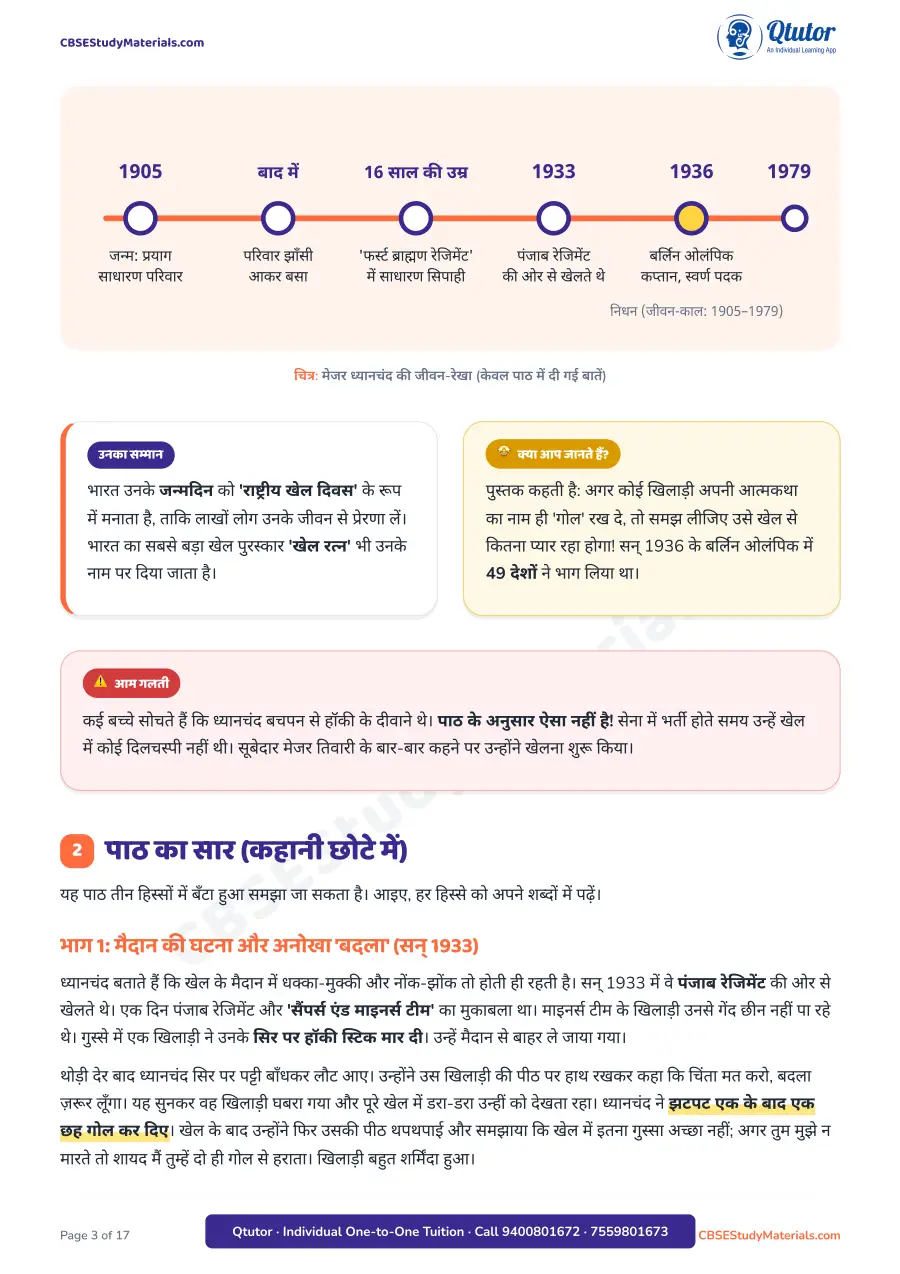
- लेखक परिचय (About the author): only what the textbook says about Major Dhyan Chand (1905–1979), shown on a drawn life-line: Prayag, Jhansi, joining the army at 16, the 1936 Berlin Olympics as captain, National Sports Day and the Khel Ratna award
- पाठ का सार (Chapter summary): the lesson in three parts: the 1933 match and the unusual "revenge", the secret of success and how he started hockey, and the Berlin Olympics with true sportsmanship
- मुख्य पंक्तियाँ (Key lines): four short lines from the lesson with simple meanings, such as "लगन, साधना और खेल भावना"
- चरित्र-चित्रण (Character sketch): eight qualities of Dhyan Chand, each with proof from the text, and notes on the Miners team player and Subedar Major Tiwari
- शब्दार्थ (Word meanings): 18 words such as संस्मरण, नोंक-झोंक, नौसिखिया, निखार, तरक्की and श्रेय, plus the solved "मिलकर करें मिलान" table (लांस नायक, सूबेदार, छावनी, बर्लिन ओलंपिक)
- संस्मरण की रचना: a memoir-vs-story comparison chart and the features of a memoir found in the lesson
- व्याकरण (Grammar): शब्द-युग्म, योजक चिह्न, writing "हार या जीत" as "हार-जीत" (all textbook pairs solved), and how ही, भी, तो add emphasis, using sentences from the lesson
- पाठ से आगे: the Bhil-Bhilala game Dandi or Gotha compared with hockey, its rules, and the reading story "एक दौड़ ऐसी भी"
- Writing practice: a model diary entry, a sample sports commentary (आँखों देखा हाल) and a newspaper task
- A mind map, a quick-revision summary, a self-check list and "अपनी समझ जाँचिए" with 12 important questions and a compact answer key
- Seven original drawn figures (including the mind map), a hockey stick cover photo and two inside photos (a hockey goal at sunset and an old ball on grass)
Structure of the PDF
| Part | What you get | Pages |
|---|---|---|
| Cover, objectives, chapter at a glance | Learning goals, summary table, story flow | 1-2 |
| Sections 1-3 | Author, three-part summary, key lines | 2-6 |
| Sections 4-6 | Character sketch, word meanings, memoir form | 6-9 |
| Section 7 | Grammar: शब्द-युग्म, योजक, ही/भी/तो | 9-11 |
| Sections 8-9 | Dandi or Gotha, "एक दौड़ ऐसी भी", diary and commentary | 11-13 |
| Section 10 | Mind map and quick recap | 14 |
| Check yourself | 12 questions and answer key | 15-17 |
Gol Class 6 Important Topics
- Who Major Dhyan Chand was and why he is called "हॉकी का जादूगर"
- The 1933 match between Punjab Regiment and the Sappers and Miners team, and his way of taking "revenge"
- The three mantras of success: लगन, साधना and खेल भावना
- How a soldier with no interest in hockey became a captain, with the encouragement of Subedar Major Tiwari
- The 1936 Berlin Olympics gold medal and passing the ball so that a teammate gets the credit
- Why "Gol" is a संस्मरण (memoir) and not a story
- शब्द-युग्म, योजक चिह्न and the emphasis words ही, भी, तो
- Dandi or Gotha vs hockey: three clear differences
Sample from This PDF
From the grammar section (बात पर बल देना):
| वाक्य | क्या फ़र्क पड़ा? |
|---|---|
| मैंने तो अपना बदला ले ही लिया है। | 'ही' से ज़ोर आया: बदला पूरी तरह ले लिया |
| मैंने तो अपना बदला ले लिया है। | सादी सूचना है; ज़ोर कम है |
From the Dandi or Gotha comparison: in Gotha there are no goal posts, the ball (दुईत) is a simple one made from a piece of bamboo, and players may hit with both sides of the stick; the team that pushes the ball into the other side most often wins.
Gol Class 6 Important Questions (Sample)
- A captain in a school match passes the ball to a better-placed teammate instead of shooting. Which idea from "Gol" does this match? (MCQ)
- Why did the Miners team player keep watching Dhyan Chand during the whole game, and what lesson does this prove? (2 marks)
- Why is "Gol" called a संस्मरण and not a कहानी? Give three proofs from the lesson. (3 marks)
- An original unseen passage about an inter-house football match, with 1 + 1 + 2 mark questions
- Explain "हार या जीत मेरी नहीं, बल्कि पूरे देश की है" and how it would change your school team. (5 marks)
All 12 questions have short, marking-style answers at the end of the PDF.
How It Helps
The notes turn a short memoir into clear parts you can revise in one sitting: what happened, why it matters, and how to write about it. Every quality of Dhyan Chand comes with proof from the text, which is exactly what school tests ask for. The grammar pages solve the textbook's word-pair exercise and show the ही/भी/तो difference with the lesson's own sentences. The questions are mostly thinking and real-life questions, not just "who said this".
Who Should Use It
- Class 6 students studying Hindi from the NCERT Malhar book who want a chapter summary, word meanings and question answers in one place
- Students revising for unit tests, half-yearly exams or class worksheets on Chapter 2
- Parents and tutors who want ready explanations and an answer key in simple Hindi
Gol (गोल) Class 6 Hindi Chapter 2 Notes: Summary, Shabdarth, Question Answers (PDF · 17 pages · ₹49)
Related Resources
- All materials for this chapter: Class 6 Hindi Chapter 2 Gol
- Short study notes for the same chapter already on the site: Class 6 Hindi Malhar Gol study material and notes
- All chapters: Class 6 Hindi study material
- Previous chapter: Matribhoomi Class 6 Hindi Chapter 1 Notes, Worksheet, Flash Cards and Model Question Paper
- Next chapter: Pahli Boond (पहली बूँद) Class 6 Hindi Chapter 3
FAQs on Class 6 Hindi Chapter 2 Gol
Where can I download Class 6 Hindi Chapter 2 Gol notes PDF? Use the download button on this page. The PDF is a premium 17-page file priced at ₹49.
What are the important topics in Gol Class 6? The 1933 match and Dhyan Chand's "revenge", the secrets of success (लगन, साधना, खेल भावना), the 1936 Berlin Olympics, the memoir form, शब्द-युग्म and योजक, and ही/भी/तो for emphasis.
Who is the author of Gol Class 6 Hindi? The lesson is part of a memoir by Major Dhyan Chand (1905–1979), known as "हॉकी का जादूगर". India celebrates his birthday as National Sports Day.
Which book is Gol Class 6 from? It is Chapter 2 of Malhar, the NCERT Hindi textbook for Class 6 used in CBSE schools in 2026-27.
Are Gol Class 6 question answers included? Yes. There are 12 practice questions (MCQ, short, source-based, long and HOTS) with an answer key, plus the textbook word-pair exercise and matching table solved inside the notes.
Are these notes in Hindi or English? The PDF is written in simple Hindi (Devanagari), the same language as the lesson.
Study tip: read the lesson once, then say the summary of each of the three parts aloud in two lines before you try the questions.