Climates of India - Class 7 Social Science Chapter 3 Question Bank (PDF · 24 pages · ₹49) Unlock the full PDF for ₹49
Free sample: pages 1 to 3 of 24. The full PDF costs ₹49.
Mumbai and Nagpur sit at almost the same latitude, so why does Nagpur swing between 44°C and 10°C while Mumbai stays between 32°C and 18°C? Working out those two ranges (34°C and 14°C) is one of the questions in this Climates of India Class 7 Social Science Chapter 3 Question Bank, written for CBSE students who use the NCERT textbook Exploring Society: India and Beyond (Part I, 2026-27).
This is a 24-page premium PDF priced at ₹49. It has 69 original important questions on the chapter, grouped by type, and every one of them is answered in a full answer key. It is an independent, NCERT based study material for CBSE 2026-27 and is not an official CBSE or NCERT publication.
Class 7 Social Science Chapter 3 Climates of India Question Bank: What Is Included
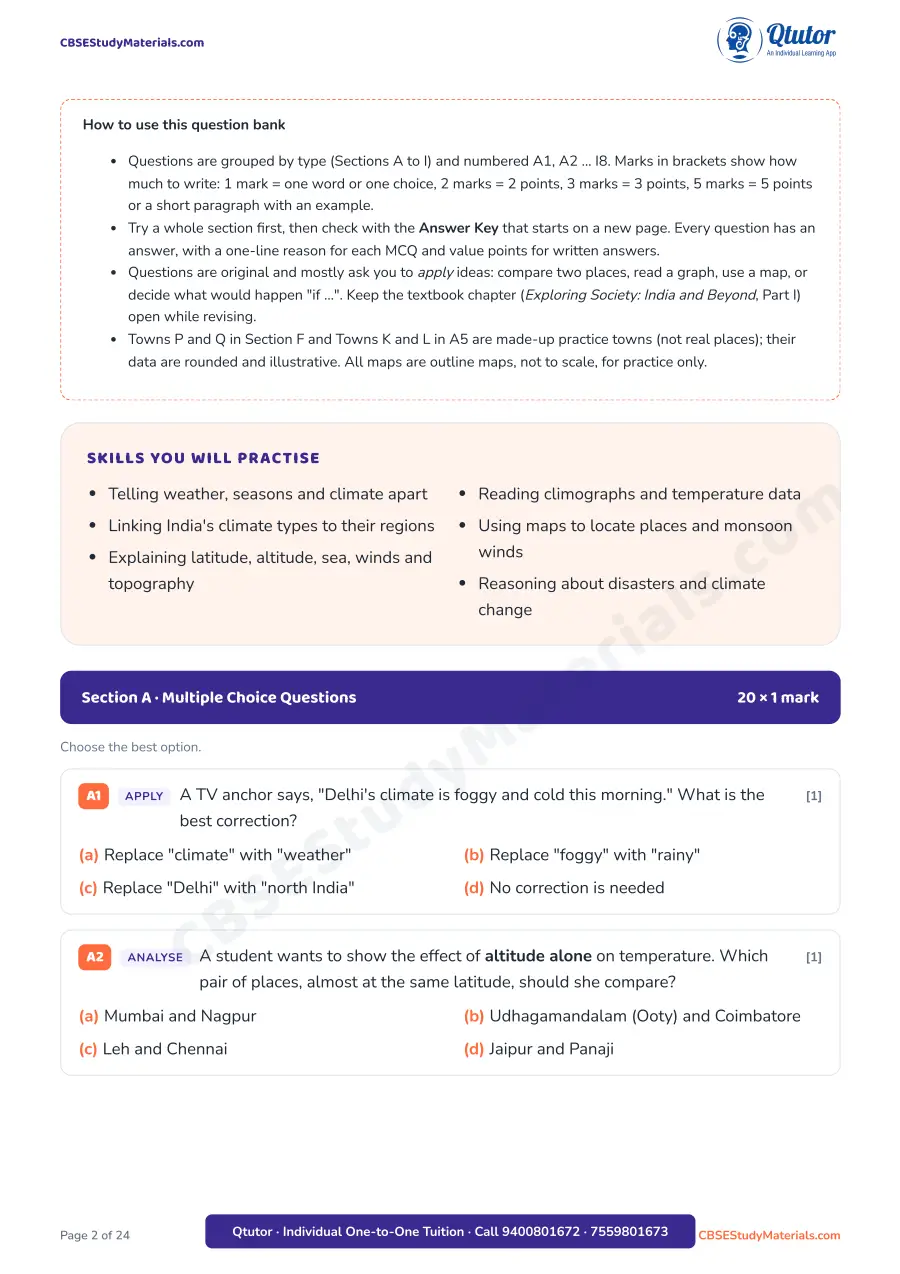
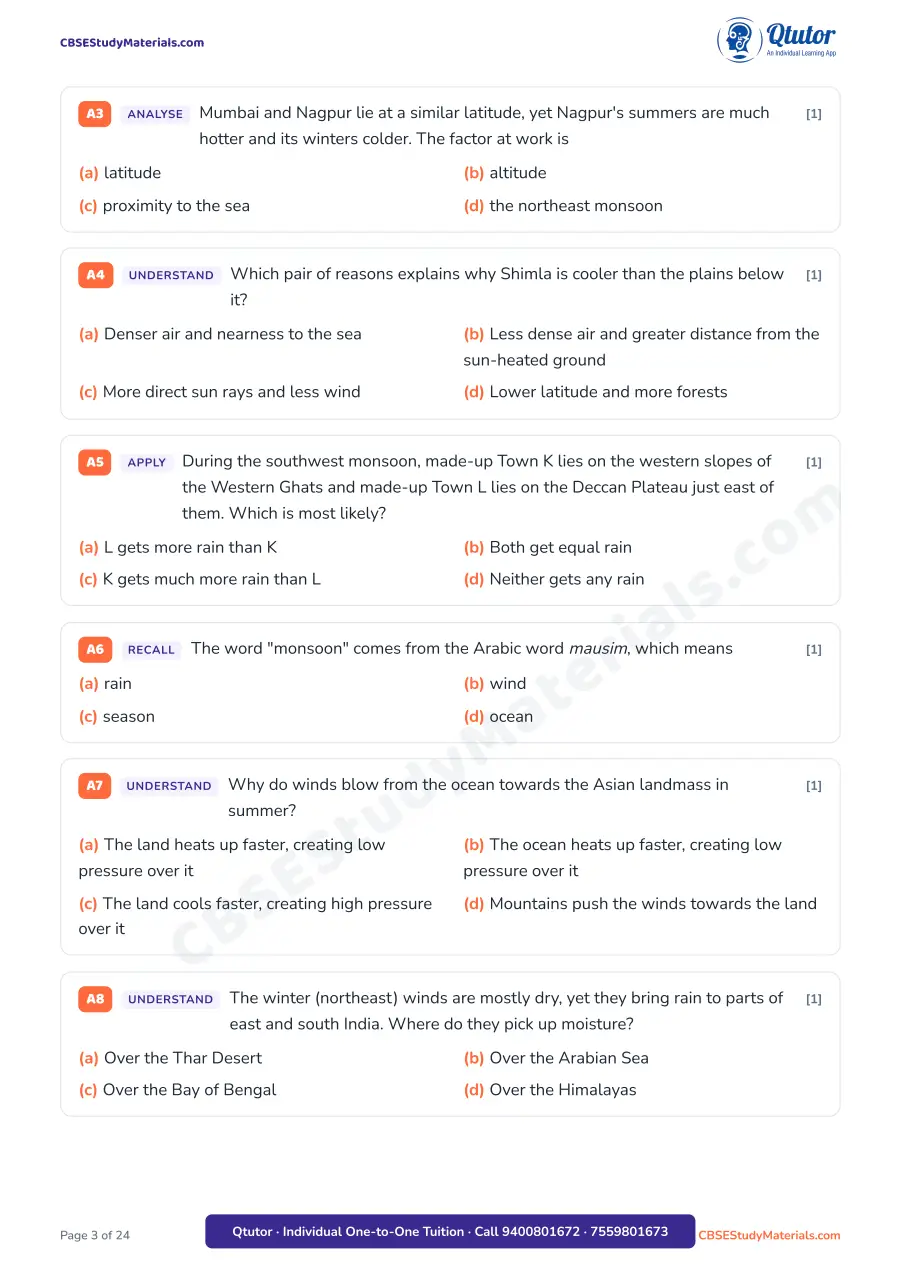
- Section A: 20 MCQs (1 mark each), mostly indirect, such as choosing the right pair of places to test the effect of altitude, or correcting a TV anchor who mixes up weather and climate.
- Section B: 8 assertion-reason questions with the standard four options, including ones where the reason is true but does not explain the assertion.
- Section C: 10 very short answer questions (2 marks): weather or climate, the six ṛitus, topography, urban heat islands, mitigation and resilience.
- Section D: 8 short answer questions (3 marks): altitude, the sea as a moderator, how the summer monsoon forms, Chennai's October-November rain, cyclones and floods.
- Section E: 5 long answer questions (5 marks): India's climate types, the five factors that determine climate, the monsoon through the year, climate and our lives, and climate change.
- Section F: 3 data, graph and diagram sets: a temperature table, side-by-side climographs of two made-up practice towns, and a land-and-sea pressure diagram.
- Section G: 2 map-skill sets on outline maps of India: eight numbered places to identify, and two wind maps to read for the summer and winter monsoons.
- Section H: 5 case-based and source-based questions on traditional monsoon signs, a cyclone warning, the 2013 Uttarakhand glacial burst, a school heat survey and a failed monsoon.
- Section I: 8 competency and HOTS questions: a holiday plan, "what if" the Western Ghats or Himalayas were missing, odd one out, a three-column match, a quick calculation, a debate and a school safety plan.
- Answer key on separate pages: a one-line reason for every MCQ and assertion-reason answer, and value points with marks for every written answer.
- A one-box quick recap before the test.
Structure of the PDF
| Part | What you get |
|---|---|
| Cover and how-to-use | How the sections and marks work, skills you will practise |
| Sections A-B | 20 MCQs and 8 assertion-reason questions |
| Sections C-E | 10 very short, 8 short and 5 long answer questions |
| Section F | Temperature table, two climographs, land-sea diagram |
| Section G | India outline map with 8 places, two monsoon wind maps |
| Sections H-I | 5 case/source sets and 8 competency questions |
| Answer key | Every question answered, with reasons and value points |
Climates of India Class 7 Important Topics
The questions cover the whole chapter as it appears in the current NCERT book:
- Weather, seasons and climate, and the six traditional ṛitus from vasanta to śhiśhir.
- The climate types of India: alpine, temperate, subtropical, arid, tropical wet, semi-arid and tropical.
- The factors that determine climate: latitude, altitude, proximity to the sea, winds and topography, plus microclimates and urban heat islands.
- The monsoons: why winds reverse between summer and winter, the southwest monsoon's advance from early June to mid-July, the Western Ghats as a barrier, and the northeast monsoon.
- Climate and our lives: festivals, farming and what a "monsoon failure" does to the economy.
- Climate-related disasters: cyclones, floods, glacial bursts, landslides and forest fires, and the roles of the IMD and NDRF.
- Climate change: the greenhouse effect, warming in India, mitigation and resilience.
Climates of India Class 7 Important Questions (Sample)
Sample 1, MCQ A5: During the southwest monsoon, made-up Town K is on the western slopes of the Western Ghats and Town L is on the Deccan Plateau just east of them. Which is most likely? Answer: K gets much more rain than L, because the Ghats act as a barrier to the moist winds.
Sample 2, Climograph F2: Two made-up practice towns have these yearly rainfall patterns:
| Town | Total rain | Main rainy months | Share in those months |
|---|---|---|---|
| P | 2,250 mm | June-September | 2,150 ÷ 2,250 × 100 = 95.6% |
| Q | 1,260 mm | October-December | 770 ÷ 1,260 × 100 = 61.1% |
Students decide that P behaves like a west-coast town such as Mumbai and Q like a southeast-coast town such as Chennai, which gets northeast monsoon rain.
Sample 3, Assertion-reason B5: A: Hill stations are cooler than the plains at the same latitude. R: The air becomes denser as we go higher. Answer: (c). The assertion is true, but the reason is false, because air becomes less dense with height.
How This Question Bank Helps
- Mixed question types mean you are ready for whatever your school test asks, from one-mark MCQs to five-mark answers.
- Most questions ask you to apply ideas to new places and situations instead of repeating lines, which builds real understanding.
- The climographs and maps train the data and map skills that Geography chapters need.
- The marks-wise answer key shows how much to write and which points earn marks.
Who Should Use It
- Class 7 CBSE students revising Social Science (Geography) Chapter 3 before a unit test or term exam.
- Parents and tutors who want ready practice with checked answers.
- Teachers looking for extra classwork or homework questions on the chapter.
How to Download the Class 7 Climates of India Question Bank PDF
Use the button below. This is a premium PDF priced at ₹49, and you can keep it on your phone or print it for revision.
Climates of India - Class 7 Social Science Chapter 3 Question Bank (PDF · 24 pages · ₹49)
Related Resources
- Chapter page: Climates of India
- Class 7 Social Science Chapter 3 Notes: revision notes, chapter summary, maps and mind map for the same chapter
- Class 7 Social Science Chapter 3 NCERT Solutions: answers to every in-text and end-of-chapter question
- All Class 7 Social Science study material
- Previous chapter: Understanding the Weather
- Next chapter: New Beginnings: Cities and States
FAQs on Class 7 Social Science Chapter 3 Climates of India
Where can I download Class 7 Social Science Chapter 3 Climates of India important questions PDF? On this page. Use the download button to get the 24-page premium question bank PDF for ₹49.
How many questions are there in this Climates of India question bank? There are 69 questions in nine sections: MCQs, assertion-reason, very short, short and long answers, data and climograph sets, map skills, case-based and competency questions.
Are answers given for all questions? Yes. The answer key on separate pages answers every question, with a reason for each MCQ and value points for written answers.
Which book is Climates of India Class 7 from? It is Chapter 3 of the NCERT textbook Exploring Society: India and Beyond, Grade 7 Part I, used in CBSE schools for 2026-27.
Does the PDF have map-based questions on India? Yes. Section G uses outline maps of India showing the complete boundary, with eight numbered places to identify and two wind maps for the summer and winter monsoons. The maps are not to scale and are meant for practice.
Is this question bank published by NCERT? No. It is an independent study resource written from the current NCERT textbook, with original questions. It is not published by CBSE or NCERT.
Study tip: attempt a full section with the answer key closed, then mark yourself and redo only the questions you got wrong.