The Rise of Nationalism in Europe - Class 10 History Chapter 1 Flash Cards (PDF · 12 pages · Free download) Download the full PDF free

You are looking at pages 1 to 3 of 12. The full PDF is free to download.
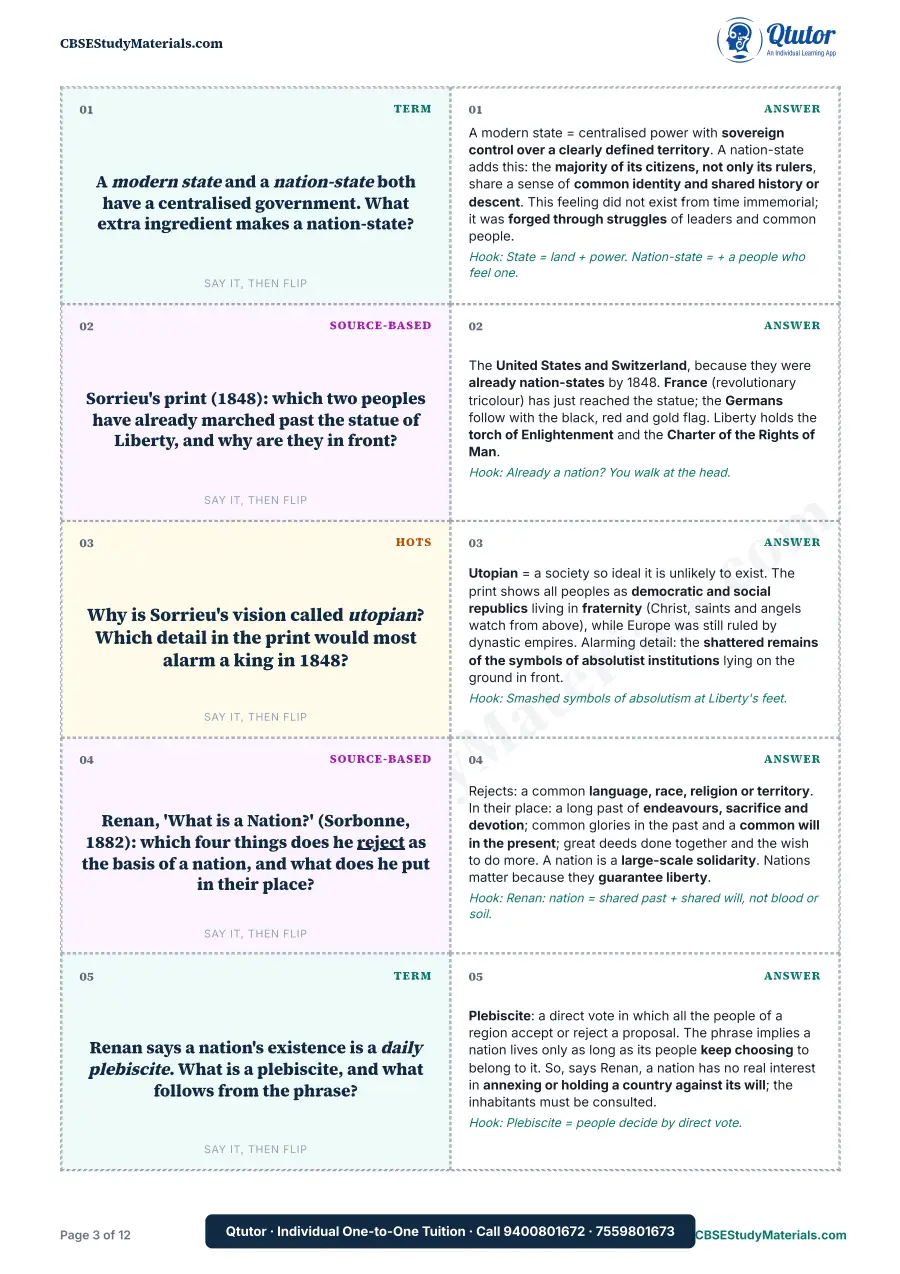
In Frédéric Sorrieu's print of 1848, the United States and Switzerland have already marched past the statue of Liberty, while the Germans behind them carry the flag of a nation that did not yet exist. Questions like "why are they in front?" are exactly what this PDF trains you to answer. These are flash cards for The Rise of Nationalism in Europe, Class 10 Social Science (History) Chapter 1, written for CBSE students from the NCERT textbook India and the Contemporary World II.
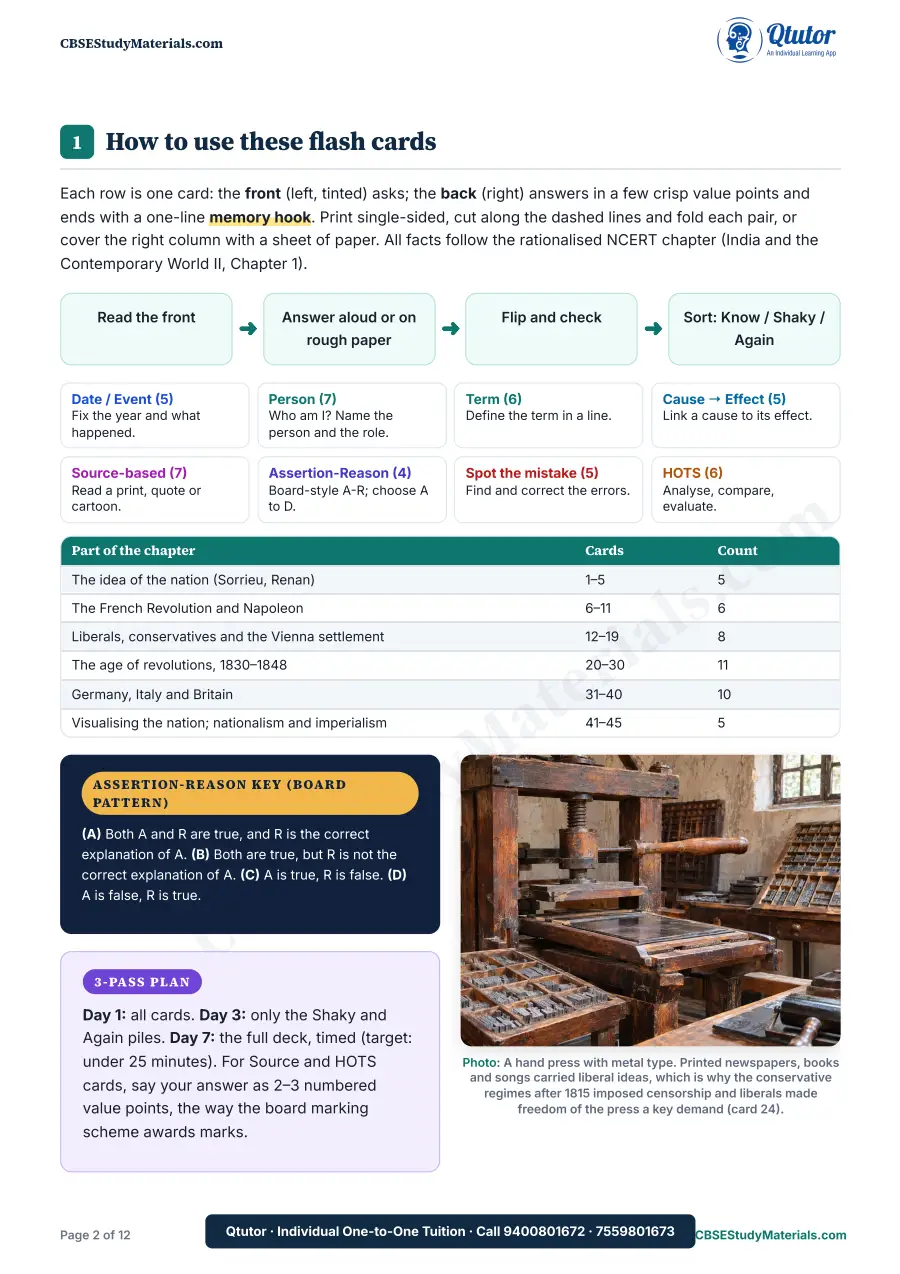
The PDF is a free, 12-page set of 45 printable revision cards for CBSE 2026-27. Each card has a question on the front and a crisp, value-point answer with a one-line memory hook on the back. It is NCERT based study material prepared independently by CBSEStudyMaterials.com; it is not an official CBSE or NCERT publication.
Class 10 History Chapter 1 Flash Cards: What Is Included
- 45 flash cards in eight types: Date / Event (5), Person (7), Term (6), Cause → Effect (5), Source-based (7), Assertion-Reason (4), Spot the mistake (5) and HOTS (6)
- A how-to-use page with a colour legend, a coverage table that maps each card to its part of the chapter, and the board-pattern Assertion-Reason key (A to D)
- A 3-pass revision plan (Day 1, Day 3, Day 7)
- A one-page timeline from 1789 to 1914 and a "tick when solid" self-check list
- Two realistic photos and an illustrated cover; cards are laid out five to a page so you can print, cut and fold them
Structure of the PDF
| Part | What you get | Cards |
|---|---|---|
| The idea of the nation | Nation-state vs modern state, Sorrieu's print, Renan's "What is a Nation?" | 1–5 |
| French Revolution and Napoleon | 1789, la patrie and le citoyen, Jacobin clubs, Napoleon's reforms, the Zweibrücken print | 6–11 |
| Liberals, conservatives, Vienna 1815 | Aristocracy, liberalism, suffrage, customs barriers, conservatism, Vienna settlement, Mazzini | 12–19 |
| Age of revolutions, 1830–1848 | July 1830, Greece, Delacroix, Herder, the Grimms, Poland, Paris 1848, Frankfurt parliament, women | 20–30 |
| Germany, Italy and Britain | Bismarck, Cavour, Garibaldi, Italy's dates, the boot cartoon, Acts of Union | 31–40 |
| Visualising the nation; imperialism | Allegory, Marianne and Germania, Veit's broken chains, the Balkans, 1914 | 41–45 |
Rise of Nationalism in Europe Class 10 Important Topics Covered
The cards follow the order of the rationalised NCERT chapter, so you can revise it as a chapter summary in card form:
- How the French Revolution of 1789 moved sovereignty from the king to the citizens, and the steps that built a collective French identity
- Napoleon's reforms in conquered lands and why French rule soon turned unpopular
- The landed aristocracy, the new middle class and what liberal nationalism stood for, including the limits of suffrage
- Economic nationalism: customs barriers in the German states and the push for a unified market
- Conservatism after 1815 and what the Congress of Vienna gave to whom
- Mazzini, Young Italy and Young Europe
- The July Revolution of 1830, the Greek war of independence and the Treaty of Constantinople (1832)
- Romanticism, Herder's volksgeist, the Grimm brothers, music and language in Poland
- The revolutions of 1848 in Paris and Frankfurt, and the question of women's rights
- German unification under Bismarck and Italian unification through Cavour, Garibaldi and Victor Emmanuel II
- The "strange case" of Britain: the Acts of Union of 1707 and 1801
- Allegories of the nation (Marianne, Germania) and the Balkan crisis that led to 1914
Rise of Nationalism in Europe Class 10 Important Questions (Sample)
Every card is a short important question with its answer. Three examples from the PDF:
Spot the mistake (card 29): "On 18 May 1848, 831 deputies met in the Hall of Mirrors at Versailles and offered William I the crown of a German republic." Answer: they met in the Church of St Paul, Frankfurt; the crown of a monarchy subject to a parliament was offered to Friedrich Wilhelm IV of Prussia, who rejected it. Versailles and William I belong to 1871.
HOTS (card 15): A merchant from Hamburg to Nuremberg in 1833 crossed 11 customs barriers, paying about 5% at each. Assuming each barrier charges 5% of the goods' original value, the duties add up to 11 × 5% = 55%, more than half the value. That is why the commercial classes wanted a unified economic territory.
Assertion-Reason (card 39):
| Statement | |
|---|---|
| A | The British nation-state was the result of a sudden revolution. |
| R | The English parliament seized power from the monarchy in 1688. |
| Key | (D) A is false, R is true: Britain's nation-state came from a long-drawn-out process. |
How These Flash Cards Help
- Fast recall before tests: dates, people and terms come back in seconds when you see the front of a card.
- Board-style thinking: Source-based, Assertion-Reason and HOTS cards practise the competency-based questions that make up a large share of the Class 10 Social Science paper.
- Fewer careless errors: "Spot the mistake" cards target the mix-ups students make most, such as Vienna 1815 vs Versailles 1871, or 1707 vs 1801.
- Memory hooks: each answer ends with a one-line hook, like "Ban a language and it becomes a flag."
Who Should Use It
Class 10 students revising History Chapter 1 before unit tests, half-yearly exams or the board exam; students who have finished the chapter notes and want quick revision notes in card form; and teachers or parents who want a ready set of oral quiz questions.
How to Download the Class 10 Rise of Nationalism in Europe Flash Cards PDF
The PDF download is free. Use the button below, then print single-sided, cut along the dashed lines and fold each card.
The Rise of Nationalism in Europe - Class 10 History Chapter 1 Flash Cards (PDF · 12 pages · Free download)
Related Resources
- Chapter page: The Rise of Nationalism in Europe, Class 10
- Practise next: Rise of Nationalism in Europe Class 10 Chapter 1 Worksheet (board-pattern questions with a full marking scheme; these cards do not repeat its questions)
- Read first: The Rise of Nationalism in Europe Class 10 History Chapter 1 Notes
- More revision: Rise of Nationalism in Europe Revision Notes and Model Question Paper 2026-27
- All subjects and chapters: Class 10 Social Science
- Next chapter: Nationalism in India, Class 10
FAQs on Class 10 History Chapter 1 The Rise of Nationalism in Europe
Where can I download Class 10 History Chapter 1 The Rise of Nationalism in Europe flash cards PDF? On this page. The download button above gives you the full 12-page PDF with all 45 cards.
Is The Rise of Nationalism in Europe flash cards PDF free? Yes. This Chapter 1 set is free to download.
What are the important topics in The Rise of Nationalism in Europe Class 10? The French Revolution and Napoleon, liberalism and conservatism after 1815, the revolutions of 1830 and 1848, the unification of Germany and Italy, the case of Britain, national allegories like Marianne and Germania, and the Balkan problem. The cards cover each of these.
Which book is The Rise of Nationalism in Europe from? It is Chapter 1 of the NCERT Class 10 History textbook, India and the Contemporary World II, part of CBSE Class 10 Social Science.
Do the flash cards include Assertion-Reason and source-based questions? Yes. There are 4 Assertion-Reason cards with the board answer key, 7 source-based cards on prints, paintings, cartoons and quotes from the chapter, 6 HOTS cards and 5 spot-the-mistake cards.
Are the answers based on the NCERT textbook? Yes. Every fact and date comes from the rationalised NCERT chapter, written in our own words.
Study tip: sort the cards into Know, Shaky and Again piles, and go through only the Shaky and Again piles two days later.