The Invisible Living World: Beyond Our Naked Eye - Class 8 Science Chapter 2 NCERT Solutions (PDF · 18 pages · ₹49) Unlock the full PDF for ₹49
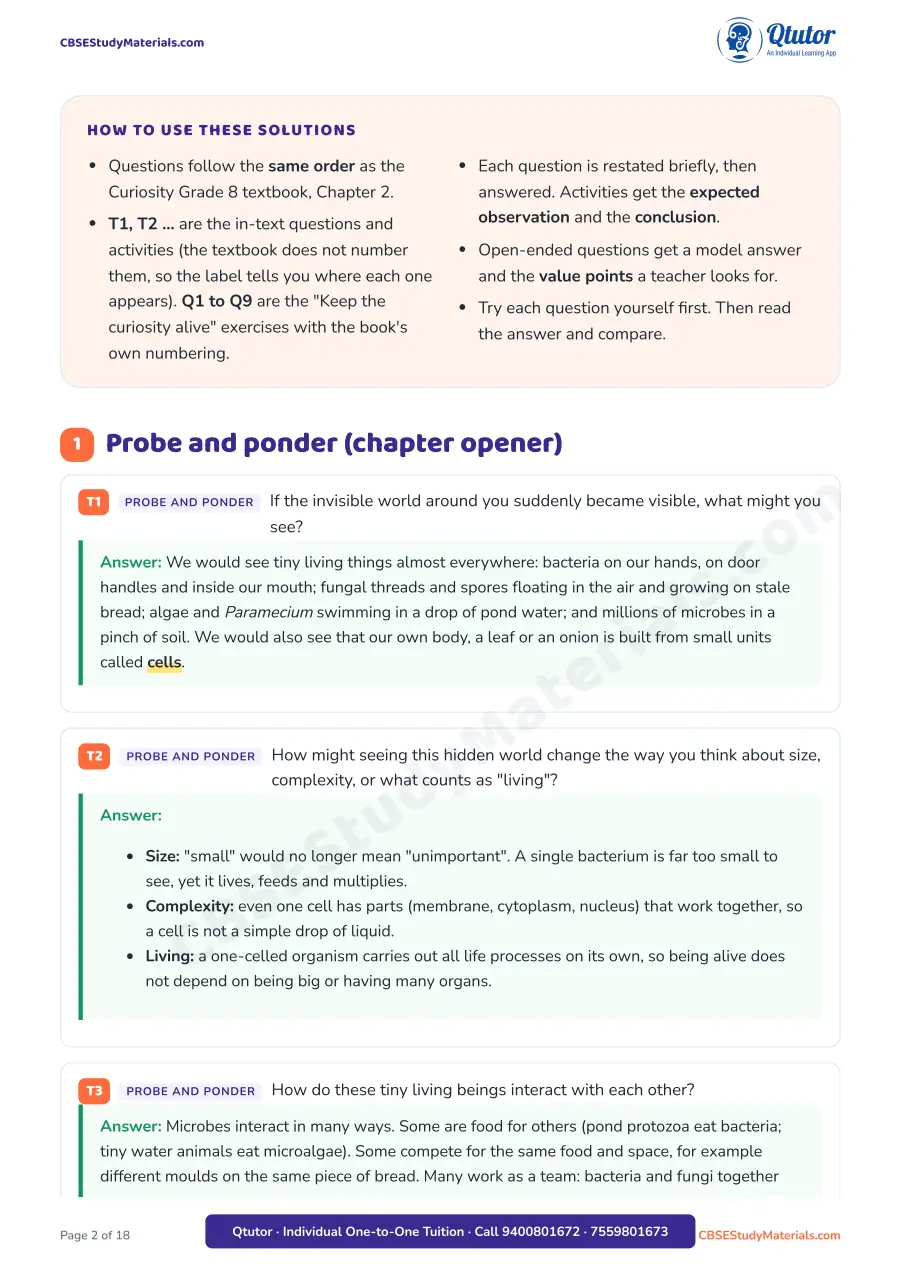
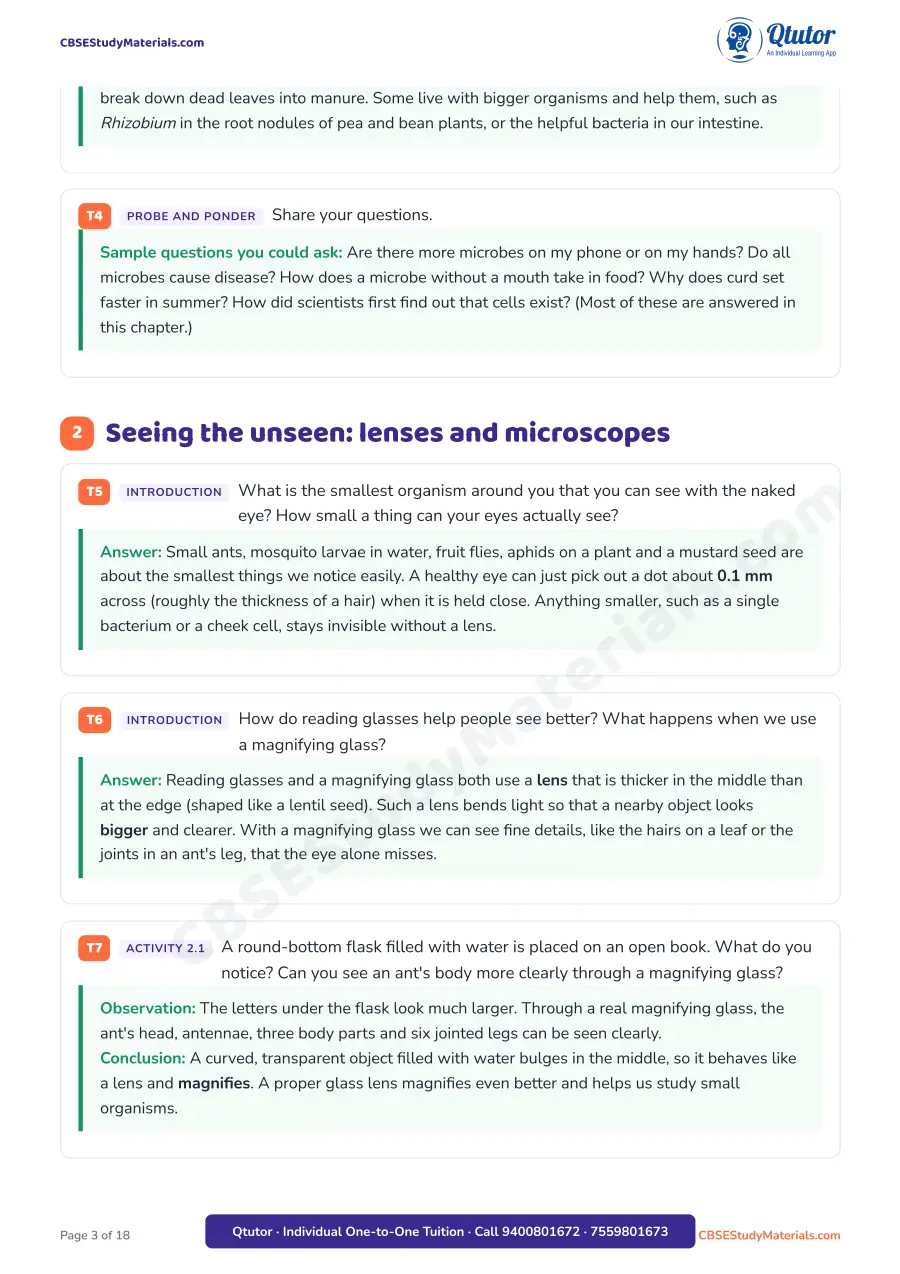
Free sample: pages 1 to 3 of 18. The full PDF costs ₹49.
Why does atta dough with yeast puff up while plain dough stays flat, and why does a balloon on a tube of sugar solution swell only when yeast is added? These NCERT Solutions for The Invisible Living World: Beyond Our Naked Eye, Class 8 Science Chapter 2 (CBSE, NCERT Curiosity textbook 2026-27), answer exactly these questions, along with every other question in the chapter. This premium 18-page PDF costs ₹49. It is NCERT based study material prepared by our team and is not an official CBSE or NCERT publication.
The solutions follow the textbook page by page. Each question is restated briefly and then answered in simple, friendly language that a Class 8 student can revise from and copy into a notebook in their own words.
Class 8 Science Chapter 2 The Invisible Living World NCERT Solutions: What Is Included
- Answers to the Probe and ponder questions that open the chapter, with sample questions you can frame yourself.
- Solutions to all nine activities: Activity 2.1 (water-filled flask as a magnifier), 2.2 (onion peel cells), 2.3 (cheek cells), 2.4 (pond water), 2.5 (soil suspension), 2.6 (recording microbes in a table), 2.7 (peels turning into manure), 2.8 (dough with and without yeast) and 2.9 (curd in warm and cold milk). Each gives the expected observation and the conclusion.
- Answers to all in-text questions, 32 in total, labelled T1 to T32 in textbook order, such as "Why do microorganisms not infect pickles and murabbas?" and "What would have happened if microorganisms did not exist on Earth?"
- A completed Table 2.4 (curd formation prediction and observation) and a model record for Activity 2.6.
- Complete answers to all 9 end-of-chapter questions in Keep the curiosity alive, with every sub-part answered.
- A drawn and labelled Venn diagram for Question 1 (animal, plant and bacterial cell parts).
- Guidance for the Prepare some questions box and for all four Discover, design, and debate projects (biogas programme, fermented foods, mushroom structure, mushroom cultivation).
- Five original diagrams and a one-box exam recap at the end.
Structure of the PDF
| Part | What you get |
|---|---|
| Probe and ponder | T1 to T4: the chapter-opening questions |
| Lenses and microscopes | T5 to T8, including Activity 2.1 and Hooke and Leeuwenhoek |
| What is a cell? (2.1, 2.1.1) | T9 to T16: onion and cheek cell activities, cell parts, shape and function |
| Microorganisms (2.3) | T17 to T20: pond water, soil suspension, Tables 2.1 and 2.2 |
| How are we connected to microbes? (2.4) | T21 to T32: decomposition, manure, yeast, curd |
| Keep the curiosity alive | Q1 to Q9 with all sub-parts |
| Questions and projects | E1 and P1 to P4 |
| Recap | Remember for the exam |
The Invisible Living World Class 8 Important Topics
The solutions cover every topic of the 2026-27 chapter: how a lens magnifies; Robert Hooke's Micrographia (1665) and the first use of the word "cell"; Leeuwenhoek as the Father of Microbiology; the basic parts of a cell (cell membrane, cytoplasm, nucleus) and the cell wall of plant cells; plastids and vacuoles; how cell shape suits function (cheek, muscle and nerve cells); levels of organisation from cell to organism; unicellular and multicellular microorganisms; protozoa, algae, fungi and bacteria; viruses as acellular; decomposition and manure; biogas; Rhizobium in root nodules; yeast and Lactobacillus in fermentation; microalgae such as Spirulina; and why bacteria have a nucleoid instead of a well-defined nucleus.
The Invisible Living World Class 8 Question Answers (Sample)
Q1. Placing cell parts in the Venn diagram. The PDF gives a scientifically careful answer rather than forcing every part into a single circle:
| Region | Cell part |
|---|---|
| Common to animal, plant and bacterial cells | Cell membrane, cytoplasm |
| Only plant cell | Chloroplast |
| Only bacterial cell | Nucleoid |
| Animal and plant cells (not bacteria) | Nucleus |
| Plant and bacterial cells (not animal) | Cell wall |
Q2 (i). Aanandi's balloon experiment. The balloon on test tube B swells because yeast respires using the sugar and releases carbon dioxide, so option (c) is correct. The PDF also explains why options (a), (b) and (d) are wrong: test tube A had the same sugar and warmth, but its balloon did not inflate.
Activity 2.9 (Table 2.4). In the warm bowl, Lactobacillus feeds on lactose and produces lactic acid, so the milk sets into sour curd. In the cold bowl the bacteria are almost inactive, so the milk stays liquid.
How These NCERT Solutions Help
- You can check your own answers to every in-text question and exercise, in the same order as the book.
- Activities are explained with an observation and a conclusion, so you know what you should have seen and why.
- Open questions, like designing an experiment (Q6) or imagining a world without microbes, get a model answer plus value points, which helps you write complete answers in tests.
- Diagrams such as the onion and cheek cell comparison and the decomposition cycle make the ideas easy to picture and draw.
Who Should Use It
Class 8 students studying the NCERT Curiosity Science book in CBSE 2026-27 schools, parents who help with homework, and teachers who want a ready reference for the chapter's activities. It works well after reading the chapter once, as homework support and for revision before a unit test.
How to Download the Class 8 Science Chapter 2 NCERT Solutions PDF
This is a premium PDF priced at ₹49. Use the download button below; the 18-page PDF opens on a phone, tablet or computer and can be printed.
The Invisible Living World: Beyond Our Naked Eye - Class 8 Science Chapter 2 NCERT Solutions (PDF · 18 pages · ₹49)
Related Resources
- The Invisible Living World Class 8 Notes: chapter notes and revision notes with diagrams and a one-page summary.
- The Invisible Living World Class 8 Question Bank: important questions with answers for practice.
- Class 8 Science Chapter 2 The Invisible Living World: Beyond Our Naked Eye: the chapter page.
- Class 8 Science study material: all chapters.
- Previous chapter: Exploring the Investigative World of Science
- Next chapter: Health: The Ultimate Treasure
FAQs on Class 8 Science Chapter 2 The Invisible Living World NCERT Solutions
Where can I download Class 8 Science Chapter 2 NCERT Solutions PDF? You can download it from this page. It is a premium 18-page PDF priced at ₹49.
Does this PDF answer all the questions of The Invisible Living World Class 8? Yes. It answers all 32 in-text questions and activities and all 9 end-of-chapter questions with their sub-parts, and gives guidance for the four projects.
Which book is The Invisible Living World: Beyond Our Naked Eye from? It is Chapter 2 of Curiosity, the NCERT Science textbook for Grade 8 (2026-27 edition).
What are the important topics in The Invisible Living World Class 8? Cell structure, plant and animal cells, cell shape and function, levels of organisation, types of microorganisms, decomposition, fermentation by yeast and Lactobacillus, and nitrogen fixation by Rhizobium.
Is the answer to the Venn diagram question (Q1) included? Yes. A completed, labelled diagram is drawn in the PDF along with an explanation for each part.
Is this an official NCERT solutions book? No. It is NCERT based study material written by our team to help students; it is not published by CBSE or NCERT.
Tip: do Activities 2.8 and 2.9 at home with an adult, then compare what you saw with the answers here.