Diversity in the Living World - Class 6 Science Chapter 2 Worksheet (PDF · 14 pages · ₹49) Unlock the full PDF for ₹49
Free sample: pages 1 to 3 of 14. The full PDF costs ₹49.
How many of the animals in a school garden use wings, and what happens to the bar graph if the pond is covered for a parking spot? Questions like this open the Diversity in the Living World Class 6 Science Chapter 2 worksheet, made for CBSE students using the NCERT Curiosity textbook (2026-27). It is a premium 14-page PDF for ₹49 with 25 questions for 50 marks, puzzles and a full answer key, and it is not an official CBSE or NCERT publication.
This worksheet gives students fresh practice after they have read the chapter. The situations are new: a butterfly count in a school garden, seeds soaked in a home kitchen, a peepal leaf held up to the sunlight, a tortoise in a village courtyard, carrots and spring onions at a vegetable market and a nursery owner who wants to sell one plant to all of India. The questions are different from those in our Notes, NCERT Solutions and Question Bank for this chapter, so the worksheet works well as a final test.
Class 6 Science Chapter 2 Diversity in the Living World Worksheet: What Is Included
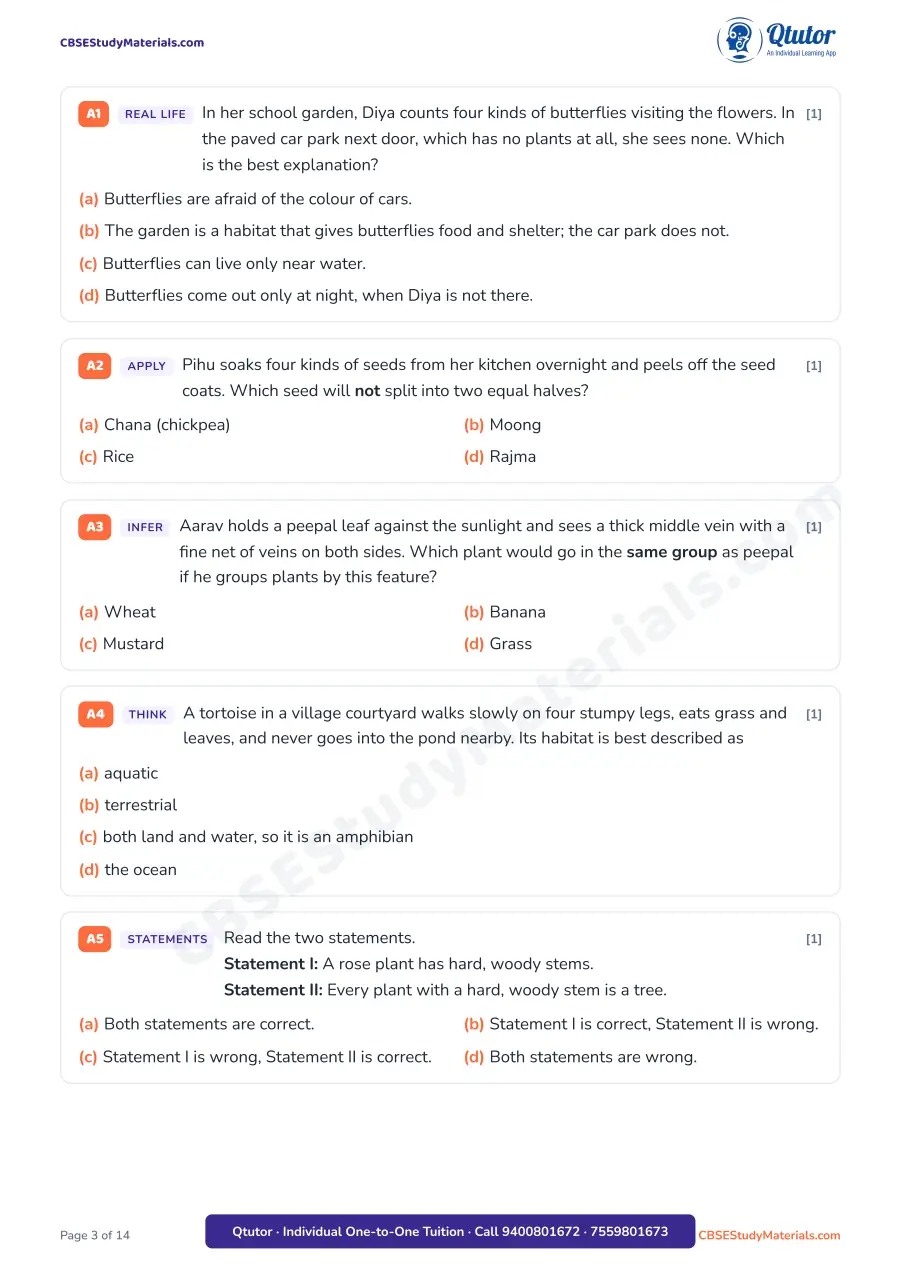
- Section A (12 marks): 12 MCQs with a "how to answer" box for the two correct-the-claim items. They cover habitats, monocot and dicot seeds, leaf venation, herbs, shrubs, trees and climbers, movement in animals, a statement I and II question, a place-to-adaptation match, why camels manage without water and why the Great Indian Bustard has declined.
- Section B (10 marks): five 2-mark short answers. They include predicting the root and seed type from a peepal leaf photo, correcting a nature scrapbook label, a butterfly versus pigeon comparison (with an OR choice), a library-style grouping question and a carrot and spring onion question.
- Section C (8 marks): two 4-mark sets with sub-parts of 1 + 1 + 2 and an OR on the 2-mark part. One is a bar graph of animals counted in a school garden, and one is a source passage, written in our own words, on the Save Silent Valley movement and botanist Janaki Ammal.
- Section D (14 marks): a "Who am I?" plant riddle, an evaluate question on why one plant cannot suit every region, a two-step sorting tree diagram to fill in, and a 5-mark HOTS question on a family garden with a pond.
- Section E (6 marks): a science crossword built from chapter key words and a match-the-clue table, plus an unmarked leaf-rubbing activity to try at home.
- Answer space with ruled lines after every written question.
- A score tracker and a "tick what you can now do" checklist.
- A complete answer key on separate pages: one-line reasons for every MCQ, value points with the mark split for each written answer, and the solved crossword.
Structure of the Diversity in the Living World Worksheet PDF
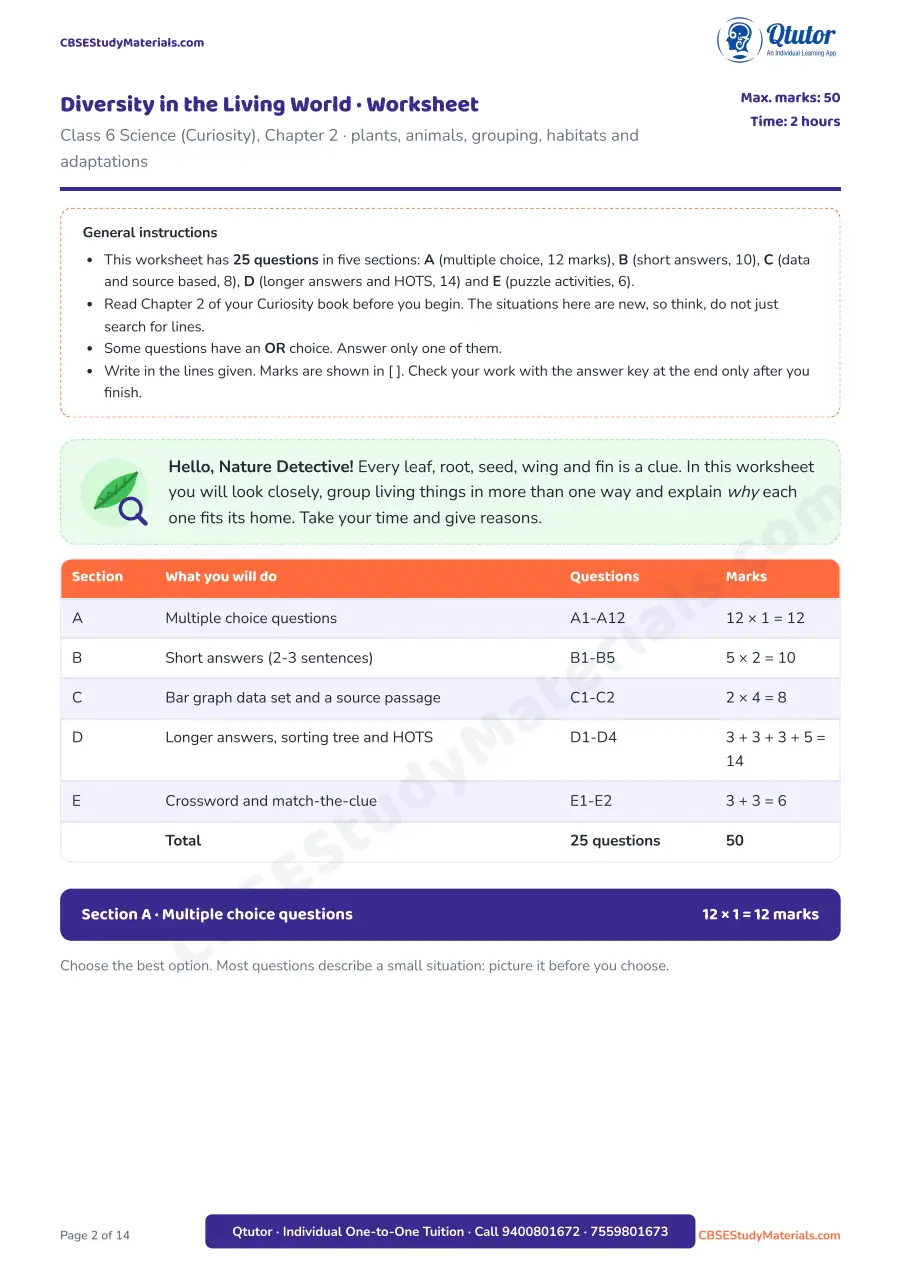
| Section | Question type | Marks |
|---|---|---|
| A | Multiple choice questions (A1-A12) | 12 × 1 = 12 |
| B | Short answer (B1-B5) | 5 × 2 = 10 |
| C | Data based and source based (C1-C2) | 2 × 4 = 8 |
| D | Longer answers, sorting tree and HOTS (D1-D4) | 3 + 3 + 3 + 5 = 14 |
| E | Crossword and match-the-clue (E1-E2) | 3 + 3 = 6 |
| Total: 25 questions, about 2 hours | 50 |
Diversity in the Living World Class 6 Important Topics Covered
- Biodiversity, and how plants and animals depend on each other
- Why we group living things, and how different bases give different groups
- Herbs, shrubs and trees by height, stem and branching; climbers and creepers
- Leaf venation (reticulate and parallel), taproot and fibrous roots
- Seeds with one or two cotyledons: monocots and dicots, and how all three features usually go together
- Movement in animals and the body parts used (legs, wings, fins)
- Habitats: terrestrial, aquatic and amphibians
- Adaptations: cactus, deodar, rhododendron, camels and fish
- Loss of habitat and loss of biodiversity, the Save Silent Valley movement and Janaki Ammal
Diversity in the Living World Class 6 Important Questions (Sample)
From Section A (A11, MCQ): Rohan says, "A camel can go for many days without drinking water because its hump is a water tank." Which statement best corrects him? Answer: (b). The hump stores food, not water; a camel survives because it loses very little water: little urine, dry dung and no sweating.
From Section C (C1, bar graph): The eco-club counted butterflies 12, pigeons 7, squirrels 4, tortoises 2, fish 9 and frogs 3. How many of these animals used wings to move? Answer: 12 + 7 = 19.
From Section D (D1, plant riddle): "I am about as tall as your teacher. Many hard, brown stems rise from close to the ground. My leaves have a net of veins, and my seeds split into two when soaked." Answer: a shrub with a taproot, for example a rose.
| Clue in the worksheet | What students work out |
|---|---|
| Peepal leaf with a net of veins | Taproot, two cotyledons (dicot) |
| Spring onion with a tuft of thin roots | Fibrous roots, so parallel venation |
| Rice grain that does not split | Monocot, one cotyledon |
How This Worksheet Helps
The worksheet checks whether a student can use the chapter's ideas, not just repeat them. Most questions ask students to predict, compare, sort, read a graph or explain a choice, and only a few test plain recall. The sorting tree and crossword make revision feel like a game for Class 6 learners, while the marked answer key shows what a complete answer looks like and where each mark comes from. Parents and teachers can use the score tracker to see which section needs another look.
Who Should Use It
- Class 6 students revising Chapter 2 of NCERT Curiosity before a unit test or term exam
- Students who have finished the notes and textbook exercises and want new practice
- Teachers looking for a ready 50-mark, two-hour class test or homework sheet
- Parents who want a printable worksheet with answers to check work at home
Diversity in the Living World - Class 6 Science Chapter 2 Worksheet (PDF · 14 pages · ₹49)
How to Download the Class 6 Diversity in the Living World Worksheet PDF
Use the download button above. The worksheet is a premium PDF priced at ₹49. It prints well on A4 paper, and the answer key starts on a new page, so you can print the questions separately.
Related Resources
- Diversity in the Living World chapter page
- Class 6 Science notes for Diversity in the Living World
- Class 6 Science Chapter 2 NCERT Solutions
- Diversity in the Living World question bank
- All Class 6 Science chapters
- Previous chapter: The Wonderful World of Science
- Next chapter: Mindful Eating: A Path to a Healthy Body
FAQs on Class 6 Science Chapter 2 Diversity in the Living World Worksheet
Where can I download the Class 6 Science Chapter 2 Diversity in the Living World worksheet PDF? You can download it from this page using the download button. It is a 14-page PDF with an answer key.
What is the price of the Diversity in the Living World Class 6 worksheet? It is a premium worksheet priced at ₹49. The price includes all 25 questions and the full answer key with value points.
What are the important topics in Diversity in the Living World Class 6? Grouping plants as herbs, shrubs and trees, leaf venation, root types, monocots and dicots, movement in animals, habitats and adaptations, and the loss and protection of biodiversity.
Does the worksheet have answers? Yes. Every question has an answer: MCQs have one-line reasons, and the written answers have value points with marks.
Are the questions the same as in the NCERT textbook exercises? No. All questions are new and use different situations. For the textbook's own questions, use our NCERT Solutions PDF for this chapter.
Which book is Diversity in the Living World Class 6 from? It is Chapter 2 of Curiosity, the NCERT Science textbook for Grade 6 (2026-27 reprint) used in CBSE schools.
Study tip: after the worksheet, cover the answer key and explain the dicot and monocot chain (seed, root, leaf) aloud in one breath. If you can, you are ready for the test.