Maa Kah Ek Kahani Class 7 Hindi Ch 1 Model Question Paper with Answers (PDF · 13 pages · Free download) Download the full PDF free
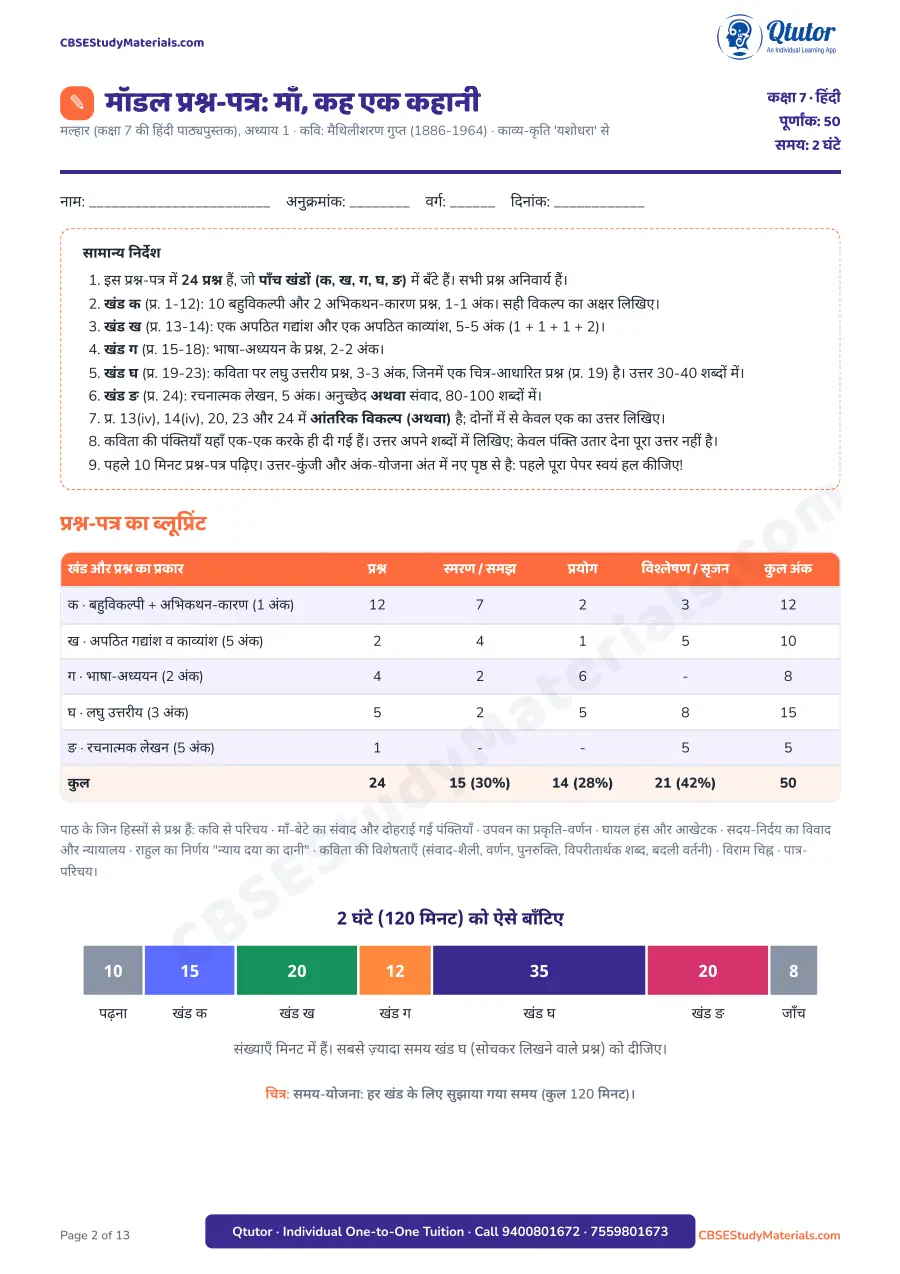
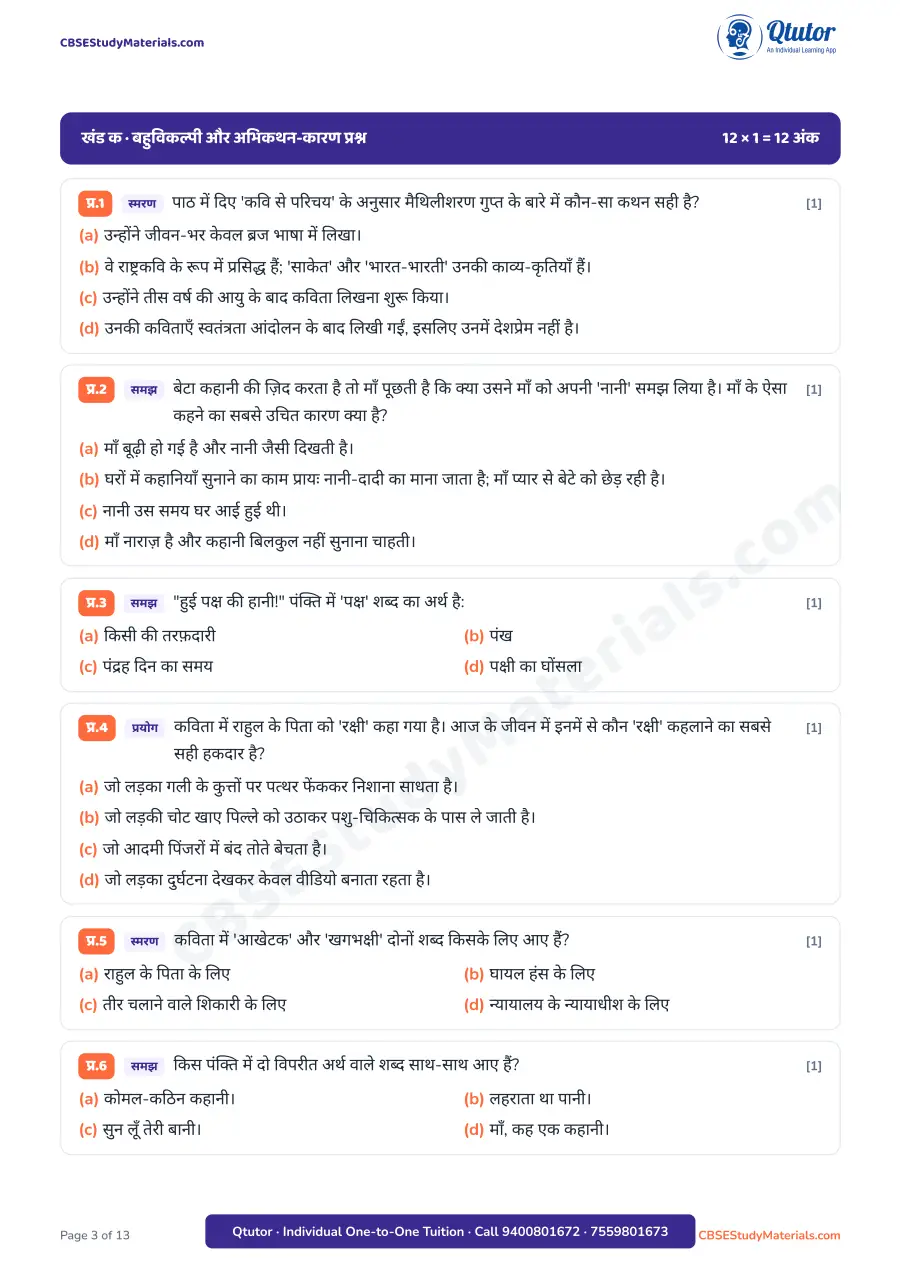
You are looking at pages 1 to 3 of 13. The full PDF is free to download.
Why does Rahul decide that the hunter should not get the swan, even though it was his arrow that brought the bird down? That exact reasoning becomes a 1-mark assertion-reason question in this free Maa, Kah Ek Kahani (माँ, कह एक कहानी) Class 7 Hindi Chapter 1 model question paper, a 13-page CBSE chapter test PDF based on the NCERT Malhar textbook for 2026-27.
The paper is written fully in Hindi (Devanagari) and follows a proper exam format: 24 questions, 50 marks, 2 hours, five sections (खंड क to ङ), general instructions, a blueprint table and internal choice (अथवा). A complete answer key with a marking scheme comes at the end, so this also works as a set of important questions with answers for the chapter. It is an independent practice paper and not an official CBSE or NCERT publication.
Class 7 Hindi Chapter 1 Maa, Kah Ek Kahani Model Question Paper: What Is Included
- Exam-style header with class, subject, chapter, poet, maximum marks (50) and time (2 hours), plus a name and roll number line
- सामान्य निर्देश (general instructions) in nine points, explaining each section and where the अथवा choice is
- Blueprint table showing questions and marks per section, split into recall/understanding (15 marks, 30%), application (14 marks, 28%) and analysis/creative (21 marks, 42%)
- A time-plan diagram that splits the 120 minutes across reading, the five sections and a final check
- खंड क: 10 MCQs and 2 assertion-reason questions on the poet's introduction, word meanings such as पक्ष, आखेटक and खगभक्षी, the order of events, the mother's purpose and changed spellings like हानी
- खंड ख: an original unseen passage (अपठित गद्यांश) about a girl who saves a pigeon caught in kite string on Makar Sankranti, and an original unseen poem (अपठित काव्यांश) about a sparrow's nest in a storm, each worth 5 marks (1 + 1 + 1 + 2)
- खंड ग: 4 language-study (भाषा-अध्ययन) questions on synonyms (पर्यायवाची), punctuation (विराम चिह्न), the prefix निर्, antonyms and repeated word pairs (पुनरुक्त शब्द)
- खंड घ: 5 short-answer questions (3 marks each), including a picture-based question with a four-panel story strip drawn for this paper, a character question, a school-life case, a poetic beauty question and an "कोमल-कठिन" analysis
- खंड ङ: creative writing, a paragraph on "दया ही सच्चा न्याय है" or a dialogue with a younger brother who wants to cage a parrot
- Answer key and marking scheme with a reason for every MCQ, value points with ½ and 1 mark splits, rubrics for writing, a sample paragraph and a sample dialogue
- A self-scoring table and a "next step" guide based on your marks
Maa, Kah Ek Kahani Model Question Paper Structure
| Section | Question type | Questions | Marks |
|---|---|---|---|
| खंड क | MCQs and assertion-reason | 12 × 1 | 12 |
| खंड ख | Unseen passage and unseen poem | 2 × 5 | 10 |
| खंड ग | Language study (grammar) | 4 × 2 | 8 |
| खंड घ | Short answers incl. picture-based | 5 × 3 | 15 |
| खंड ङ | Paragraph or dialogue writing | 1 × 5 | 5 |
| Total | 24 | 50 |
Internal choice (अथवा) is given in Q13(iv), Q14(iv), Q20, Q23 and Q24.
Maa, Kah Ek Kahani Class 7 Important Topics Tested
- The poet Maithilisharan Gupt (1886-1964), known as Rashtrakavi, and his works Saket, Bharat-Bharati and Yashodhara, from which this poem is taken
- The dialogue (संवाद-शैली) between mother Yashodhara and son Rahul, and the playful "नानी" exchange at the start
- The morning garden scene: flowers, dew drops, the breeze, rippling water and singing birds
- The swan struck by a sharp arrow, Rahul's father Siddhartha saving it, and the hunter demanding the bird
- The quarrel between the kind and the cruel (सदय-निर्दय), the case reaching the court, and Rahul's verdict that justice gives the side of compassion
- Features of the poem: repeated lines, rhyming end sounds, words repeated together, opposite words side by side, nature description and spellings changed for rhyme
- Punctuation, synonyms, antonyms and prefixes, plus unseen reading and writing
Maa, Kah Ek Kahani Class 7 Important Questions (Sample)
Here are three real questions from the PDF:
- (MCQ, 1 mark) कविता में राहुल के पिता को 'रक्षी' कहा गया है। आज के जीवन में इनमें से कौन 'रक्षी' कहलाने का सबसे सही हकदार है?
- (Application, 3 marks) विद्यालय के मैदान में मोनू एक घायल पिल्ले पर पत्थर फेंक रहा है ... आप शिक्षिका होते तो क्या निर्णय देते? कविता के विचार "न्याय दया का दानी!" से जोड़कर उत्तर दीजिए।
- (Analysis, 3 marks) आखेटक के आने की बात सुनकर बेटा कहता है "कोमल-कठिन कहानी।" कहानी में 'कोमल' क्या है और 'कठिन' क्या है?
And a sample from the marking scheme:
| Question | Value points | Marks |
|---|---|---|
| Q12 (A-R) | A is false: Rahul sides with the one who saves, not the one who kills; R is true: the hunter shot the arrow | 1 |
| Q23 | कोमल: compassion for the swan (1); कठिन: the hunter's cruelty and stubbornness (1); both are in one story, so it is "कोमल-कठिन" (1) | 3 |
How This Model Paper Helps
Most questions are not answered word for word in the book. Students must apply the poem: pick who deserves to be called a protector today, put scenes of the story in order, judge a playground case using "न्याय दया का दानी", or explain why a calm garden scene makes the sudden fall of the swan more moving. This matches the competency-based, NCERT based style used in CBSE schools for 2026-27. The blueprint tells the parent or teacher what each section tests, and the step-wise marking scheme shows students exactly where marks are won or lost. The unseen passage and poem are new, so students practise real reading, not memory.
Who Should Use It
- Class 7 students revising Hindi Chapter 1 before a unit test, periodic test or half-yearly exam
- Students who have finished the notes, worksheet and flash cards and want one full timed test
- Parents who want to give a 2-hour mock test at home and mark it with the answer key
- Teachers looking for a ready chapter test with a blueprint and marking scheme
How to Download the Class 7 Hindi Maa, Kah Ek Kahani Model Question Paper PDF
This study material is free. Click the button below to download the 13-page PDF, print it on A4 and attempt it in 2 hours before opening the answer key.
Maa Kah Ek Kahani Class 7 Hindi Ch 1 Model Question Paper with Answers (PDF · 13 pages · Free download)
Related Resources
- Class 7 Hindi Chapter 1 Maa, Kah Ek Kahani notes: meaning, word meanings, chapter summary and question answers
- Class 7 Hindi Chapter 1 Maa, Kah Ek Kahani worksheet: practice questions, unseen texts and puzzles with answers
- Class 7 Hindi Chapter 1 Maa, Kah Ek Kahani flash cards: quick revision of words, lines and poem features
- Maa, Kah Ek Kahani chapter page: all study material for this chapter in one place
- Class 7 Hindi study material: every Malhar chapter
- Next chapter: Teen Buddhiman (तीन बुद्धिमान)
FAQs on Class 7 Hindi Chapter 1 Maa, Kah Ek Kahani
Where can I download the Class 7 Hindi Chapter 1 Maa, Kah Ek Kahani question paper PDF? On this page. Click the download button above to get the free 13-page model question paper with answer key and marking scheme.
Is the Maa, Kah Ek Kahani model question paper free? Yes. This Chapter 1 paper is free to download and print.
How many marks and questions are in this Class 7 Hindi Chapter 1 test paper? It has 24 questions for 50 marks in 2 hours, in five sections: MCQ and assertion-reason, unseen passage and poem, language study, short answers and creative writing.
What are the important questions in Maa, Kah Ek Kahani Class 7? Questions on why the mother asks Rahul to decide, the meaning of "न्याय दया का दानी", the arguments of the hunter and Siddhartha, the characters of Yashodhara and Rahul, and the features of the poem are the most important. All of these are in the paper with answers.
Which book is Maa, Kah Ek Kahani from? It is Chapter 1 of Malhar, the NCERT Hindi textbook for Class 7. The poem is by Maithilisharan Gupt and is taken from his work Yashodhara.
Tip: attempt the full paper with a timer first, then mark it yourself with the marking scheme and rewrite every answer where you missed a reason or proof from the poem.