Playing with Constructions Class 6 Maths Chapter 8 NCERT Solutions PDF (PDF · 22 pages · ₹49) Unlock the full PDF for ₹49
Free sample: pages 1 to 3 of 22. The full PDF costs ₹49.
How long should the compass be opened for the wavy wave? Which of PQSR, SPQR, RSPQ and QRSP is not a name for the square? These Playing with Constructions Class 6 Maths Chapter 8 NCERT Solutions answer every such question from the CBSE NCERT Ganita Prakash chapter, in the same order as the book, with neat construction drawings.
This is a premium 22-page NCERT Solutions PDF (₹49) for Class 6 Mathematics, Chapter 8 "Playing with Constructions", for CBSE 2026-27. It is independent study material and is not an official CBSE or NCERT publication. All in-text questions, every "Figure it Out" question and every "Construct" task from Sections 8.1 to 8.6 are solved, including the two solved examples in Section 8.5 with their in-between questions. Each question is restated briefly and then answered step by step.
Class 6 Maths Chapter 8 Playing with Constructions NCERT Solutions: What Is Included
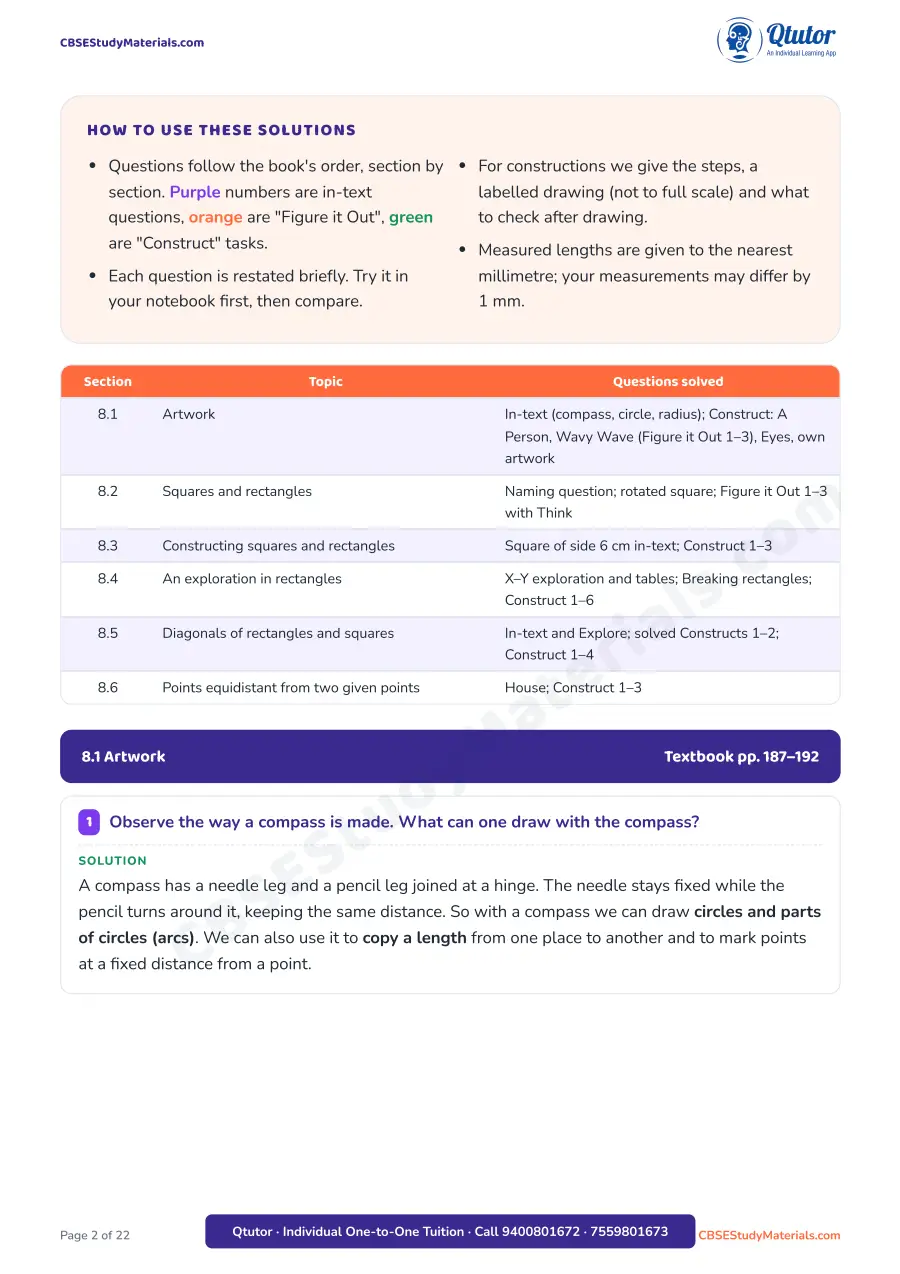
- A "How to use" box and a table showing which questions each section covers
- Colour-coded numbers: purple for in-text questions, orange for Figure it Out, green for Construct
- 8.1 Artwork: compass and circle questions, A Person, Wavy Wave with Figure it Out 1–3, Eyes and your own artwork
- 8.2 Squares and Rectangles: naming rules, the rotated square, Figure it Out 1–3 and the dot-grid Think question
- 8.3 Constructing Squares and Rectangles: the 6 cm square in six steps and Construct 1–3
- 8.4 An Exploration in Rectangles: the X–Y tables, breaking rectangles into squares, and Construct 1–6 (square within a rectangle, falling squares, shadings, holes and curves)
- 8.5 Diagonals: equal diagonals, equal angle pairs, the square case, both solved examples and Construct 1–4
- 8.6 The House and Construct 1–3, including a four-sided figure with equal sides that is not a square
- More than 25 labelled construction drawings and a quick answer key on the last page
Structure of the PDF
| Book section | Questions solved |
|---|---|
| 8.1 Artwork | 6 in-text, Construct 1–3, Figure it Out 1–3 |
| 8.2 Squares and Rectangles | 4 in-text, Figure it Out 1–3, Think |
| 8.3 Constructing Squares and Rectangles | 1 in-text, Construct 1–3 |
| 8.4 An Exploration in Rectangles | 5 in-text and Explore questions, Breaking Rectangles, Construct 1–6 |
| 8.5 Exploring Diagonals | 6 in-text and solved examples, Construct 1–4 |
| 8.6 Points Equidistant from Two Given Points | House, Construct 1–3 |
Playing with Constructions Class 6 Important Topics Covered
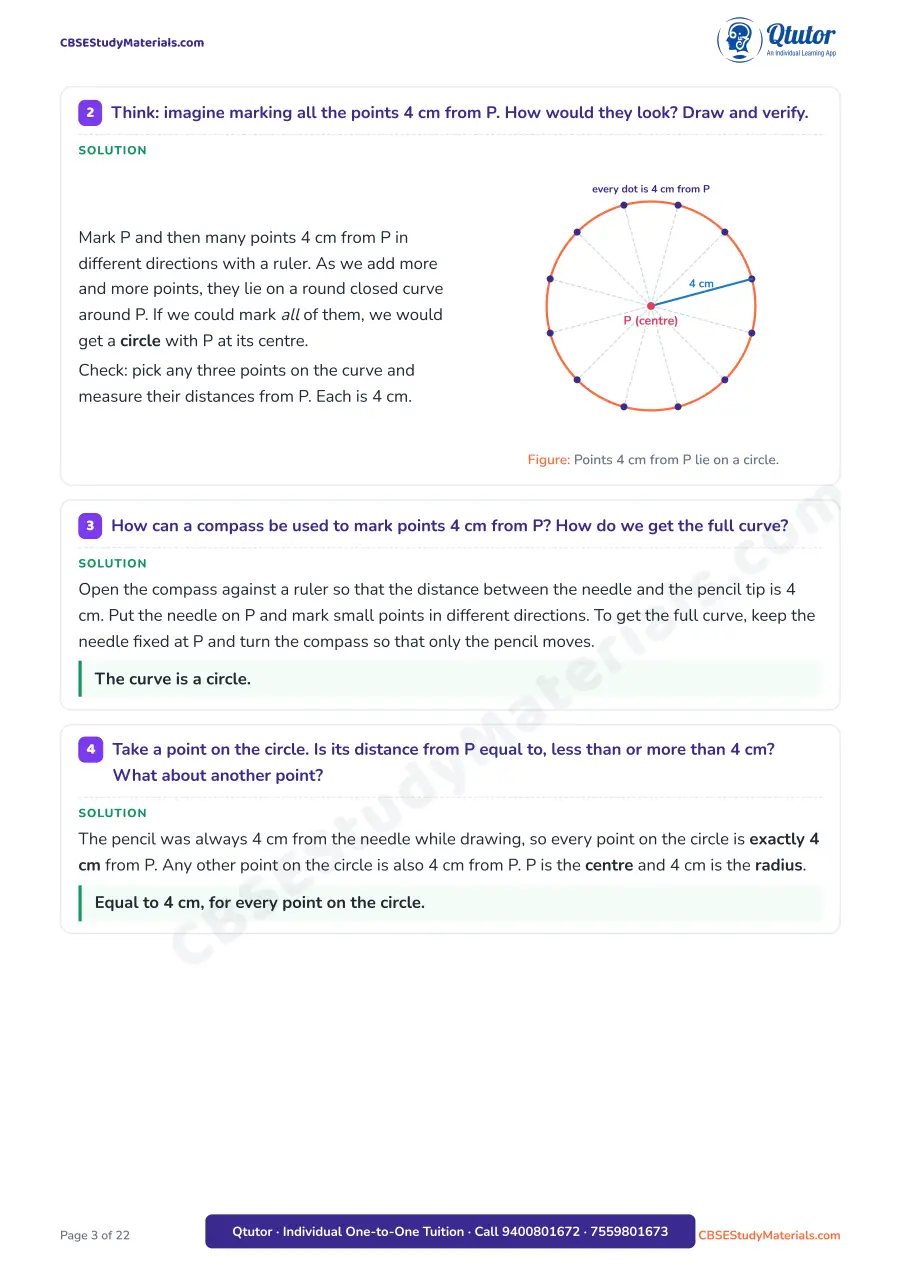
- Circle as all the points at one distance from the centre; centre and radius
- Choosing the compass centre and radius for curves in artwork
- Properties of rectangles (R1, R2) and squares (S1, S2), and correct names
- Constructing squares and rectangles and checking them
- Shortest and longest distance between points on opposite sides of a rectangle
- Diagonals of rectangles and squares
- Constructing rectangles from an angle split or from a side and a diagonal
- Locating a point equidistant from two given points
Playing with Constructions Class 6 Question Answers (Sample)
Wavy Wave, Figure it Out Q1: What radius gives the half circle on AB = 8 cm, and what is AX? Answer: the two half circles share AB, so AX = 4 cm, and the radius is half of AX, 2 cm.
Section 8.3, Construct Q3: Can a 4-sided figure have all angles 90° but opposite sides unequal? Answer: No. Both sides standing on the base are perpendicular to it, so the top side is forced to match the base; opposite sides always come out equal.
Section 8.5, Construct Q3: Construct a rectangle with one side 4 cm and diagonal 8 cm. Draw DC = 4 cm, a perpendicular at C, and an arc of radius 8 cm from D to cut it at B; complete with perpendiculars. The other side measures about 6.9 cm.
| X from A | Y from B | XY |
|---|---|---|
| 5 mm | 3 cm | 7 cm 4 mm |
| 1 cm | 1 cm | 7 cm |
| 2 cm | 4 cm | 7 cm 3 mm |
How It Helps
For constructions, the answer is the method, not just a number. Every solution lists the steps in order, shows a labelled figure and says what to measure afterwards to check the work, so students can find their own mistakes. Exploration questions are answered with sample measurements and the general rule behind them, which is exactly what teachers look for in class discussions.
Who Should Use It
- Class 6 students checking their Ganita Prakash homework for Chapter 8
- Students preparing for class tests on constructions and diagonals
- Parents and tutors who want correct, step-by-step NCERT answers with figures for CBSE 2026-27
How to Download the Class 6 Playing with Constructions NCERT Solutions PDF
This premium PDF download costs ₹49. Use the button below to get the 22-page file; it prints well on A4.
Playing with Constructions Class 6 Maths Chapter 8 NCERT Solutions PDF (PDF · 22 pages · ₹49)
Related Resources
- Playing with Constructions Class 6 Notes PDF
- Playing with Constructions Class 6 Question Bank PDF
- Class 6 Maths Chapter 8 Playing with Constructions chapter page
- All Class 6 Mathematics study material
- Previous chapter: Fractions (Class 6 Maths Chapter 7)
- Next chapter: Symmetry (Class 6 Maths Chapter 9)
FAQs on Class 6 Maths Chapter 8 Playing with Constructions NCERT Solutions
Where can I get Class 6 Maths Chapter 8 Playing with Constructions NCERT Solutions PDF? On this page, as a 22-page premium PDF for ₹49, with every textbook question solved in book order.
Are all Figure it Out and Construct questions solved? Yes. All Figure it Out and Construct tasks in Sections 8.1 to 8.6 are solved, along with the in-text questions and the two solved examples of Section 8.5.
Which is not a name for the square in Section 8.2? PQSR, because Q to S jumps across the square instead of going to the next corner.
How do you construct a rectangle with a side and a diagonal given? Draw the side, a perpendicular at one end, and an arc of the diagonal's length from the other end; the arc cuts the perpendicular at the third corner. Complete with perpendiculars.
Which book are these solutions from? Ganita Prakash, the NCERT Class 6 Mathematics textbook (2026-27 reprint), Chapter 8.
Study tip: after every construction, measure one length and one angle you did not draw directly; if they match, your construction is right.