Fractions Class 6 Maths Chapter 7 Notes PDF (PDF · 17 pages · ₹49) Unlock the full PDF for ₹49
Free sample: pages 1 to 3 of 17. The full PDF costs ₹49.
Is 1⁄9 of a roti bigger than 1⁄5 because 9 is bigger than 5? Most students say yes at first, and that one slip causes many wrong answers later. Fractions, Class 6 Maths Chapter 7, clears it up with rotis, chikki bars, folded paper strips and number lines, and these CBSE Class 6 Maths notes explain every idea with colourful pictures and short worked examples. This is a premium 17-page chapter notes PDF written from the NCERT Ganita Prakash (Grade 6) textbook, 2026-27 edition. It is an independent study resource and not an official CBSE or NCERT publication.
The notes follow the book in order, from 7.1 Fractional Units and Equal Shares to 7.9 A Pinch of History. Every number in the examples and in the answer key was checked by calculation, so this study material is safe to revise from before a test.
Class 6 Maths Chapter 7 Fractions Notes: What Is Included
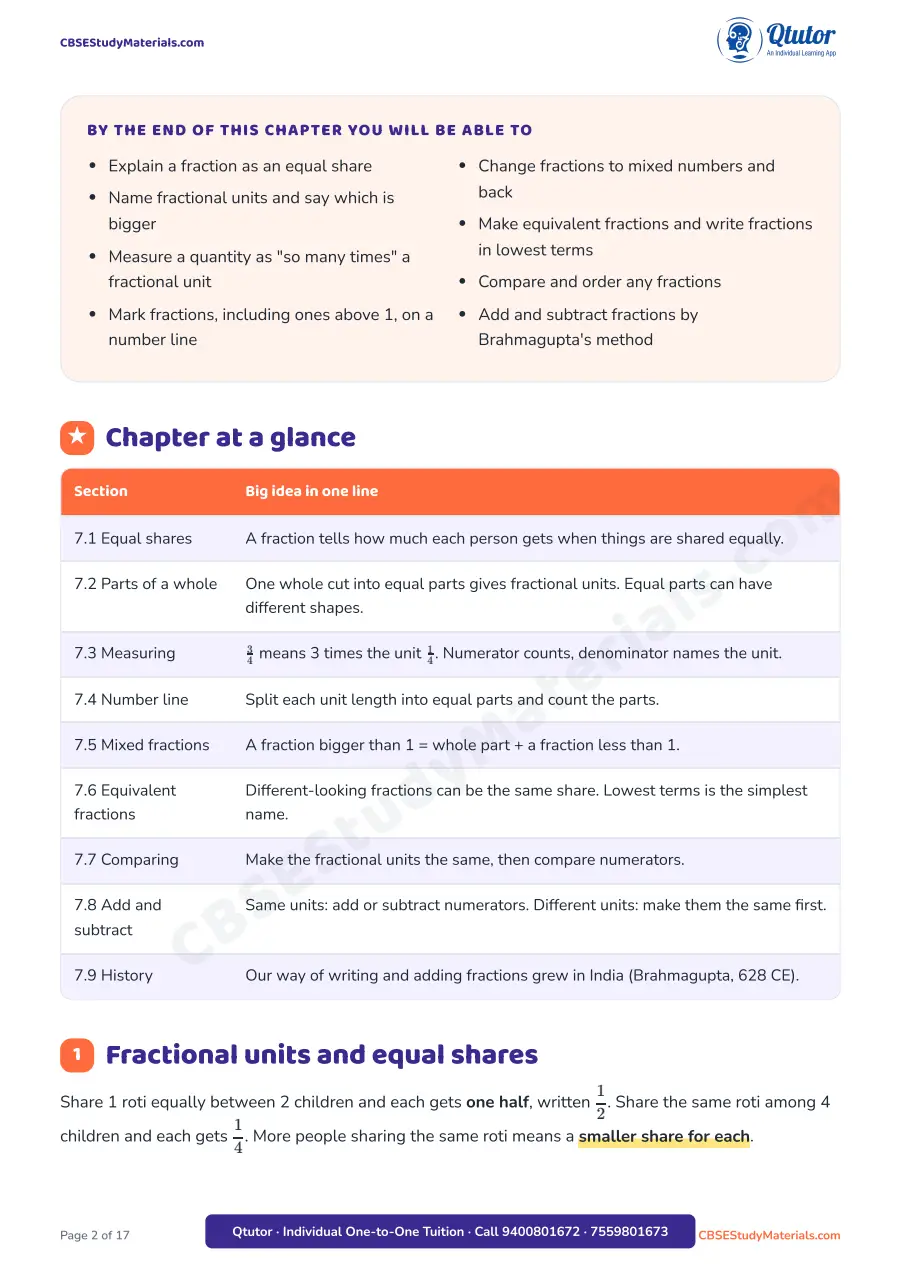
- A cover, eight learning goals and a "Chapter at a glance" table with one line for each of the nine sections
- Nine numbered sections: equal shares and fractional units, parts of a whole, measuring with fractional units, fractions on the number line, mixed fractions, equivalent fractions and lowest terms, comparing fractions, adding and subtracting fractions, and the history of fractions
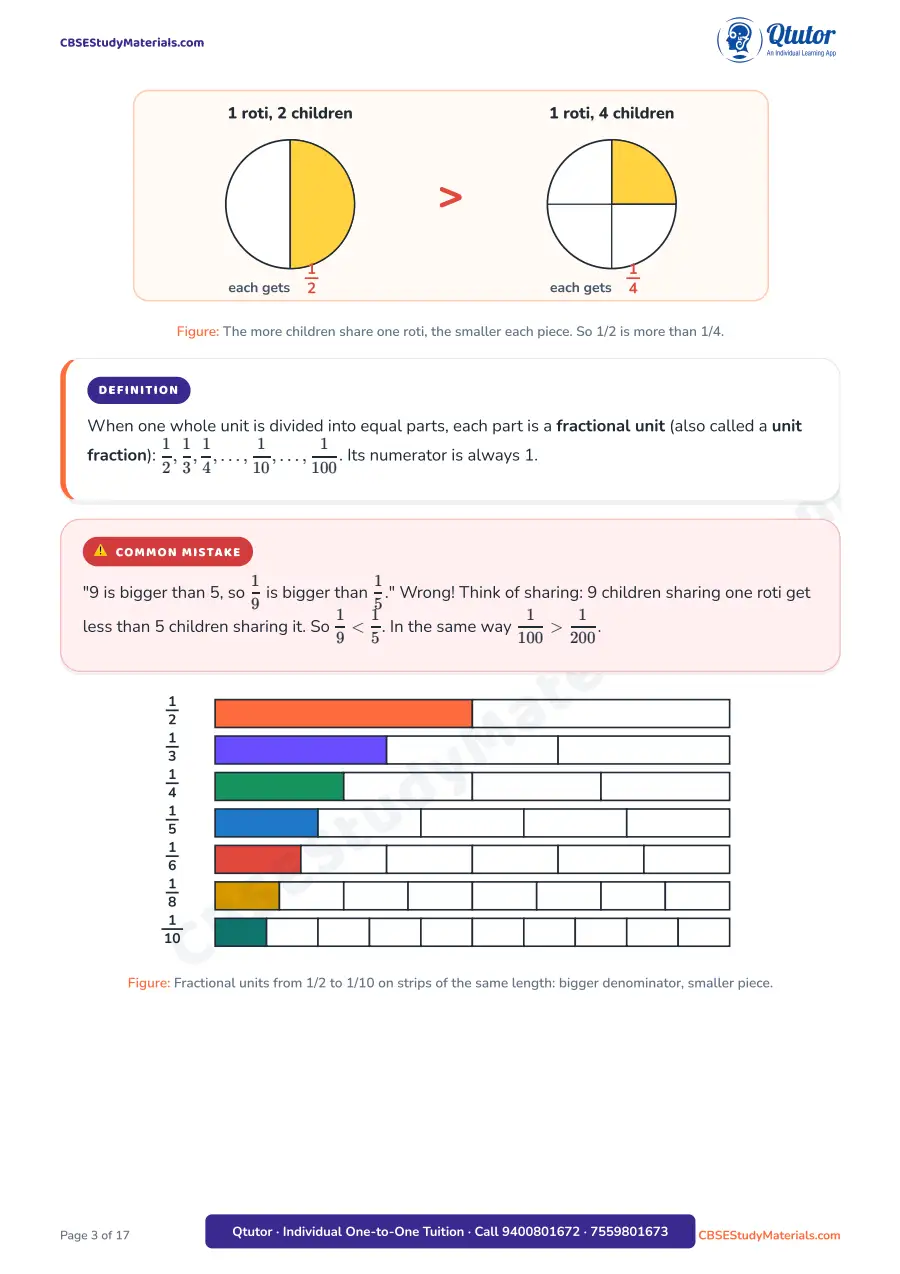
- 13 original figures: roti sharing, a strip chart of unit fractions from 1/2 to 1/10, a chikki cut into sixths in two ways, paper-strip folding, fifths on a number line, a fraction wall, equal shares of rotis, comparing 3/4 and 7/10, adding chikki pieces, adding and subtracting with strips, and a circle split as 1/2 + 1/3 + 1/6
- Definition, Big idea, Common mistake, Think deeper, Real life and Did you know cards
- Key terms with meanings and a mind map of the whole chapter
- "Check yourself": 12 questions that make you think, with an answer key
- A one-page summary at the end for quick revision
Structure of the PDF
| Part | What you get |
|---|---|
| Pages 1-2 | Cover, learning goals, chapter at a glance |
| Sections 1-4 | Equal shares, fractional units, measuring with units, number line |
| Sections 5-7 | Mixed fractions, equivalent fractions, lowest terms, comparing |
| Sections 8-9 | Brahmagupta's method for adding and subtracting, history and the Egyptian fraction puzzle |
| End pages | Key terms, mind map, Check yourself with answers, one-page summary |
Fractions Class 6 Important Topics
- Fraction as an equal share, and why more sharers means a smaller share
- Fractional units (unit fractions) and how to compare them
- Reading 3⁄4 as "3 times 1⁄4"; numerator and denominator
- Marking fractions, including ones greater than 1, on a number line
- Changing a fraction to a mixed number and back
- Equivalent fractions from a fraction wall and from equal sharing
- Lowest terms (simplest form) using the HCF
- Comparing and ordering fractions with a common denominator
- Brahmagupta's method for adding and subtracting fractions
- Bhinna, the Bakshali manuscript, Al-Hassar's bar and Egyptian fractions
Fractions Class 6 Important Questions (Sample)
Mixed numbers. The notes show both directions with one example each: 47 = 5 × 9 + 2, so 47⁄9 = 52⁄9; and each whole holds 4 quarters, so 33⁄4 = 15⁄4.
Comparing. Which is more, 3⁄4 or 7⁄10? Rename both in twentieths: 15⁄20 > 14⁄20, so 3⁄4 is more.
| Pair | Common denominator | Rewritten | Result |
|---|---|---|---|
| 4/5, 7/9 | 45 | 36/45, 35/45 | 4/5 is greater |
| 7/9, 17/21 | 63 | 49/63, 51/63 | 17/21 is greater |
Check yourself, Q11. Find the missing unit fraction: 1⁄2 + 1⁄4 + 1⁄5 + ? = 1. Since the first three add to 19⁄20, the answer is 1⁄20.
How These Notes Help
Fractions is a chapter where one wrong habit, like adding the denominators, keeps coming back. The Common mistake cards name these habits and show the right way with a picture. The fraction wall and number line figures let you see why 1⁄2 = 2⁄4 = 3⁄6 instead of just memorising it. The short cards in every section also work as a quick oral test at home, and the one-page summary is ideal for the night before a class test or the half-yearly exam.
Who Should Use These Notes
- Class 6 students studying Ganita Prakash in CBSE schools in 2026-27
- Parents who want to explain fractions with rotis and paper strips at home
- Teachers looking for ready pictures and "Check yourself" questions for a class discussion
Fractions Class 6 Maths Chapter 7 Notes PDF (PDF · 17 pages · ₹49)
How to Download the Class 6 Fractions Notes PDF
Use the download button on this page. The notes are a premium 17-page PDF for ₹49. They print well in colour and are clear in black and white too.
Related Resources
- Class 6 Maths Chapter 7 Fractions NCERT solutions: every Figure it Out and in-text question solved in textbook order
- Class 6 Maths Chapter 7 Fractions question bank: 51 important questions with worked answers
- Fractions chapter page
- All Class 6 Mathematics study material
- Previous chapter: Perimeter and Area
- Next chapter: Playing with Constructions
FAQs on Class 6 Maths Chapter 7 Fractions
Where can I download Class 6 Maths Chapter 7 Fractions notes PDF? On this page. Use the download button to get the 17-page premium notes PDF for ₹49.
What are the important topics in Fractions Class 6? Fractional units, fractions on the number line, mixed fractions, equivalent fractions, lowest terms, comparing fractions, and adding and subtracting fractions by Brahmagupta's method.
What is the price of the Fractions Class 6 notes PDF? It is a premium PDF priced at ₹49.
Which book is Fractions Class 6 from? It is Chapter 7 of Ganita Prakash, the NCERT Class 6 Mathematics textbook used in CBSE schools for 2026-27.
What is Brahmagupta's method for adding fractions? First change the fractions so they have the same denominator, then add the numerators and keep the denominator, and finally write the answer in lowest terms.
Do these notes include a summary and practice questions? Yes. They end with key terms, a mind map, 12 Check yourself questions with answers and a one-page summary.
Study tip: whenever you add or compare fractions, first ask "are the fractional units the same?" and fix that before anything else.