Biological Classification - Class 11 Biology Chapter 2 Flash Cards (PDF · 12 pages · ₹49) Unlock the full PDF for ₹49
Free sample: pages 1 to 3 of 12. The full PDF costs ₹49.
Is Gonyaulax a cyanobacterium or a protist, and which label on a bacteriophage diagram is the one examiners catch most often? This premium PDF of Biological Classification Class 11 Biology Chapter 2 flash cards turns the whole CBSE chapter from the NCERT textbook into 45 quick question-and-answer cards. It is a 12-page, print-and-cut revision set for the CBSE 2026-27 session, priced at ₹49, and prepared as independent study material; it is not an official CBSE or NCERT publication.
Each card has a front (a question, a "Which kingdom?" list, a statement or label to correct, an assertion-reason pair or a diagram prompt) and a back (a crisp answer with an example and a one-line memory hook). The deck is NCERT based and follows sections 2.1 to 2.6 of the 2026-27 reprint: the five-kingdom system, Kingdoms Monera, Protista and Fungi, a brief look at Plantae and Animalia, and viruses, viroids, prions and lichens. It is written to sit beside our chapter notes and worksheet, so the cards use fresh questions rather than repeating theirs.
Class 11 Biology Chapter 2 Biological Classification Flash Cards: What Is Included
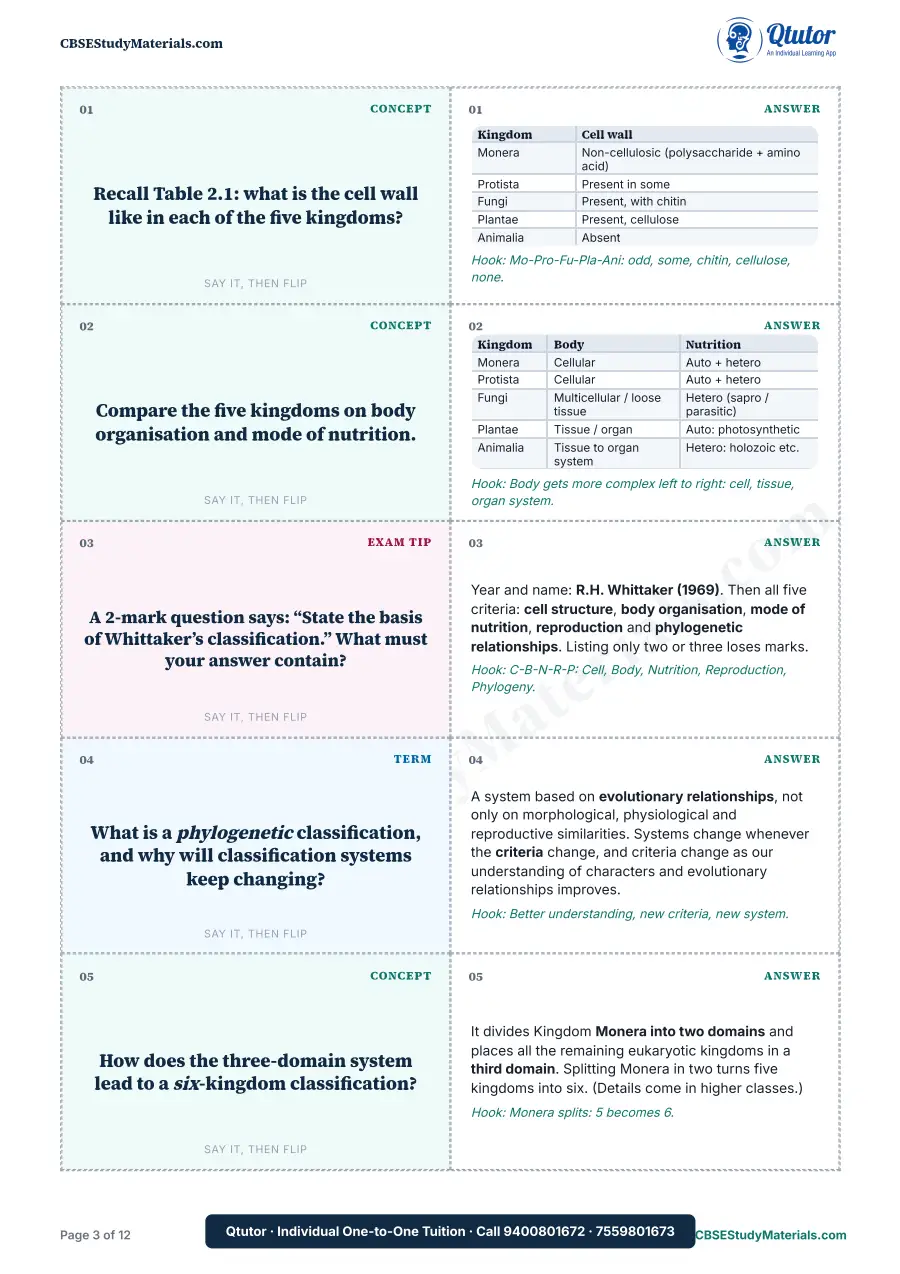
- 45 flash cards printed five to a page, front beside back, with dashed cut lines
- Five-kingdom cards built on NCERT Table 2.1: cell wall, body organisation and mode of nutrition of all five kingdoms in mini tables, Whittaker's five criteria, phylogenetic classification and the three-domain idea
- 3 "Which kingdom?" cards that ask you to place real NCERT organisms such as Nostoc, Gonyaulax, Albugo, Cuscuta, Trypanosoma, yeast, Euglena, Mycoplasma, Venus fly trap and Neurospora
- 3 diagram cards with original drawings: the four bacterial shapes with singular and plural names, a coenocytic hypha with a sporangium beside a septate hypha, and a bacteriophage with one wrong label to spot
- 6 "Spot the mistake" cards (plus the bacteriophage label card) on red tides, protist reproduction, the fungal sexual cycle, Agaricus and deuteromycetes
- 4 Assertion-Reason cards, 4 HOTS cards, 3 Why? cards and an Exam tip card in CBSE board style
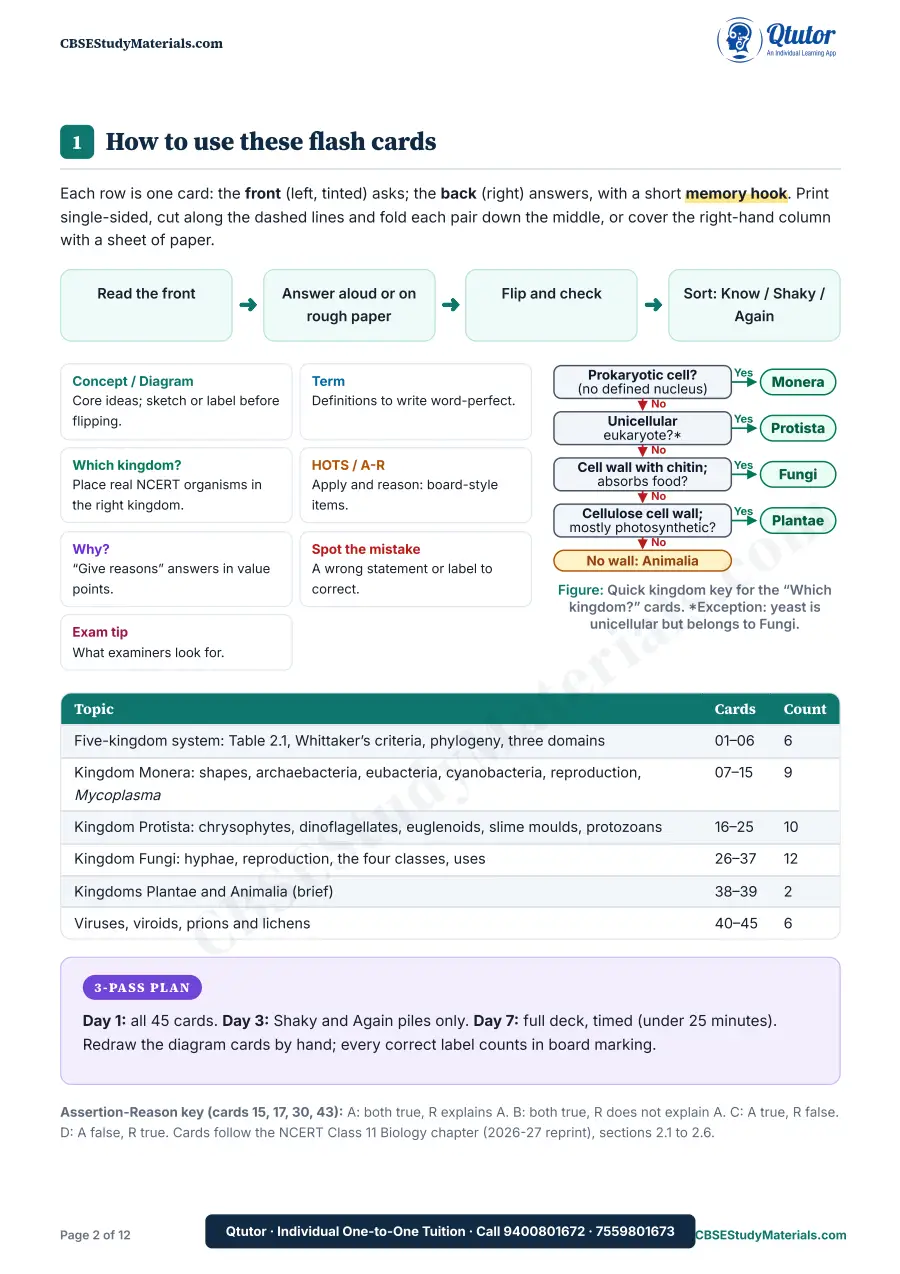
- A how-to-use page with card types, a quick kingdom-key flowchart, a topic index, an assertion-reason key and a 3-pass revision plan
- A one-page recap table of nine groups (archaebacteria to deuteromycetes) with defining features, spores and NCERT examples, a labelled lichen diagram (phycobiont and mycobiont) and a self-check list
Structure of the PDF
| Pages | What you get |
|---|---|
| 1 | Cover |
| 2 | How to use the cards, card types, kingdom-key flowchart, topic index, assertion-reason key |
| 3-11 | Cards 01-45 (front and back side by side) |
| 12 | One-page recap table, lichen diagram and self-check list |
| Topic | Cards |
|---|---|
| Five-kingdom system | 01-06 |
| Kingdom Monera | 07-15 |
| Kingdom Protista | 16-25 |
| Kingdom Fungi | 26-37 |
| Plantae and Animalia (brief) | 38-39 |
| Viruses, viroids, prions and lichens | 40-45 |
Biological Classification Class 11 Important Topics
- Whittaker's five-kingdom classification (1969) and its five criteria
- Characteristics of the five kingdoms (NCERT Table 2.1)
- Phylogenetic classification and the three-domain system
- Bacterial shapes: coccus, bacillus, vibrium and spirillum
- Archaebacteria (halophiles, thermoacidophiles, methanogens), eubacteria, cyanobacteria and heterocysts
- Chemosynthetic bacteria, bacterial reproduction and Mycoplasma
- Chrysophytes and diatomaceous earth, dinoflagellates and red tides, euglenoids and the pellicle, slime moulds and protozoans
- Fungi: hyphae, mycelium, coenocytic hyphae, spores, plasmogamy, karyogamy and the dikaryon
- Phycomycetes, ascomycetes, basidiomycetes and deuteromycetes with examples
- Alternation of generations in plants and the features of Kingdom Animalia
- Viruses (Ivanowsky, Beijerinck, Stanley), capsid and genetic material, viroids, prions and lichens
Class 11 Biological Classification Important Questions (Sample Cards)
Card 20 (Spot the mistake). "Red tides are caused by Gonyaulax, a red-coloured cyanobacterium of Kingdom Monera." Correction: Gonyaulax is a red dinoflagellate, a protist in Kingdom Protista. Its rapid multiplication turns the sea red, and the toxins released may even kill fishes.
Card 30 (Assertion-Reason). A: In ascomycetes and basidiomycetes, cells with two nuclei form after plasmogamy. R: In these fungi, karyogamy follows plasmogamy immediately. Answer: option C. A is true, because an intervening dikaryotic stage (n + n) occurs; R is false, because karyogamy is delayed in these classes.
Card 42 (Concept). Which genetic material do viruses usually carry?
| Host | Usual genetic material |
|---|---|
| Plants | Single-stranded RNA |
| Animals | Single- or double-stranded RNA, or double-stranded DNA |
| Bacteria (bacteriophages) | Usually double-stranded DNA |
No virus contains both RNA and DNA; a protein capsid made of capsomeres protects the nucleic acid.
How These Revision Flash Cards Help
Flash cards make you recall an answer before you see it, which is exactly what an exam asks of you. This chapter is full of look-alike names and paired terms (endogenous and exogenous spores, phycobiont and mycobiont, viroid and prion), and the cards drill each pair until it sticks. The "Which kingdom?" cards train the quick sorting that MCQs test, the "Spot the mistake" cards target the errors students most often make in written answers, and the A-R and HOTS cards practise the reasoning style of the CBSE Class 12 board pattern that Class 11 papers follow. The recap page works as a chapter summary for the night before a test.
Who Should Use It
- Class 11 CBSE students revising Chapter 2 after reading the textbook or our chapter notes
- Students who mix up the protist groups or the four classes of fungi
- Students preparing for unit tests, half-yearly exams and the foundation for NEET Biology
- Teachers and parents who want a ready oral-quiz deck for the chapter
How to Download the Class 11 Biological Classification Flash Cards PDF
This is a premium PDF priced at ₹49. Use the button below to get it, print the pages single-sided, cut along the dashed lines and fold each card down the middle. You can also revise on screen by covering the right-hand column.
Biological Classification - Class 11 Biology Chapter 2 Flash Cards (PDF · 12 pages · ₹49)
Related resources
- Class 11 Biology Chapter 2 Biological Classification chapter page
- Class 11 Biology: all chapters
- Biological Classification Class 11 chapter notes
- Class 11 Biology Chapter 2 Biological Classification worksheet
- Biological Classification high-yield short notes and PYQs
- Class 11 Biology Chapter 1 The Living World flash cards
- Next chapter: Plant Kingdom
FAQs on Class 11 Biology Chapter 2 Biological Classification Flash Cards
Where can I download Class 11 Biology Chapter 2 Biological Classification flash cards PDF? On this page. Use the download button to get the 12-page PDF with 45 cards.
What is the price of the Biological Classification Class 11 flash cards PDF? It is a premium PDF priced at ₹49. The chapter page also links our other resources for this chapter.
What are the important topics in Biological Classification Class 11? Whittaker's five kingdoms and Table 2.1, the groups of Monera, Protista and Fungi with their examples, the sexual cycle of fungi, and viruses, viroids, prions and lichens.
Which kingdom does yeast belong to in Class 11 Biology? Yeast belongs to Kingdom Fungi. It is a unicellular ascomycete, so being single-celled does not make it a protist.
Are these flash cards different from the Biological Classification notes and worksheet? Yes. The cards use new questions, statements to correct and diagram prompts, so they add practice instead of repeating the notes or the worksheet.
Which book is Biological Classification Class 11 from? It is Chapter 2 of the NCERT Class 11 Biology textbook (2026-27 reprint).
Study tip: answer every card aloud before you flip it, and redraw the three diagrams by hand until every label is right.