Relations and Functions - Class 12 Maths Chapter 1 Notes (PDF · 18 pages · Free download) Download the full PDF free
You are looking at pages 1 to 3 of 18. The full PDF is free to download.
These Relations and Functions Class 12 notes cover CBSE Maths Chapter 1 as a free 18-page PDF, written as NCERT based revision notes for the rationalised textbook (CBSE 2026-27 session). A housing society hangs 24 spare keys on a cabinet of 30 hooks, one key per hook: the notes use that picture to show exactly why the map from flats to hooks is one-one but not onto, and how many hooks must go before it becomes a bijection.
The PDF explains types of relations (empty, universal, reflexive, symmetric, transitive), equivalence relations and equivalence classes, and one-one, onto and bijective functions, with 15 worked examples and 12 board-pattern important questions. It is independent study material, not an official CBSE or NCERT publication.
Class 12 Maths Chapter 1 Relations and Functions Notes: What Is Included
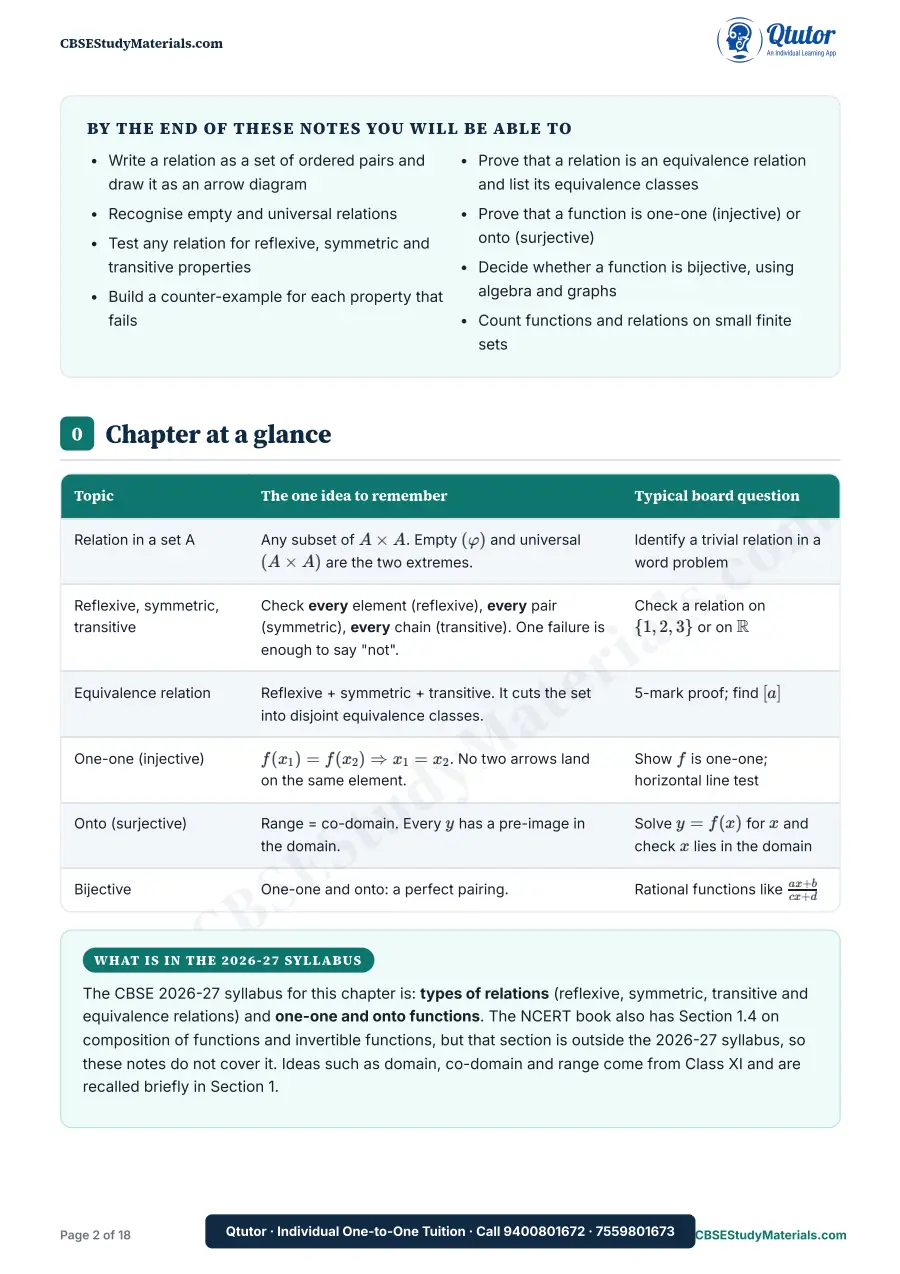
- A cover, learning objectives and a "chapter at a glance" table that links each topic to the kind of board question it produces
- A short note on the CBSE 2026-27 syllabus for this chapter: composition of functions and invertible functions (Section 1.4 of the NCERT book) are outside the current syllabus, so the notes focus on the topics that are examined
- 5 numbered topic sections with definition cards, concept cards, real-life links, "did you know" boxes, common-mistake boxes and think-deeper prompts
- 15 worked examples with complete solutions, from relations on small finite sets to rational functions such as f(x)=3x+1⁄x−2
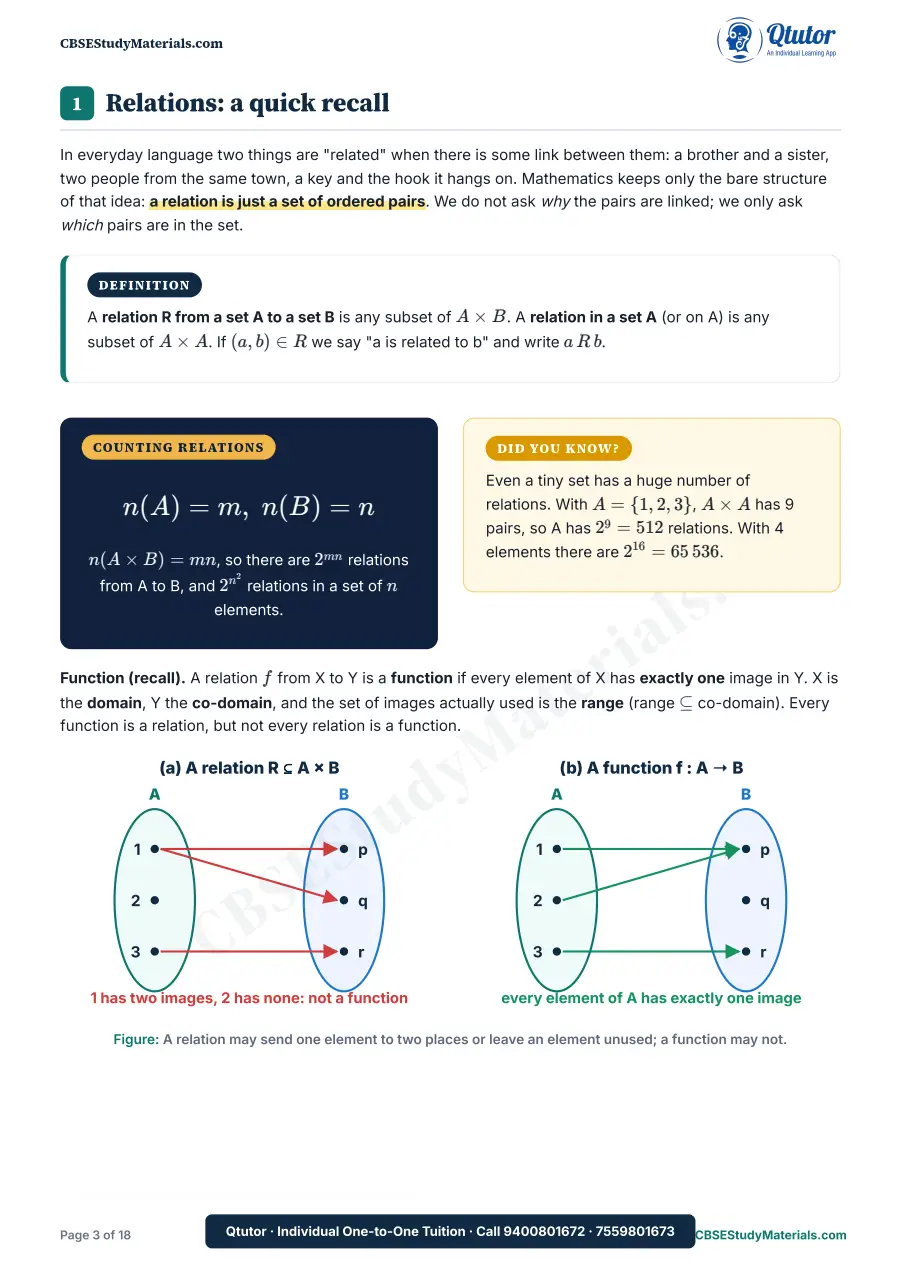
- 7 original diagrams: a relation versus a function as arrow diagrams, the three properties drawn as loops, return arrows and shortcuts, an arrow picture of a relation that fails transitivity, the partition of mathbbZ into three classes modulo 3, four arrow diagrams for one-one, many-one, onto and into functions, a horizontal line test for x2, x3 and [x], and a mind map
- Photographs that link the ideas to real life: keys hanging on a row of hooks, one key per hook, to picture one-one and onto functions; railway tracks branching at a junction, to picture a relation that is not a function
- A table with one example relation for every mix of properties (symmetric only, reflexive and transitive but not symmetric, and so on)
- Counting results: relations in a set, functions, one-one functions and equivalence relations on small sets
- A key-terms grid with 12 terms, a key-results card and a one-page chapter summary with a property table and a board-exam checklist
- "Check yourself": 12 important questions in the CBSE 2026-27 Class 12 Maths pattern (MCQ, assertion-reason, 2-mark, 3-mark, 5-mark and a case study), 25 marks in all
- An answer key with marking-scheme style step marks for every question
Structure of the Relations and Functions Notes PDF
| Part | What you get |
|---|---|
| Opening | Cover, objectives, chapter at a glance, syllabus note |
| Section 1 | Relations and functions: a quick recall, counting relations |
| Section 2 | Empty and universal (trivial) relations |
| Section 3 | Reflexive, symmetric and transitive relations, with counter-examples |
| Section 4 | Equivalence relations, equivalence classes and partitions |
| Section 5 | One-one, onto and bijective functions, horizontal line test, counting functions |
| Revision | Key terms, key results, mind map, one-page summary and checklist |
| Practice | Check yourself (12 questions) and answer key with marking scheme |
Relations and Functions Class 12 Important Topics
- A relation in a set A as a subset of A× A; a set of n elements has 2n2 relations
- Empty and universal relations
- How to test reflexive, symmetric and transitive properties, and how to write one clean counter-example
- Why the empty relation is symmetric and transitive but not reflexive
- Equivalence relations: congruence modulo n, relations on mathbbN×mathbbN such as (a,b) R (c,d) iff a+d=b+c, and the relation f(a)=f(b)
- Equivalence classes [a] and why they split a set into disjoint pieces
- One-one (injective), onto (surjective), many-one, into and bijective functions
- Proving onto by solving y=f(x) and checking that x lies in the domain
- How the same rule, such as x2, changes type when the domain or co-domain changes
- For a finite set, a function from the set to itself is one-one if and only if it is onto
Relations and Functions Class 12 Important Questions (Sample)
From the worked examples. In A={0,1,2,…,10} with R={(a,b): |a−b| is a multiple of 4}, the notes prove R is an equivalence relation and list its classes:
| Class | Elements |
|---|---|
| [0] | {0,4,8} |
| [1] | {1,5,9} |
| [2] | {2,6,10} |
| [3] | {3,7} |
From Check yourself (assertion-reason). Assertion: f:mathbbN→mathbbN, f(x)=x2, is one-one. Reason: g:mathbbZ→mathbbZ, g(x)=x2, is one-one. The answer key explains why the correct option is (c): the assertion is true but the reason is false, since g(−1)=g(1).
From the 5-mark question. Show that R={(a,b): 5 mid 2a+3b} in mathbbZ is an equivalence relation and find its number of classes. The marking scheme shows the step 2a+3b=2(a−b)+5b, which proves (a,b)∈ R exactly when 5mid a−b, giving 5 classes.
How These Relations and Functions Revision Notes Help
Every result in the notes is shown with a reason, not just stated. Each property test comes with a ready counter-example, and the common-mistake boxes point out the slips that cost marks: checking reflexivity only for elements that appear in R, calling a relation with no chains "not transitive", or stopping an onto proof before checking that x is in the domain. The arrow diagrams and the horizontal line test let you see the answer before you write it. All finite-set claims and answers were checked by listing every case.
Who Should Use This Class 12 Maths Chapter 1 Study Material
- Class 12 CBSE students starting the chapter who want a clear chapter summary alongside the NCERT textbook
- Students revising before unit tests, pre-boards and the 2026-27 board exam
- Students who find "give an example of a relation that is ..." or "prove that f is onto" questions hard
- Teachers and tutors looking for a compact set of examples and board-style important questions
How to Download the Class 12 Relations and Functions Notes PDF
The notes are free. Use the download button below to get the 18-page PDF.
Relations and Functions - Class 12 Maths Chapter 1 Notes (PDF · 18 pages · Free download)
Related resources
- Class 12 Maths Chapter 1 Relations and Functions: all study material for this chapter
- Class 12 Mathematics: chapter-wise notes and practice for the whole subject
- Next chapter: Inverse Trigonometric Functions
FAQs on Class 12 Maths Chapter 1 Relations and Functions
Where can I download Class 12 Maths Chapter 1 Relations and Functions notes PDF? On this page. The 18-page notes PDF is free to download using the download button above.
What are the important topics in Relations and Functions Class 12? Reflexive, symmetric and transitive relations, equivalence relations and equivalence classes, and one-one, onto and bijective functions. Proving that a relation is an equivalence relation and that a function is bijective are the most common long questions.
Is the Relations and Functions Class 12 notes PDF free? Yes. This Chapter 1 notes PDF is free.
Which book is Relations and Functions Class 12 from? It is Chapter 1 of the NCERT Class 12 Mathematics Part I textbook. These notes are based on the rationalised NCERT chapter and the CBSE 2026-27 syllabus.
Are composition of functions and invertible functions in the Class 12 2026-27 syllabus? No. The CBSE 2026-27 syllabus for this chapter lists types of relations, equivalence relations and one-one and onto functions only. The notes follow that list.
Do the notes include important questions with answers? Yes. There are 12 board-pattern questions (MCQ, assertion-reason, short and long answer, and a case study) with an answer key that shows step marks.
Study tip: for every relation you test, write the property, then either a general reason or one concrete counter-example, never both and never neither.