Understanding the Weather - Class 7 Social Science Chapter 2 Question Bank (PDF · 19 pages · ₹49) Unlock the full PDF for ₹49
Free sample: pages 1 to 3 of 19. The full PDF costs ₹49.
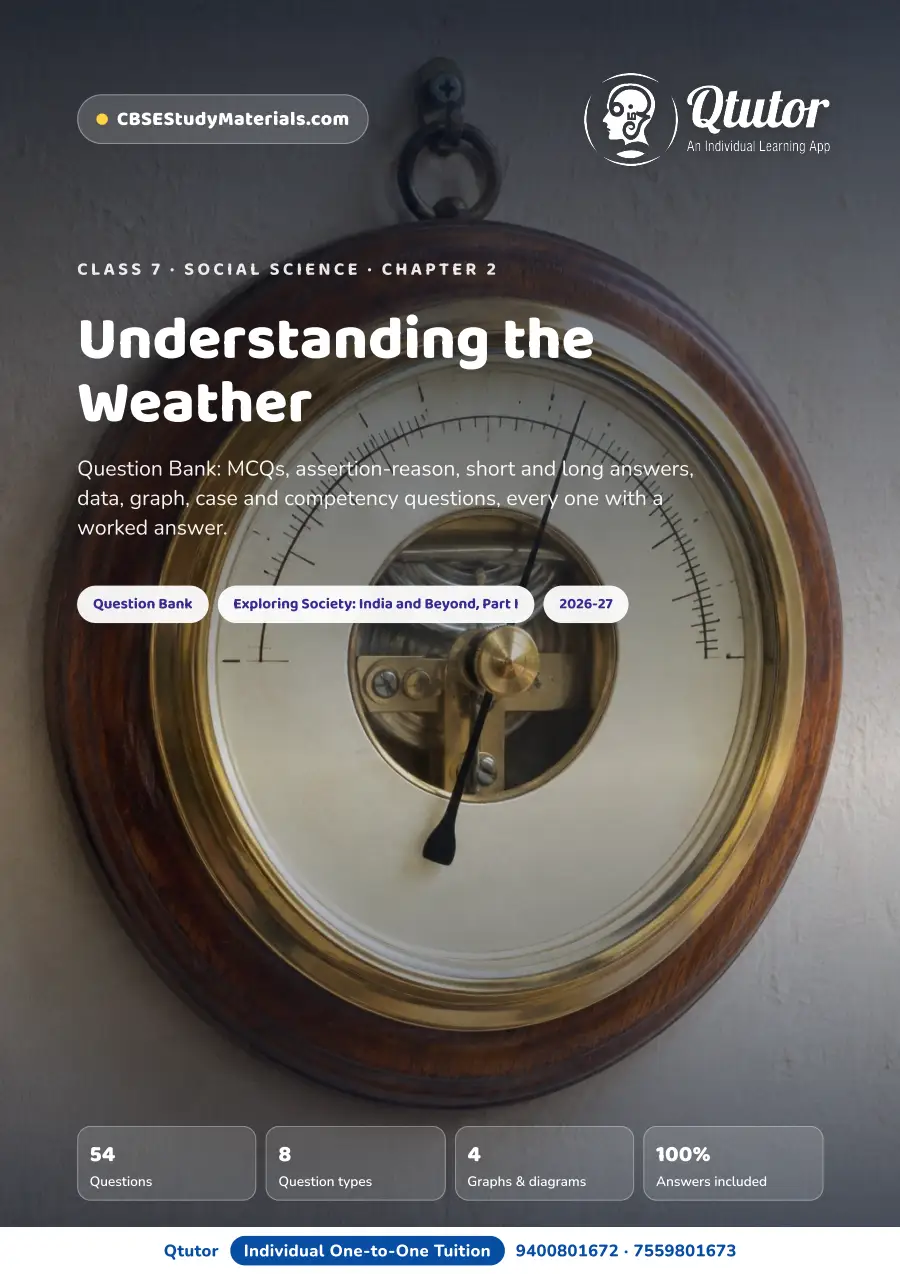
If a coastal town's barometer drops from 1012 mb to 993 mb in five days, on which day should fishermen stop going to sea? That is one of 54 practice questions in this Understanding the Weather Class 7 Social Science Chapter 2 Question Bank, built on the CBSE 2026-27 NCERT textbook. This premium 19-page PDF of important questions covers MCQs, assertion-reason, short and long answers, data, graph, case and competency questions, all with worked answers.
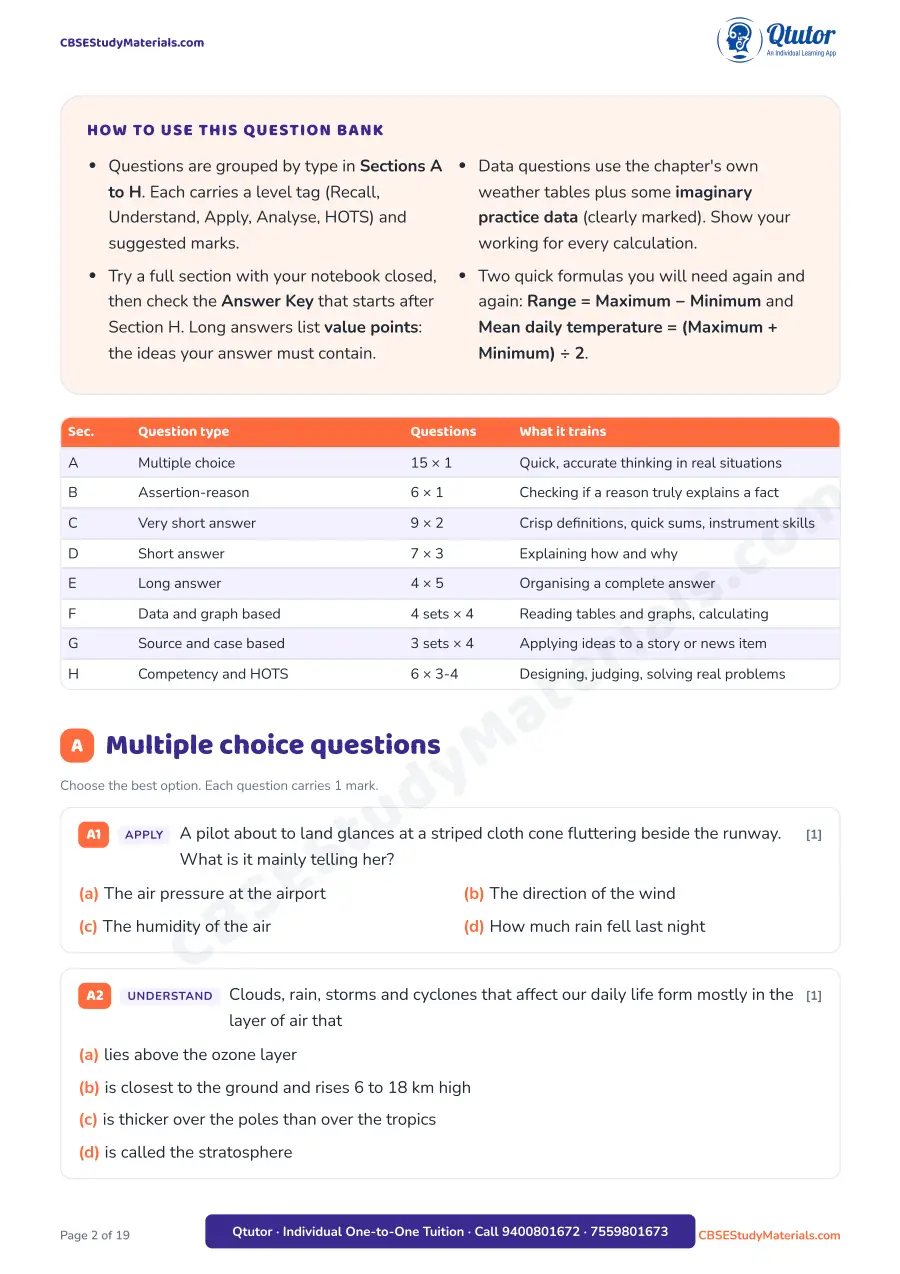
The questions are based on Chapter 2 of the NCERT book Exploring Society: India and Beyond, Part I (2026-27 edition). The PDF is priced at ₹49. It is independent study material and is not an official CBSE or NCERT publication.
Class 7 Social Science Chapter 2 Understanding the Weather Question Bank: What Is Included
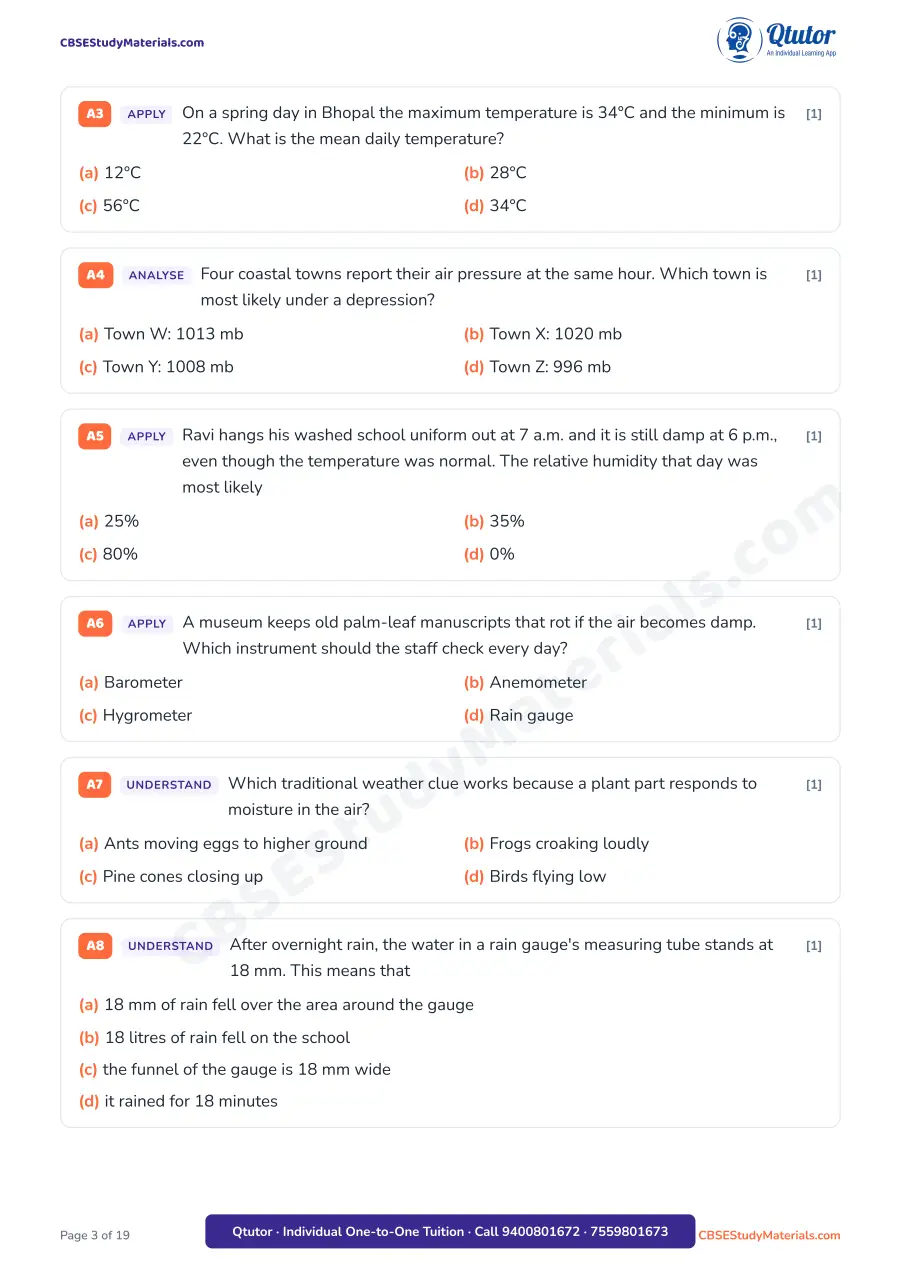
- 15 multiple choice questions set in real situations: a pilot reading a wind sock, a museum protecting palm-leaf manuscripts, a cyclone heading for the Odisha coast.
- 6 assertion-reason questions in a simplified Class 7 format, with the reason for each answer explained.
- 9 very short answer questions (2 marks), including an instrument line-up diagram (P, Q, R, S) to identify.
- 7 short answer questions (3 marks) on how a rain gauge, wind vane and anemometer work, relative humidity, Automated Weather Stations and traditional weather signs.
- 4 long answer questions (5 marks) with value points, including planning a school weather corner.
- 4 data and graph sets: a temperature line graph, a rain-gauge bar chart, an IMD bulletin table for Jammu and Kashmir, and a falling-pressure graph.
- 3 source and case based sets: a Konkan grandmother's weather signs, soldiers posted near Khardung La, and a depression warning for a fishing cooperative.
- 6 competency and HOTS questions: a pine-cone "hygrometer", choosing a papad-drying town by humidity, spotting errors in a rain-gauge experiment and more.
- A complete answer key with every calculation worked out and marks shown as value points.
Structure of the PDF
| Section | Question type | Number of questions |
|---|---|---|
| A | Multiple choice (1 mark) | 15 |
| B | Assertion and reason (1 mark) | 6 |
| C | Very short answer (2 marks) | 9 |
| D | Short answer (3 marks) | 7 |
| E | Long answer (5 marks) | 4 |
| F | Data and graph based (4 marks) | 4 sets |
| G | Source and case based (4 marks) | 3 sets |
| H | Competency and HOTS (3-4 marks) | 6 |
| Key | Answers with working and value points | All 54 |
Every question carries a level tag (Recall, Understand, Apply, Analyse, HOTS), so you can see at a glance that most of the bank asks you to apply and analyse, not just remember.
Understanding the Weather Class 7 Important Topics
- Weather as the state of the atmosphere at a place and time, and the troposphere where it happens
- The five elements of weather: temperature, precipitation, atmospheric pressure, wind and humidity
- Traditional weather signs from nature and why measured data is still needed
- Thermometers, range of temperature and mean daily temperature
- How a rain gauge measures rainfall in millimetres
- Atmospheric pressure, the barometer, millibars, depressions and life at high altitude
- Wind vane, wind sock and anemometer
- Relative humidity, the hygrometer, and why clothes dry slowly on humid days
- Weather stations and Automated Weather Stations
- Weather prediction, the India Meteorological Department and colour-coded warnings
Understanding the Weather Class 7 Important Questions (Sample)
Data-based (from the PDF): Shillong records a maximum of 27°C and a minimum of 19°C. Find the range and the mean daily temperature. Answer: Range = 27 − 19 = 8°C. Mean = (27 + 19) ÷ 2 = 23°C.
Assertion-reason (from the PDF): A: Atmospheric pressure is usually higher at the sea coast than on a high mountain. R: Mountain air holds much more water vapour than coastal air. Answer: (c) A is true, R is false. Pressure falls with height because there is less air above us, not because of water vapour.
Case-based (from the PDF): At Khardung La the pressure is about 650 mb, compared with about 1013 mb at the coast. Roughly what fraction is that?
| Working | Result |
|---|---|
| 650 ÷ 1013 | ≈ 0.64 |
| Meaning | about two-thirds of the coastal pressure |
How the Question Bank Helps
- Practice in the new style. The NCERT Exploring Society books ask you to think, calculate and apply. These questions do the same, with situations from across India.
- Working shown for every number. Range, mean daily temperature, weekly rainfall, average rainfall and pressure drops are all solved step by step.
- Value points for long answers. You learn exactly which ideas earn marks in a 3-mark or 5-mark answer.
- Graphs and tables to read. Four data sets train you to read a line graph, a bar chart and a real IMD bulletin.
- Original questions. The questions are written fresh for this PDF, so they test understanding rather than memory of the textbook exercise.
Who Should Use It
- Class 7 students preparing for unit tests, periodic tests and half-yearly exams in Social Science
- Students who have finished the chapter notes and want important questions for revision
- Parents and tutors who need a ready question bank with a reliable answer key
- Teachers looking for case-based and competency questions for class discussion
How to Download the Class 7 Understanding the Weather Question Bank PDF
Use the download button below to get the 19-page premium PDF for ₹49. It works on phones, tablets and computers and prints cleanly on A4.
Understanding the Weather - Class 7 Social Science Chapter 2 Question Bank (PDF · 19 pages · ₹49)
Related Resources
- Understanding the Weather Class 7 chapter page: chapter summary, key points and practice questions.
- Understanding the Weather Class 7 Notes: revision notes with diagrams, a mind map and a one-page chapter summary.
- Understanding the Weather Class 7 NCERT Solutions: answers to every in-text and end-of-chapter question.
- Class 7 Social Science: all chapters
- Previous chapter: Geographical Diversity of India
- Next chapter: Climates of India
FAQs on Class 7 Social Science Chapter 2 Understanding the Weather
Where can I download Class 7 Social Science Chapter 2 Understanding the Weather important questions PDF? On this page. Use the download button to get the 19-page premium question bank for ₹49.
What are the important topics in Understanding the Weather Class 7? The five elements of weather, the instruments that measure them (thermometer, rain gauge, barometer, wind vane, anemometer, hygrometer), range and mean daily temperature, atmospheric pressure and depressions, relative humidity, weather stations and IMD weather warnings.
Does the question bank have answers? Yes. All 54 questions have answers. Calculations are worked out step by step, and long answers come with value points.
Which book is Understanding the Weather Class 7 from? It is Chapter 2 of the NCERT Class 7 Social Science textbook Exploring Society: India and Beyond, Part I (2026-27), in the theme "India and the World: Land and the People".
Are these the same as the NCERT textbook questions? No. These are original practice questions on the chapter. For answers to the textbook's own questions, see the NCERT Solutions PDF for this chapter.
What is the price of the Understanding the Weather Class 7 question bank PDF? It is a premium PDF priced at ₹49.
Study tip: whenever a question gives you weather numbers, write the formula first (Range = Max − Min, Mean = (Max + Min) ÷ 2), then the working, then one line on what the number means for people.