Life Processes - Class 10 Biology Chapter 5 Flash Cards (PDF · 12 pages · Free download) Download the full PDF free
You are looking at pages 1 to 3 of 12. The full PDF is free to download.
Can you name the five parts of a stoma, write the photosynthesis equation without looking, and say why the pulmonary artery breaks the "arteries carry oxygenated blood" rule? These Life Processes Class 10 flash cards cover CBSE Class 10 Science (Biology) Chapter 5 from the rationalised NCERT textbook in 39 cut-and-revise cards. This is a free 12-page flash cards PDF for CBSE 2026-27 revision. It is our own study material and not an official CBSE or NCERT publication.
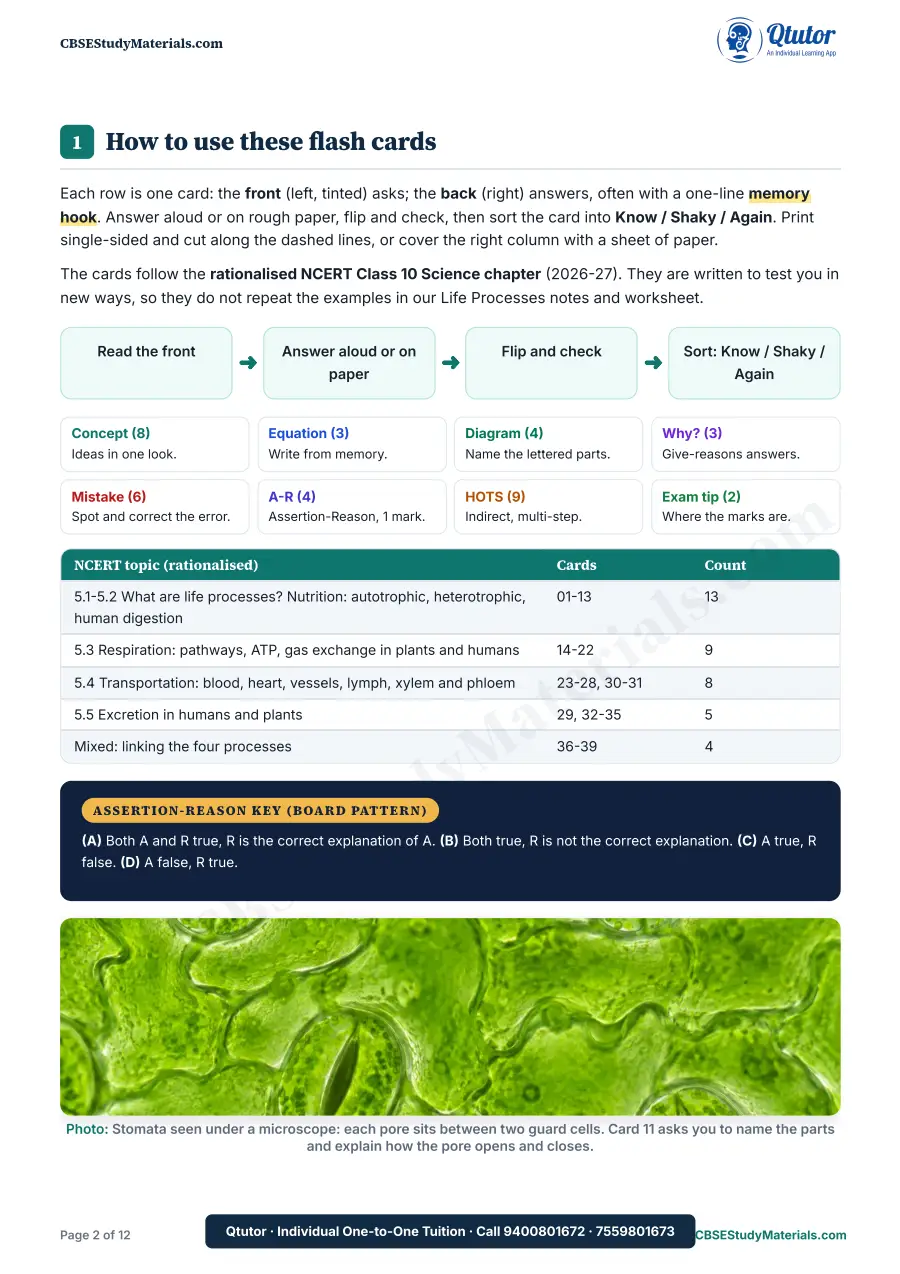
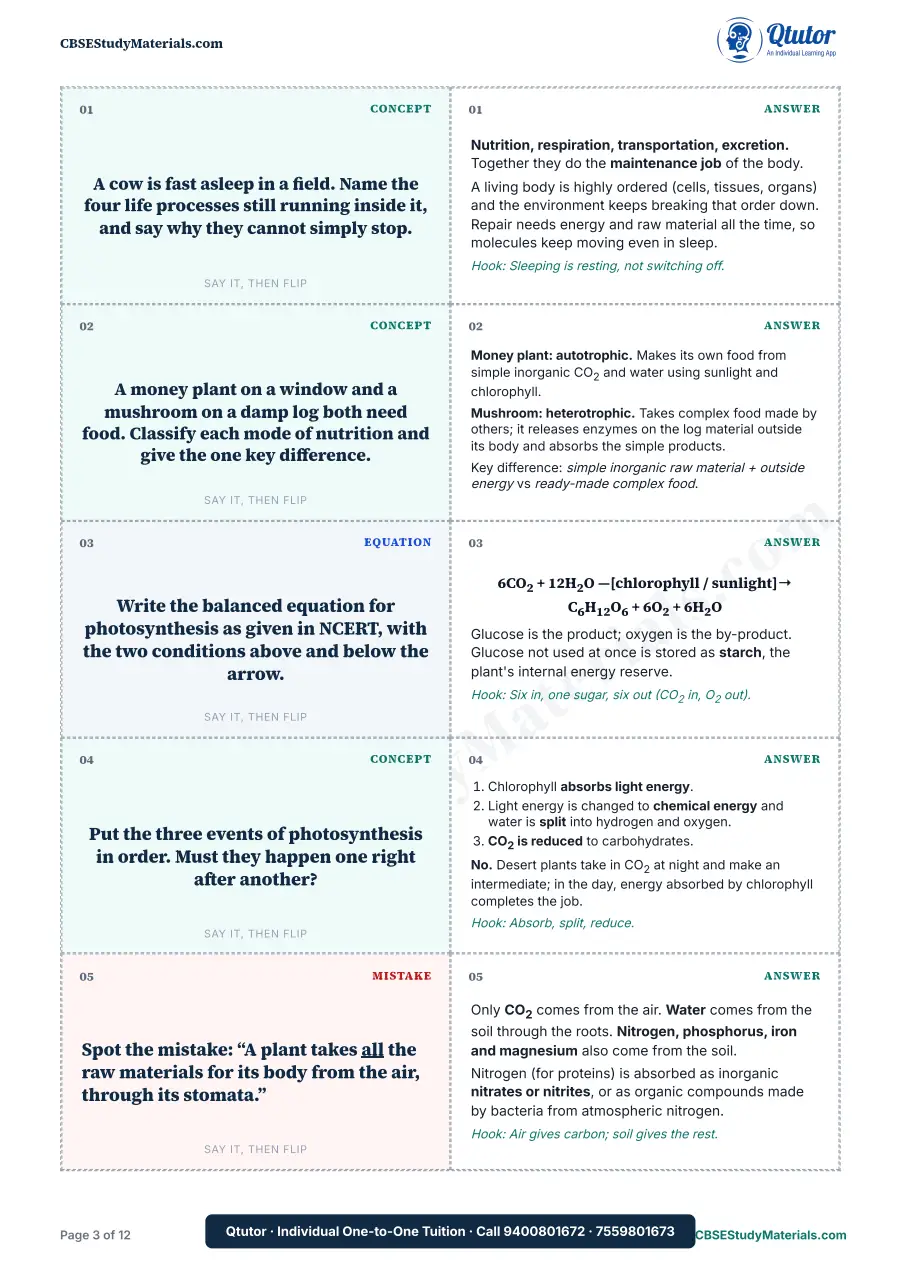
Each card has a front (the question, or a lettered diagram) and a back (a short answer, often with a one-line memory hook). The set is written to test the chapter in new ways, so it does not repeat the examples in our Life Processes notes and worksheet. Use it after you have read the chapter, or as a quick revision deck before a test.
Class 10 Biology Chapter 5 Life Processes Flash Cards: What Is Included
- 39 flash cards laid out front-beside-back, so you can fold, cover or cut them
- 4 diagram cards with original labelled diagrams to name: stomata (surface view), the human alimentary canal, a schematic section of the heart, and a nephron with its blood supply
- 3 equation cards: photosynthesis, the three pathways of glucose breakdown, and the making and use of ATP
- 6 "spot the mistake" cards built on common slips, such as "systolic pressure is the lower reading" or "an artificial kidney re-absorbs glucose"
- 4 assertion-reason cards in the board format, with the A-R option key printed on page 2
- 9 HOTS cards with indirect, real-life situations, and 2 exam-tip cards with comparison tables
- A one-page recap of numbers to remember, a 3-pass revision plan and a tick list
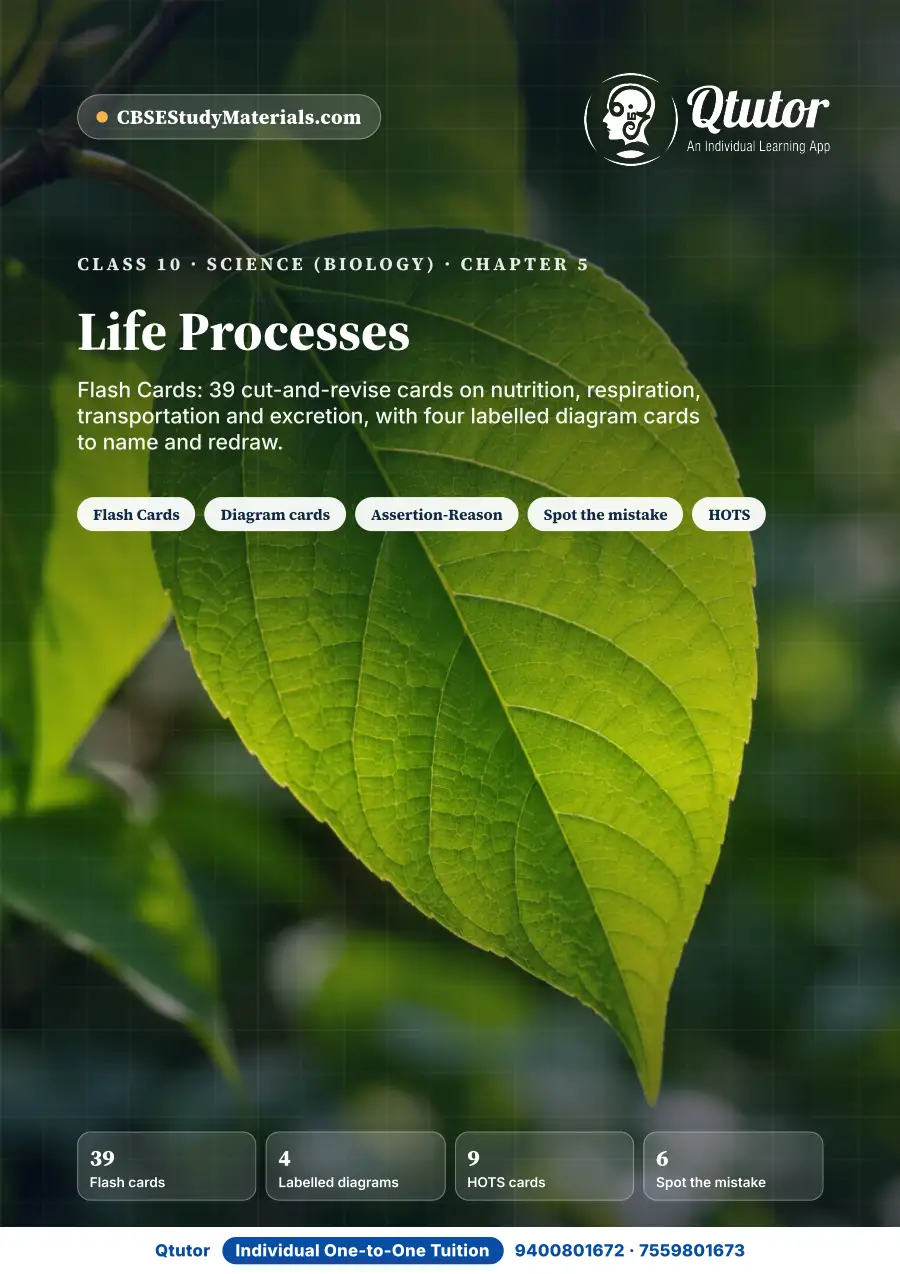
- Realistic photos (a sunlit leaf, stomata under a microscope, a model of the human heart) alongside the cards
Structure of the PDF
| Part | What you get | Cards |
|---|---|---|
| How to use | Method, card types, topic map, A-R key | - |
| Nutrition | Autotrophic and heterotrophic nutrition, stomata, human digestion | 01-13 |
| Respiration | Glucose pathways, ATP, gas exchange in plants and humans | 14-22 |
| Transportation | Blood, heart, vessels, lymph, xylem and phloem | 23-28, 30-31 |
| Excretion | Nephron, urine volume, dialysis, excretion in plants | 29, 32-35 |
| Mixed HOTS | Linking all four life processes | 36-39 |
| Recap | Key numbers, revision plan, diagram tips | - |
Life Processes Class 10 Important Topics Covered
The cards follow the NCERT chapter section by section: why life processes are needed for maintenance; autotrophic nutrition, the three events of photosynthesis and the role of stomata; raw materials plants take from the soil; heterotrophic strategies (Cuscuta, bread mould, Amoeba and Paramoecium); the human alimentary canal with saliva, gastric juice, bile, pancreatic and intestinal juice, and villi; aerobic and anaerobic respiration, pyruvate, lactic acid and ATP; breathing, alveoli, haemoglobin and the role of cilia; the heart, double circulation, blood pressure, capillaries, platelets and lymph; transpiration pull, root pressure and translocation in phloem; the nephron, re-absorption and the artificial kidney; and how plants get rid of wastes.
Life Processes Class 10 Important Questions (Sample)
Card 15 (Equation): Write the two reactions that show how ATP is made and used. Back: ADP + Pi + energy from respiration → ATP; ATP + H2O → ADP + Pi + energy. Breaking the terminal phosphate linkage releases about 30.5 kJ/mol, used for muscle contraction, protein synthesis and nerve impulses.
Card 33 (HOTS): Kidneys make about 180 L of filtrate a day and normally re-absorb about 99% of it. A drug lowers re-absorption to 98%. Does urine "hardly change"? Back: At 99%, urine is 1% of 180 L = 1.8 L; at 98% it is 2% = 3.6 L. Urine output doubles, so a small change in re-absorption makes a large change in urine volume.
Card 38 (Spot the mistake): "Arteries always carry oxygenated blood and veins always carry deoxygenated blood." Back: Vessels are named by direction. The pulmonary artery carries deoxygenated blood to the lungs; the pulmonary veins bring oxygenated blood back to the heart.
How These Flash Cards Help
Flash cards make you recall the answer before you see it, which builds memory faster than rereading notes. The diagram cards train you to name parts and then redraw the figures that are often asked in the board exam. The A-R, mistake and HOTS cards match the competency-based question types in the CBSE Class 10 Science paper, so the chapter feels familiar on exam day. The recap page gives you the key numbers in one place: 120/80 mm of Hg, 30.5 kJ/mol, about 80 m² of alveolar surface and about 180 L of filtrate.
Who Should Use It
- Class 10 students revising Chapter 5 Life Processes for unit tests, pre-boards and the board exam
- Students who have finished the NCERT chapter and want quick self-testing instead of rereading
- Teachers and parents who want ready question-and-answer cards for oral quizzes
How to Download the Class 10 Life Processes Flash Cards PDF
The PDF is free. Use the download button below, print it single-sided, and cut along the dashed lines, or simply cover the answer column with a sheet of paper.
Life Processes - Class 10 Biology Chapter 5 Flash Cards (PDF · 12 pages · Free download)
Related Resources
- Life Processes chapter page: all study material for this chapter
- Life Processes Class 10 Notes PDF: our chapter notes with labelled diagrams
- Life Processes Class 10 Worksheet PDF: board-pattern practice with a marking scheme
- Life Processes Topic-Wise Revision Notes
- Life Processes Application Questions with Answers
- Life Processes Chapter-wise Question Paper and Set 2
- Class 10 Biology: all chapters
- Next chapter: Control and Coordination
FAQs on Class 10 Biology Chapter 5 Life Processes
Where can I download Class 10 Biology Chapter 5 Life Processes flash cards PDF? On this page. Click the download button to get the free 12-page PDF with 39 flash cards and answers.
What are the important topics in Life Processes Class 10? Photosynthesis and stomata, human digestion and enzymes, aerobic and anaerobic respiration, ATP, alveoli and haemoglobin, the heart and double circulation, xylem and phloem transport, the nephron and excretion in plants. All of these have cards in the PDF.
Which diagrams of Life Processes are important for the Class 10 board exam? Stomata, the human alimentary canal, the human heart and the nephron are the most asked. Each has a diagram card in this PDF with lettered parts and the answers on the back.
Is the Life Processes flash cards PDF free? Yes. This Life Processes flash cards PDF is free to download, with all answers on the backs of the cards.
Which book is Life Processes Class 10 from? It is Chapter 5 of the rationalised NCERT Class 10 Science textbook used for CBSE 2026-27. These flash cards are NCERT based but are not an official NCERT or CBSE publication.
Are these the same as the Life Processes notes on this site? No. The notes explain the chapter in full; these flash cards are a self-test deck with new questions, mistake cards and HOTS cards, so use both together.
Study tip: do all 39 cards once, then repeat only the ones you got wrong on day 3 and day 7.