Lines and Angles - Class 6 Maths Chapter 2 Notes (PDF · 14 pages · ₹49) Unlock the full PDF for ₹49
Free sample: pages 1 to 3 of 14. The full PDF costs ₹49.
Why can you draw countless lines through one dot but only one line through two? Why does a pair of scissors with long blades open no “wider” than one with short blades? And why did mathematicians choose 360 degrees for a full turn? These Lines and Angles Class 6 Maths Chapter 2 notes answer these questions for CBSE students using the NCERT Ganita Prakash textbook, with clear pictures instead of long rules.
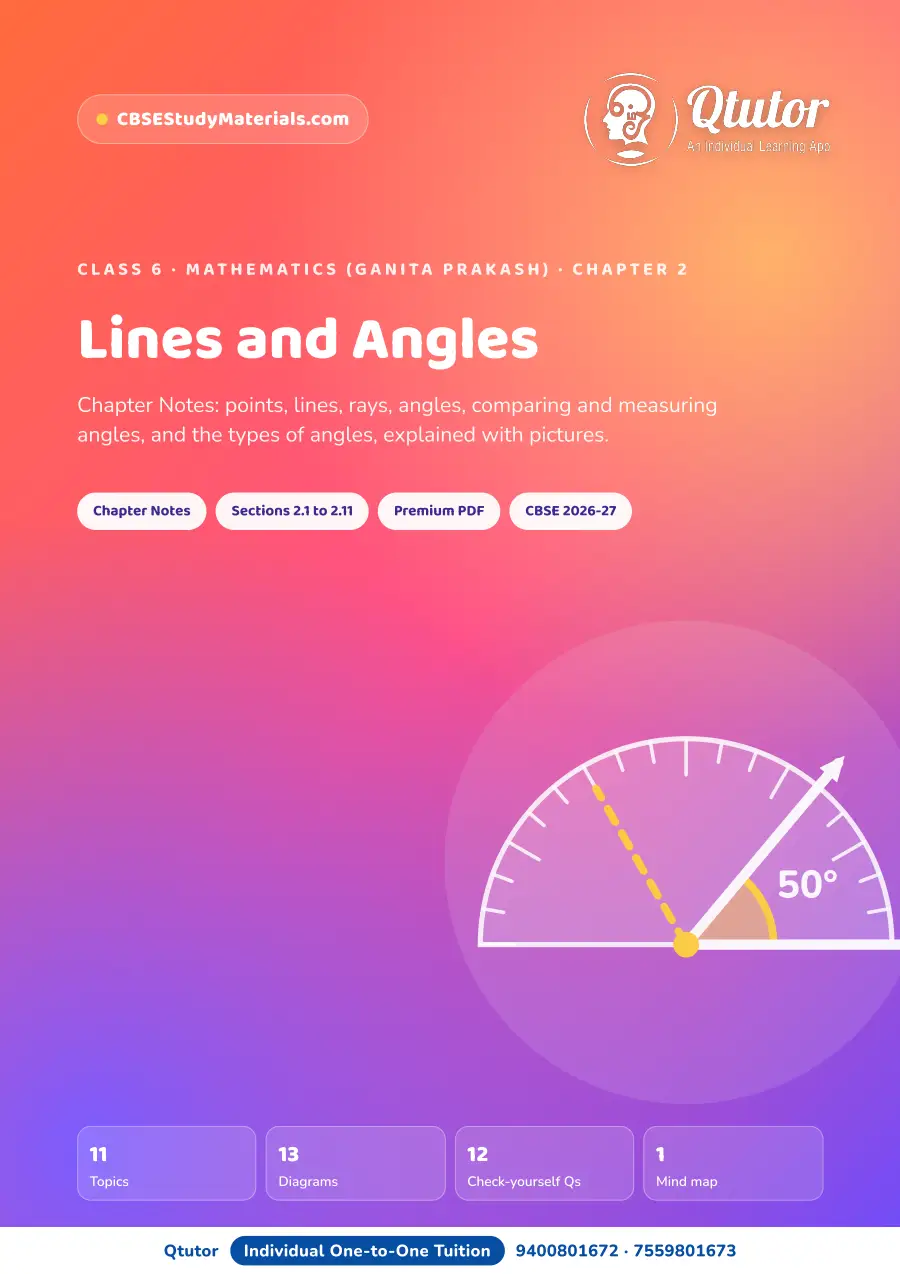
This is a premium 14-page PDF (₹49) of revision notes for CBSE Class 6 Mathematics, Chapter 2, Lines and Angles, prepared for the 2026-27 session. It is our own NCERT-based study material; it is not an official CBSE or NCERT publication. Every angle value in it was rechecked before publishing.
Class 6 Maths Chapter 2 Lines and Angles Notes: What Is Included
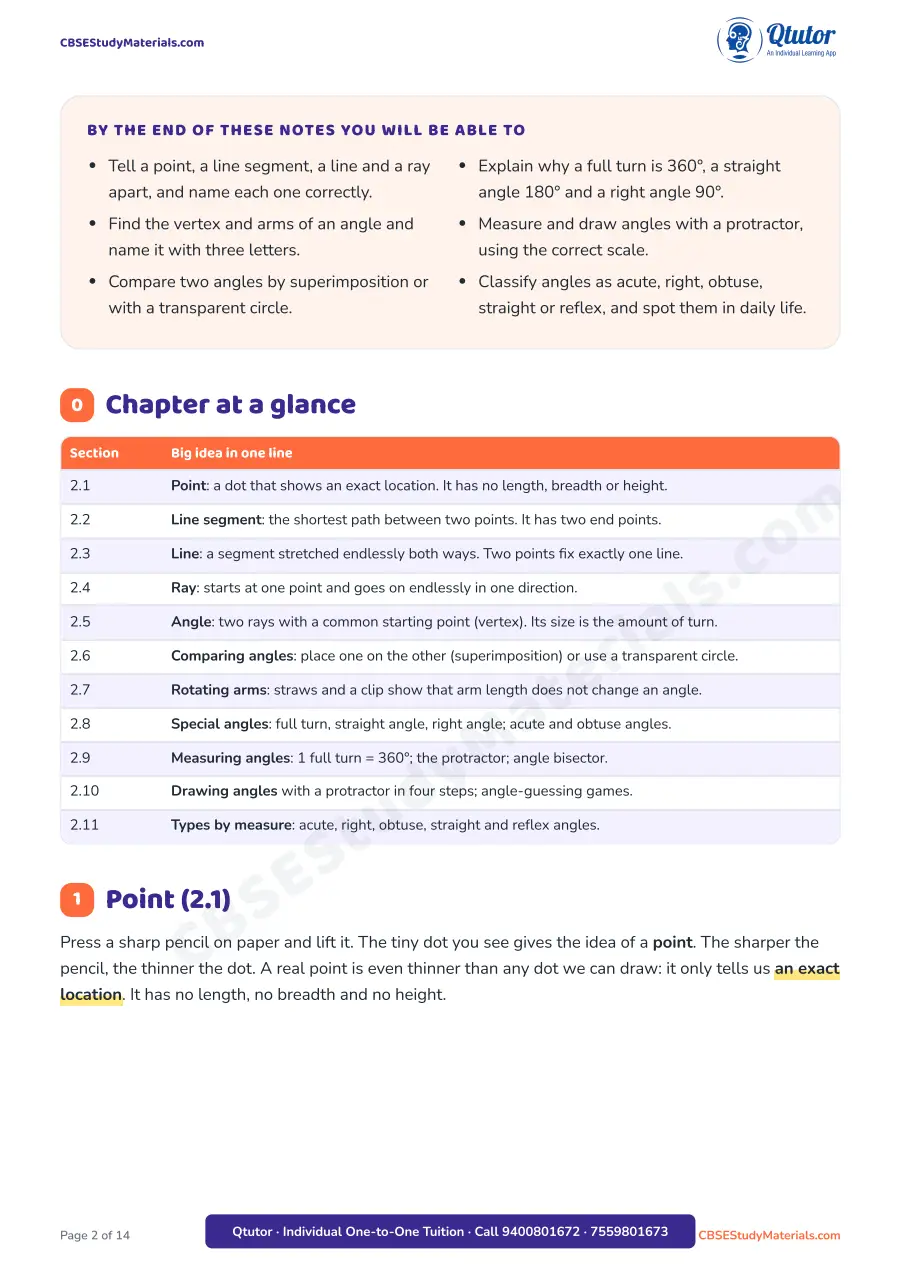
- A chapter at a glance table with the big idea of each section, 2.1 Point to 2.11 Types of Angles and their Measures, in one line
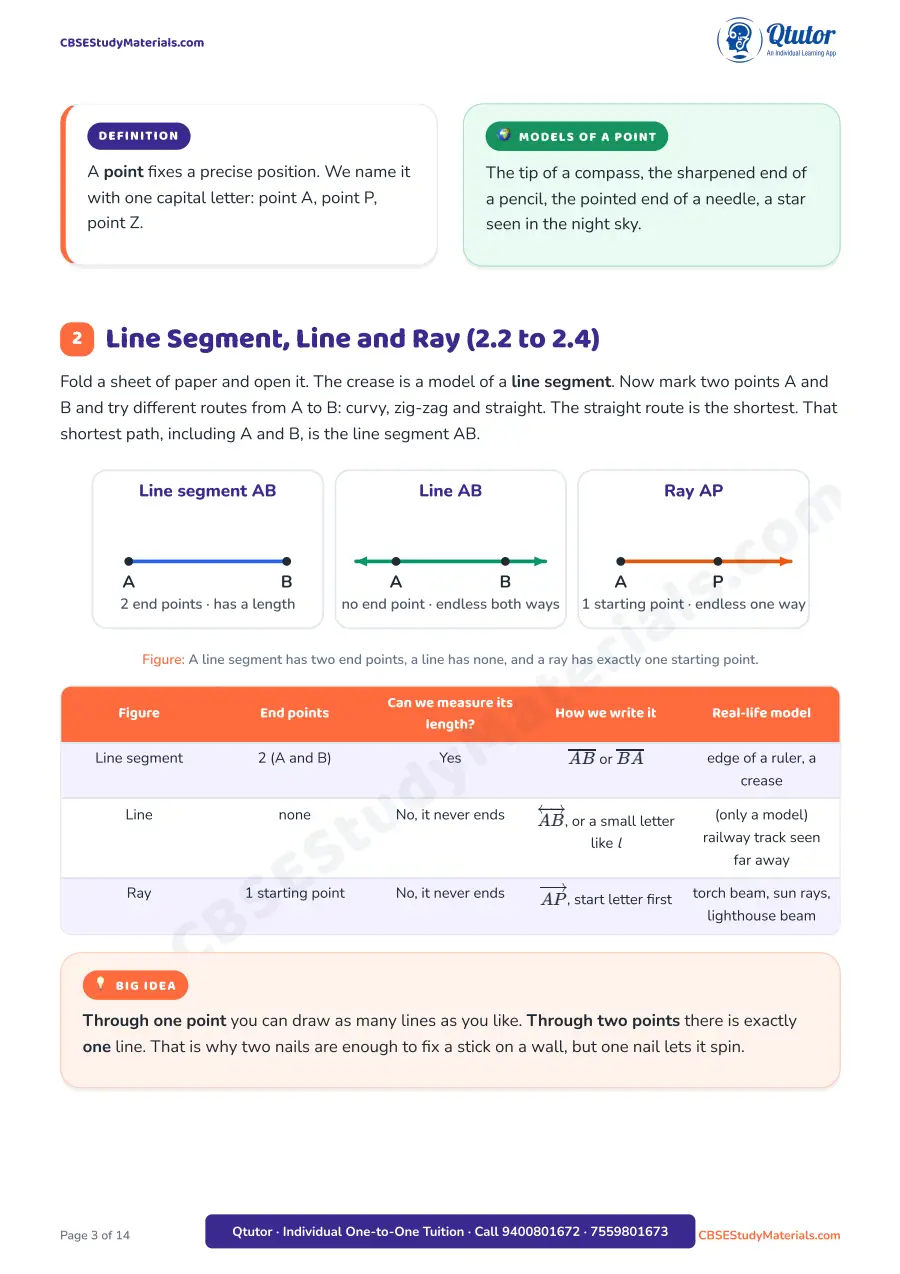
- Simple explanations of points, line segments, lines and rays, with a comparison table (end points, length, notation, real-life models)
- Angles: vertex, arms, naming with three letters, and the size of an angle as the amount of turn
- Comparing angles by superimposition and with a transparent circle, plus the rotating-arms idea
- Full turn, straight angle, right angle, perpendicular lines, acute and obtuse angles
- Measuring in degrees: why 360, a protractor diagram with both scales, the subtraction trick and a folded paper protractor (angle bisectors)
- Drawing an angle in four steps, clock angles, and reflex angles
- 13 original diagrams, “Think deeper” prompts, “Did you know?” boxes and common-mistake warnings
- A key terms grid, a mind map, 12 Check Yourself questions with an answer key and a one-page summary
Structure of the Lines and Angles Class 6 Notes PDF
| Part | What you get |
|---|---|
| Chapter at a glance | Sections 2.1 to 2.11 in one table |
| Topics 1 to 3 | Point, line segment, line, ray and angle |
| Topics 4 and 5 | Comparing angles, special angles, perpendicular lines |
| Topic 6 | Degrees, protractor, paper protractor, clock angles |
| Topics 7 and 8 | Drawing angles and types of angles by measure |
| Revision | Key terms, mind map, Check Yourself with answers, one-page summary |
Lines and Angles Class 6 Important Topics
- A point marks an exact location; a line segment is the shortest path between two points
- Through one point there are endless lines; through two points there is exactly one line
- A ray has one starting point, so \(\overrightarrow{OA}\) and \(\overrightarrow{AO}\) are different rays
- An angle is two rays with a common starting point; the vertex is written in the middle (∠DBE)
- The size of an angle depends on the turn, not on the length of its arms
- Full turn = 360°, straight angle = 180°, right angle = 90°
- Acute (less than 90°), obtuse (between 90° and 180°) and reflex (between 180° and 360°) angles
- Reading the correct scale of a protractor, and finding the other part of a straight angle
Sample from This PDF
Key measures. A full turn is 360°. Half of it, a straight angle, is tfrac12 × 360° = 180°, and half of that, a right angle, is 90°.
Why 360? The notes explain that 360 is the smallest number that divides exactly by every number from 1 to 10 except 7, so a circle can be shared into 2, 3, 4, 5, 6, 8, 9 or 10 equal parts with whole-number angles.
Clock angles. The 12 numbers split 360° into 12 gaps of 360° ÷ 12 = 30°. So at 5 o’clock the hands make 5 × 30° = 150°, an obtuse angle.
| Acute | Right | Obtuse | Straight | Reflex |
|---|---|---|---|---|
| less than 90° | 90° | 90° to 180° | 180° | 180° to 360° |
How These Lines and Angles Notes Help
The notes follow the order of the textbook, so you can read them side by side with Ganita Prakash. Each idea comes with a picture, and the common-mistake boxes point out the slips that cost marks, such as reading the wrong protractor scale or naming a ray from the wrong end. The Check Yourself questions are mostly reasoning questions (“Whose angle is bigger?”, “What mistake did she make?”), so they train you for the competency-based questions now used in CBSE schools. The one-page summary is ready for the night before a test.
Who Should Use This Study Material
- Class 6 students studying Ganita Prakash in CBSE schools in 2026-27
- Students who find protractor reading or angle types confusing
- Parents and tutors who want a short, picture-based chapter summary
- Anyone revising Lines and Angles before a unit test or a half-yearly exam
Lines and Angles - Class 6 Maths Chapter 2 Notes (PDF · 14 pages · ₹49)
Related Resources for Class 6 Maths Chapter 2
- Class 6 Maths Chapter 2 Lines and Angles NCERT solutions: every textbook question solved in order
- Class 6 Maths Chapter 2 Lines and Angles question bank: 51 important questions with answers
- Lines and Angles chapter page
- All Class 6 Mathematics study material
- Previous chapter: Patterns in Mathematics
- Next chapter: Number Play
FAQs on Class 6 Maths Chapter 2 Lines and Angles
Where can I download Class 6 Maths Chapter 2 Lines and Angles notes PDF? On this page. Use the download button to get the 14-page premium notes PDF for ₹49.
What are the important topics in Lines and Angles Class 6? Points, line segments, lines and rays; angles and how to name them; comparing angles; right, straight and full-turn angles; measuring and drawing angles with a protractor; and acute, obtuse and reflex angles.
Which book is Lines and Angles Class 6 from? It is Chapter 2 of Ganita Prakash, the NCERT Mathematics textbook for Grade 6 used in CBSE schools for 2026-27.
How many degrees are there in a full turn, a straight angle and a right angle? A full turn is 360°, a straight angle is 180° and a right angle is 90°.
Do these notes include a mind map and a summary? Yes. There is a mind map, a key-terms grid, 12 practice questions with answers and a one-page summary at the end.
Are these notes the same as the NCERT solutions? No. The notes explain the concepts. For answers to every textbook question, see our NCERT solutions for this chapter.
Study tip: before you read a protractor, decide whether the angle looks acute or obtuse; that one check catches most reading mistakes.