Patterns in Mathematics - Class 6 Maths Chapter 1 NCERT Solutions (PDF · 19 pages · Free download) Download the full PDF free
You are looking at pages 1 to 3 of 19. The full PDF is free to download.
Why does 1 + 3 + 5 + 7 + 9 + 11 always land on a perfect square like 36? Why does a complete graph with 6 points need exactly 15 lines, and how many tiny segments hide inside a Koch snowflake? These Patterns in Mathematics Class 6 Maths Chapter 1 NCERT Solutions answer every question of CBSE Class 6 NCERT Ganita Prakash Chapter 1, step by step and with colourful dot and shape pictures. This is a free 19-page PDF built on the 2026-27 NCERT Ganita Prakash (Grade 6) textbook. It is our own study material and not an official CBSE or NCERT publication.
The solutions follow the exact order and numbering of the textbook, section by section, from 1.1 What is Mathematics? to 1.6 Relation to Number Sequences. Every Figure it Out question and every in-text question is restated briefly and then solved, so you can use the PDF side by side with your book.
Class 6 Maths Chapter 1 Patterns in Mathematics NCERT Solutions: What Is Included
- Solutions to all 30 questions of the chapter: Figure it Out Q1-Q2 (1.1), Q1-Q2 (1.2), Q1-Q5 (1.3), the 5 in-text questions and Figure it Out Q1-Q9 (1.4), Q1-Q2 (1.5) and Q1-Q5 (1.6)
- 17 original pictures: dot triangles, squares, hexagons, L-shaped layers, cube views, complete graphs, stacked triangles and Koch snowflake steps
- The next three terms and the rule for every sequence in Table 1, worked out in one table
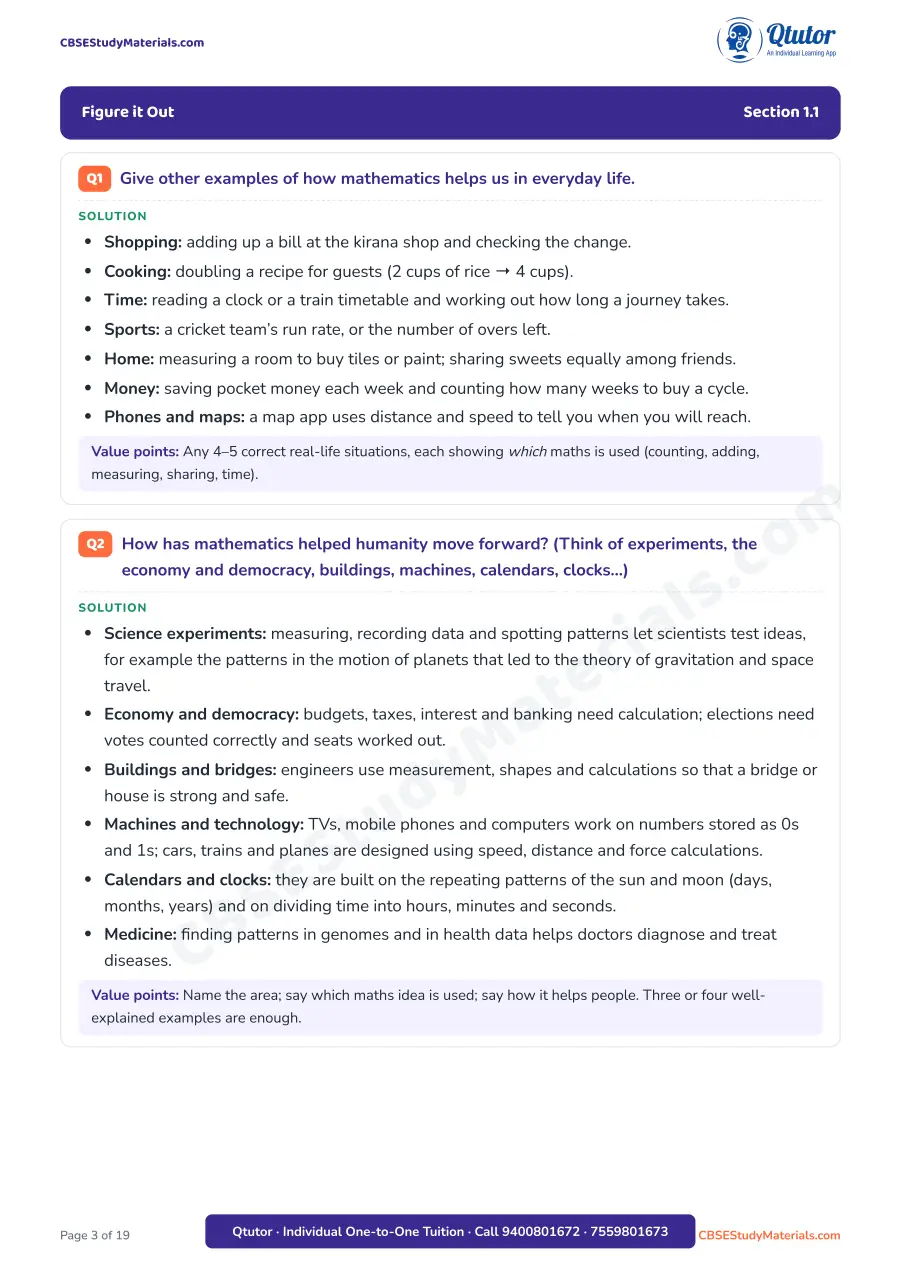
- Model answers with value points for the open questions in Section 1.1
- Green "final answer" boxes for quick checking
- A one-page Quick Answer Key and a "Remember from Chapter 1" recap box
Structure of the PDF
| Part | What you get |
|---|---|
| Section 1.1 | Everyday uses of maths and how maths moved humanity forward |
| Section 1.2 | Patterns and next three terms of all ten number sequences |
| Section 1.3 | Next pictures, why the names triangular, square and cube, 36 as a triangle and a square, hexagonal numbers |
| Section 1.4 | Odd numbers and squares, adding up and down, triangular, hexagonal and cube relations, your own patterns |
| Sections 1.5-1.6 | Shape sequences: regular polygons, complete graphs, stacked squares and triangles, Koch snowflake |
| Answer key | One-line answers to all questions for revision |
Patterns in Mathematics Class 6 Important Topics
- Number sequences: all 1's, counting, odd, even, triangular, square, cube, Virahānka numbers, powers of 2 and powers of 3
- Visualising sequences with dot pictures, and hexagonal numbers 1, 7, 19, 37, 61
- Why the sum of the first n odd numbers is n × n, shown with L-shaped layers
- Adding up and down: 1 + 2 + ... + n + ... + 2 + 1 = n × n
- Relations among sequences: consecutive triangular numbers make squares, 6 × triangular + 1 is hexagonal, sums of hexagonal numbers are cubes, sums of powers of 2
- Shape sequences in geometry and the number sequences hidden inside them
Patterns in Mathematics Class 6 Important Questions (Sample)
Sum of the first 100 odd numbers (Section 1.4). The 100 L-shaped layers, from 1 up to the 100th odd number 199, fill a 100 × 100 square, so 1 + 3 + 5 + … + 199 = 100 × 100 = 10,000.
Powers of 2 (Figure it Out 1.4, Q6).
| Sum | Total | Total + 1 |
|---|---|---|
| 1 + 2 | 3 | 4 |
| 1 + 2 + 4 | 7 | 8 |
| 1 + 2 + 4 + 8 | 15 | 16 |
| 1 + 2 + 4 + 8 + 16 | 31 | 32 |
Adding 1 always gives the next power of 2, because 1 + 1 = 2, 2 + 2 = 4, 4 + 4 = 8 and so on.
Complete graphs (Figure it Out 1.6, Q2). K2 to K6 have 1, 3, 6, 10 and 15 lines, the triangular numbers. Each new point joins all the earlier points, so K6 has 1 + 2 + 3 + 4 + 5 = 15 lines.
How These NCERT Solutions Help
Chapter 1 of Ganita Prakash asks "why" much more often than "what". Many questions say "Can you explain it with a picture?" These solutions give that picture every time, drawn neatly, so a Class 6 student can see the reason and not just memorise the answer. Number answers such as 61, 100, 10,000, 3072 and the next terms of every sequence were checked by computer before publishing. The open questions in Section 1.1 come with value points, so students learn what a complete answer looks like. The Quick Answer Key at the end doubles as a chapter summary for revision before a class test.
Who Should Use It
- Class 6 CBSE students using the new NCERT Ganita Prakash book who want to check homework and Figure it Out answers
- Students who find "explain with a picture" questions hard and want to see clear diagrams
- Parents and tutors looking for reliable, NCERT based solutions with every step shown
- Teachers who want ready pictures for triangular, square, hexagonal and cube numbers
How to Download the Class 6 Patterns in Mathematics NCERT Solutions PDF
Click the button below to download the 19-page PDF. It is free, opens on phone, tablet or computer, and prints cleanly on A4.
Patterns in Mathematics - Class 6 Maths Chapter 1 NCERT Solutions (PDF · 19 pages · Free download)
Related Resources
- Class 6 Maths Chapter 1 Patterns in Mathematics Notes for revision notes and a one-page chapter summary
- Class 6 Maths Chapter 1 Patterns in Mathematics Question Bank for extra important questions with answers
- Patterns in Mathematics chapter page
- All Class 6 Mathematics study material
- Next chapter: Lines and Angles
FAQs on Class 6 Maths Chapter 1 Patterns in Mathematics
Where can I download Class 6 Maths Chapter 1 Patterns in Mathematics NCERT Solutions PDF? You can download it from this page using the download button. It is a free 19-page PDF.
Is the Patterns in Mathematics Class 6 solutions PDF free? Yes. Chapter 1 solutions are free to download.
Does it solve all questions of Patterns in Mathematics Class 6? Yes. It solves all 30 questions: every Figure it Out in Sections 1.1 to 1.6 and the in-text questions of Section 1.4, in textbook order and numbering.
Which book is Patterns in Mathematics Class 6 from? It is Chapter 1 of the NCERT Class 6 Mathematics textbook Ganita Prakash, used for CBSE 2026-27.
What is the next hexagonal number after 1, 7, 19, 37? It is 61. Each new hexagon adds a ring of dots, and the rings have 6, 12, 18, 24 dots, so 37 + 24 = 61.
Is this an official NCERT solutions PDF? No. It is independent study material prepared by our team from the NCERT textbook; it is not published by CBSE or NCERT.
Study tip: before reading a solution, draw the dot picture yourself; once you can see the pattern, the answer usually explains itself.