Exploring Substances: Acidic, Basic, and Neutral - Class 7 Science Chapter 2 Flash Cards (PDF · 11 pages · ₹49) Unlock the full PDF for ₹49
Free sample: pages 1 to 3 of 11. The full PDF costs ₹49.
Can one cup of crushed rose petals tell vinegar, soap solution and sugar water apart? Class 7 Science Chapter 2, Exploring Substances: Acidic, Basic, and Neutral, says yes, and these NCERT based CBSE flash cards turn the chapter into 40 quick cards you can revise in about twenty minutes.
This is a premium Flash Cards PDF (₹49) for Class 7 Science (Curiosity), Chapter 2 "Exploring Substances: Acidic, Basic, and Neutral", written for the new NCERT textbook used in CBSE 2026-27. It has 11 pages and is independent study material, not an official CBSE or NCERT publication. Each card has a question on the front and a short answer with a memory hook on the back, so the PDF works as revision notes, a chapter summary and a set of important questions in one PDF download.
Class 7 Science Chapter 2 Exploring Substances Flash Cards: What Is Included
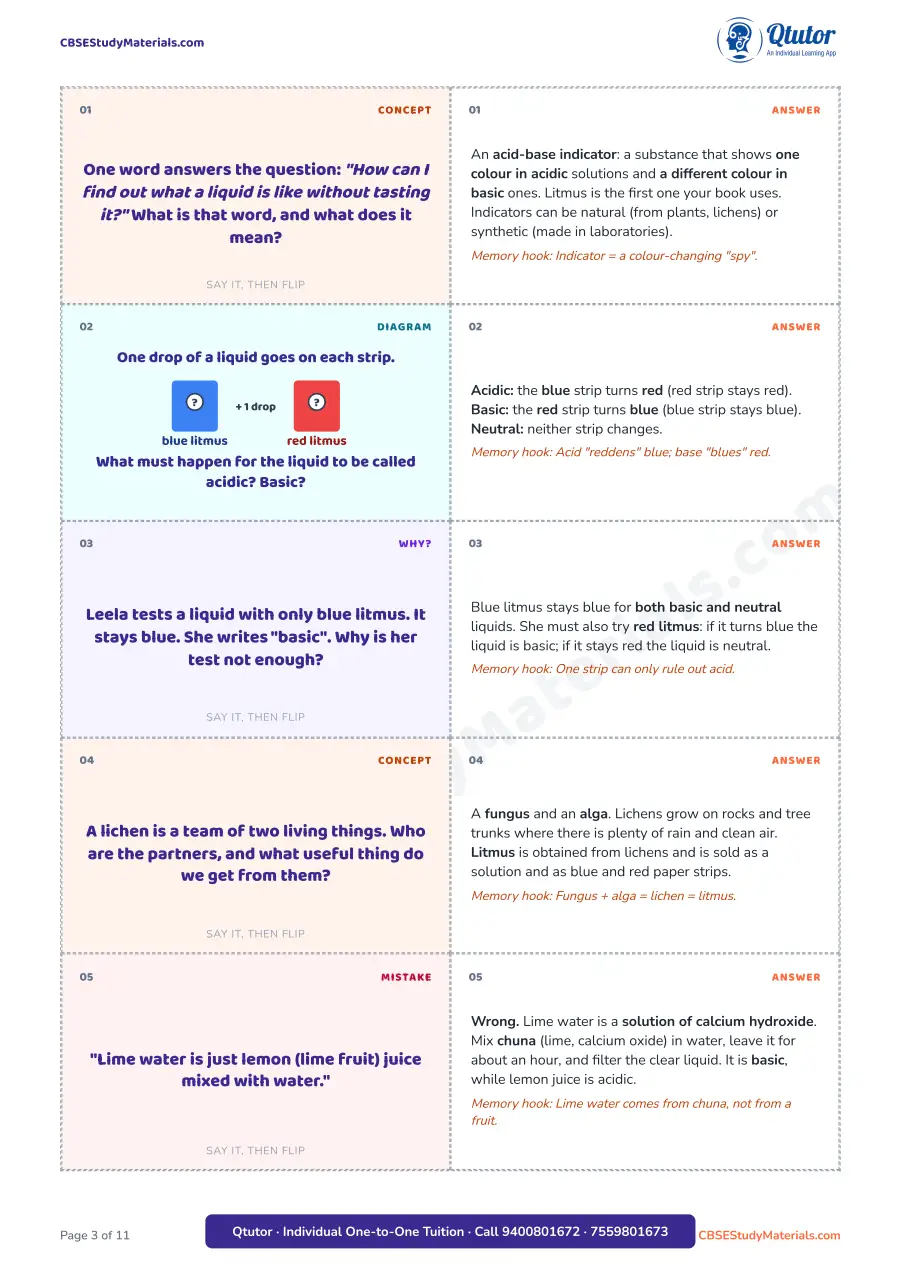
- 40 printable flash cards, five to a page, front and back side by side so you can cut and fold them or just cover the answer column
- Nine card types, each colour-coded: Concept, Diagram, Why?, Mistake, Exam tip, Word equation, HOTS, Assertion-Reason and Beyond the book
- 4 picture cards drawn for this PDF: blue and red litmus strips, the four foods of Fig. 2.4, three test tubes with red rose extract, and the Activity 2.7 colour sequence
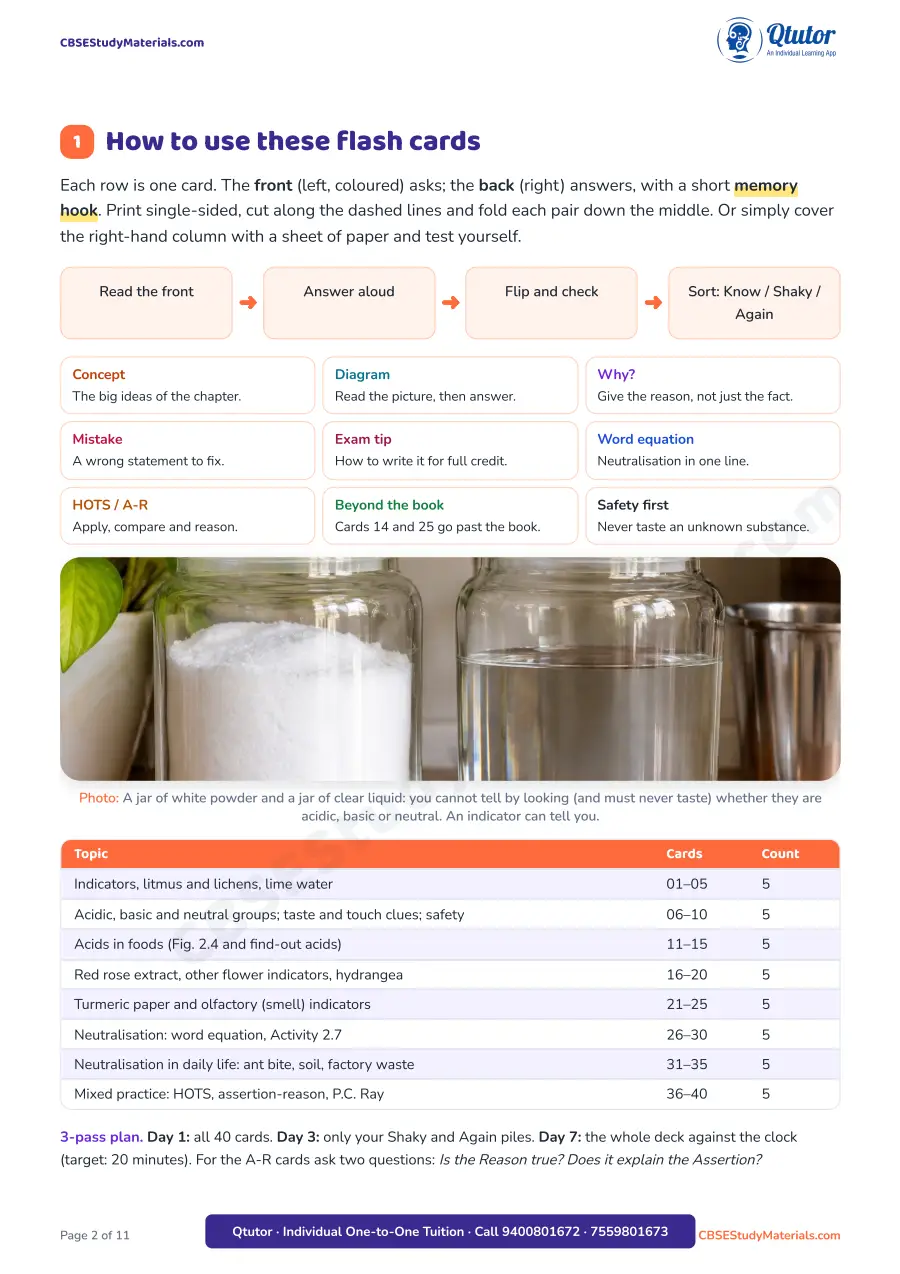
- A "How to use" page with a Know / Shaky / Again sorting method and a 3-pass revision plan (Day 1, Day 3, Day 7)
- A topic map showing which cards cover which part of the chapter
- A one-page indicator colour cheat sheet for blue litmus, red litmus, red rose extract, turmeric paper and the onion (olfactory) indicator
- Two "tick when solid" checklists to see what you still need to revise
- Real photos on the cover and inside pages
Structure of the Flash Cards PDF
| Cards | Topic |
|---|---|
| 01-05 | Acid-base indicators, litmus from lichens, lime water |
| 06-10 | Acidic, basic and neutral groups; sour, slippery and bitter clues; lab safety |
| 11-15 | Acids in foods: orange, amla, raw mango, tomato, plus find-out acids |
| 16-20 | Red rose extract, other flower and vegetable indicators, hydrangea |
| 21-25 | Turmeric paper, the curry stain, olfactory indicators |
| 26-30 | Neutralisation: Acid + Base → Salt + Water + Heat, Activity 2.7 |
| 31-35 | Neutralisation in daily life: ant bite, acidic and basic soil, factory waste |
| 36-40 | Mixed HOTS, two assertion-reason cards, Acharya P.C. Ray |
Exploring Substances Class 7 Important Topics
- What an acid-base indicator is, and why litmus is one
- How blue and red litmus sort substances into acidic, basic and neutral groups
- Why "neutral" means neither acidic nor basic, not "nothing dissolved"
- The most common acids in orange, amla, raw mango and tomato from the textbook figure
- Making red rose extract and turmeric paper at home, with the safety steps
- Why turmeric can find bases but cannot tell acidic from neutral liquids
- Olfactory (smell) indicators made with onion
- Neutralisation, why the amounts of acid and base matter, and how heat is given out
- Using neutralisation for an ant bite, acidic or basic soil and acidic factory waste
Two cards go a little past the book and are clearly marked "Beyond the book": the find-out acids for lemon, curd, tamarind and vinegar, and the usual result of the onion smell test.
Exploring Substances Class 7 Important Questions (Sample)
Card 18 (HOTS). You have just one blue litmus strip or one cup of red rose extract. Which can sort acidic, basic and neutral liquids by itself? Back of the card: Red rose extract. It gives three results: red (acidic), green (basic), no change (neutral). Blue litmus alone turns red for acids but stays blue for both bases and neutral liquids.
Card 08 (Mistake). "Sugar solution and salt solution have things dissolved in them, so they cannot be neutral." Back of the card: Wrong. Neutral means neither acidic nor basic. Sugar and salt solutions change neither litmus paper, so they are neutral.
Card 39 (Assertion-Reason). A: When lime water neutralises lemon juice, salt and water are formed. R: A neutralisation reaction gives out heat. Back of the card: Both are true, but R does not explain A. Heat is a third product of the same reaction: Acid + Base → Salt + Water + Heat.
From the cheat sheet:
| Indicator | Acidic | Basic | Neutral |
|---|---|---|---|
| Red rose extract | red | green | no change |
| Turmeric paper | stays yellow | turns red | stays yellow |
How These Flash Cards Help
- Fast revision. One card takes under a minute, so the full chapter fits into a short session before a class test or unit test.
- Thinking, not just memory. Most cards ask you to apply, compare or give a reason, in the competency-based style used in CBSE 2026-27 classrooms.
- Common mistakes fixed early. Mistake cards correct ideas such as "lime water is lemon juice" or "turmeric is useless for acids".
- Exam-ready answers. Exam tip cards show how to write a litmus result clearly and how to describe Activity 2.7 in four value points.
- Fresh practice. The cards are written as short revision prompts, so they work alongside our notes, NCERT solutions and question bank for this chapter.
Who Should Use It
- Class 7 students using the NCERT Curiosity textbook who want quick, colourful revision of Chapter 2
- Students who have read the chapter or our notes and want to test themselves
- Parents who want to quiz their child for ten minutes at home
- Teachers looking for printable cards for pair work or a quick class quiz
How to Download the Class 7 Exploring Substances Flash Cards PDF
Click the download button below. The PDF prints well on A4 paper in colour. Print single-sided, cut along the dashed lines and fold each card, or revise on screen by covering the answer column.
Exploring Substances: Acidic, Basic, and Neutral - Class 7 Science Chapter 2 Flash Cards (PDF · 11 pages · ₹49)
Related resources
- Class 7 Science Chapter 2: Exploring Substances, Acidic, Basic, and Neutral (chapter page)
- Exploring Substances Class 7 Science Chapter 2 Notes
- Exploring Substances Class 7 Science Chapter 2 NCERT Solutions
- Exploring Substances Class 7 Science Chapter 2 Question Bank
- Previous chapter: The Ever-Evolving World of Science
- Next chapter: Electricity: Circuits and their Components
- All Class 7 Science study material
FAQs on Class 7 Science Chapter 2 Exploring Substances
Where can I download Class 7 Science Chapter 2 Exploring Substances flash cards PDF? On this page. Use the download button above to get the 11-page PDF with 40 flash cards.
What is the price of the Exploring Substances Class 7 flash cards PDF? It is a premium PDF priced at ₹49.
What are the important topics in Exploring Substances Class 7? Acid-base indicators (litmus, red rose extract, turmeric and onion), acidic, basic and neutral substances, acids in common foods, neutralisation, and its uses for ant bites, soil and factory waste.
Which book is Exploring Substances: Acidic, Basic, and Neutral from? It is Chapter 2 of the NCERT Class 7 Science textbook Curiosity, used in CBSE schools in 2026-27.
What colour does turmeric turn in a basic solution? Turmeric turns red in a basic solution and stays yellow in acidic and neutral solutions.
Are these flash cards the same as the NCERT solutions? No. The flash cards use new questions and short answers for quick revision. For the textbook exercise answers, use our NCERT Solutions for this chapter.
Study tip: revise the cards you got wrong first, then explain one card aloud to someone at home every day.