The Kites Class 6 English Chapter 14 Notes PDF (PDF · 15 pages · ₹49) Unlock the full PDF for ₹49
Free sample: pages 1 to 3 of 15. The full PDF costs ₹49.
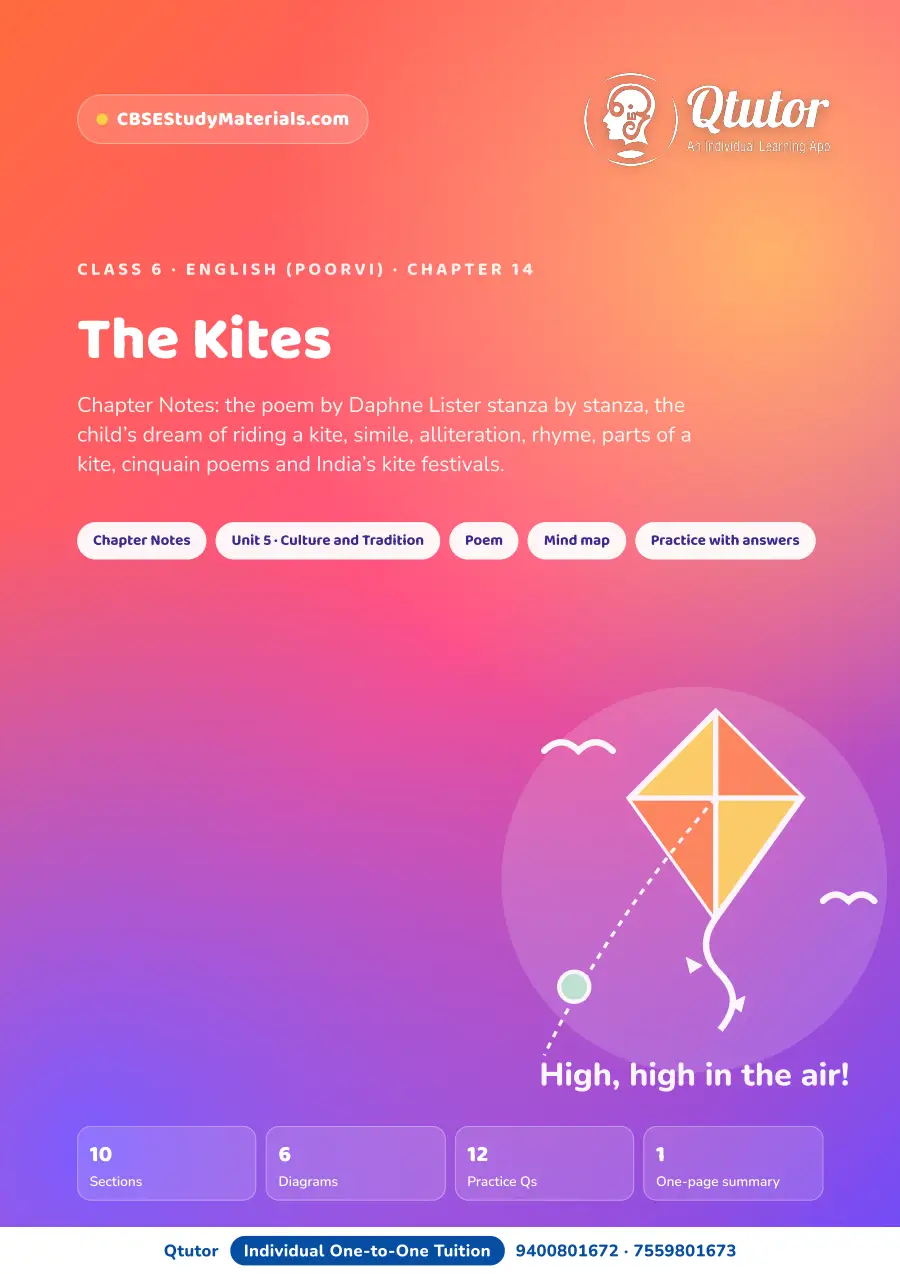
What would you see if you could sit on a kite and look right down at your town? Class 6 English Chapter 14 The Kites is a happy poem about exactly that wish, and these premium CBSE chapter notes, based on the NCERT Poorvi textbook, explain it stanza by stanza in a colourful 15-page PDF that a Class 6 student can read alone.
This is a premium Chapter Notes PDF (₹49) for Class 6 English, Chapter 14 "The Kites", the poem by Daphne Lister from Unit 5 "Culture and Tradition" of the new NCERT Poorvi book (Grade 6, CBSE 2026-27). It is independent study material and is not an official CBSE or NCERT publication. A friendly paper kite called Patang guides you through the poem, so the PDF works as revision notes, a poem summary, a word list and a set of important questions with answers in one PDF download.
Class 6 English Chapter 14 The Kites Notes: What Is Included
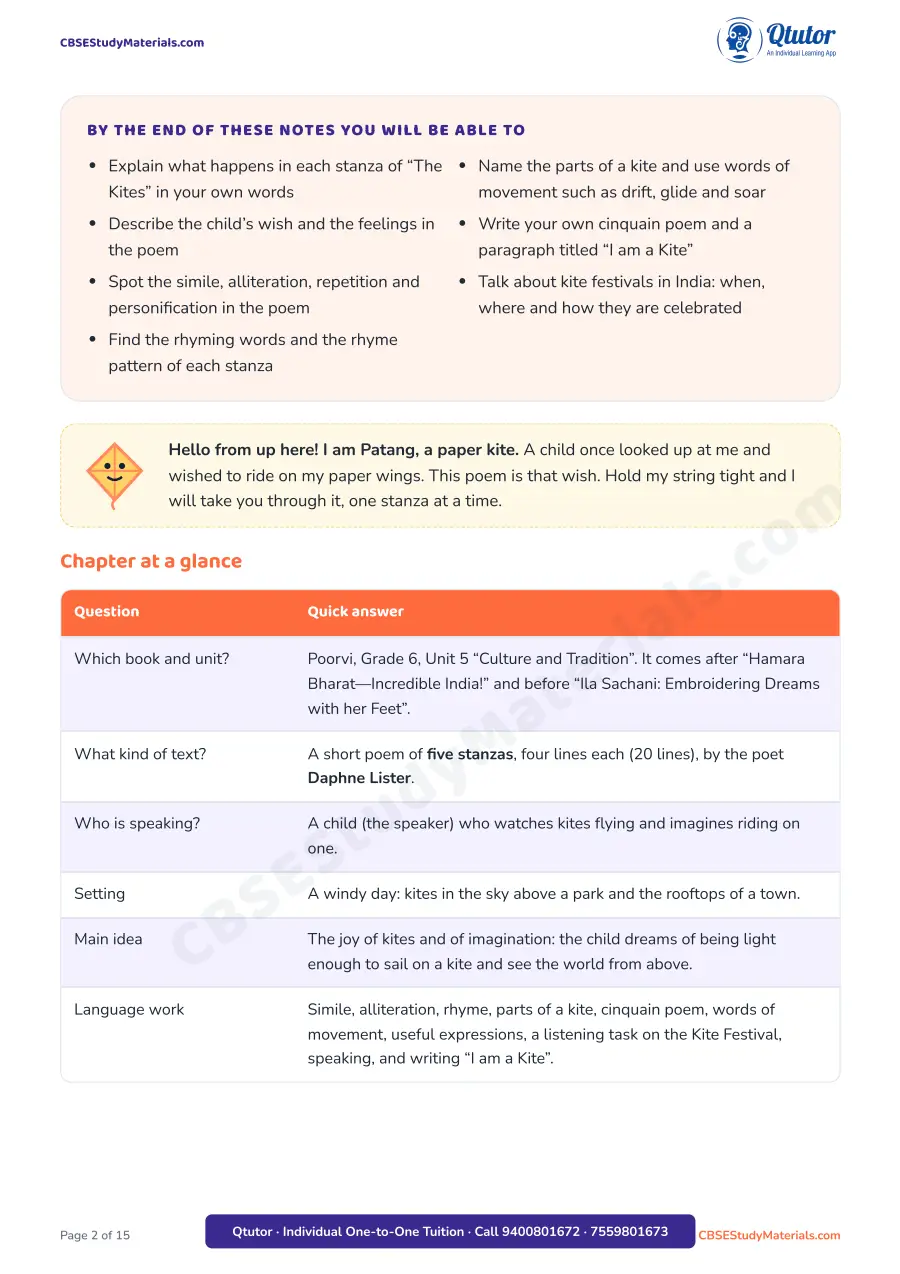
- Learning objectives and a "Chapter at a glance" table: book, unit, poet, speaker, setting, main idea and language work
- Before we read: the kite memories and festival questions from the book, with a "try this" senses activity
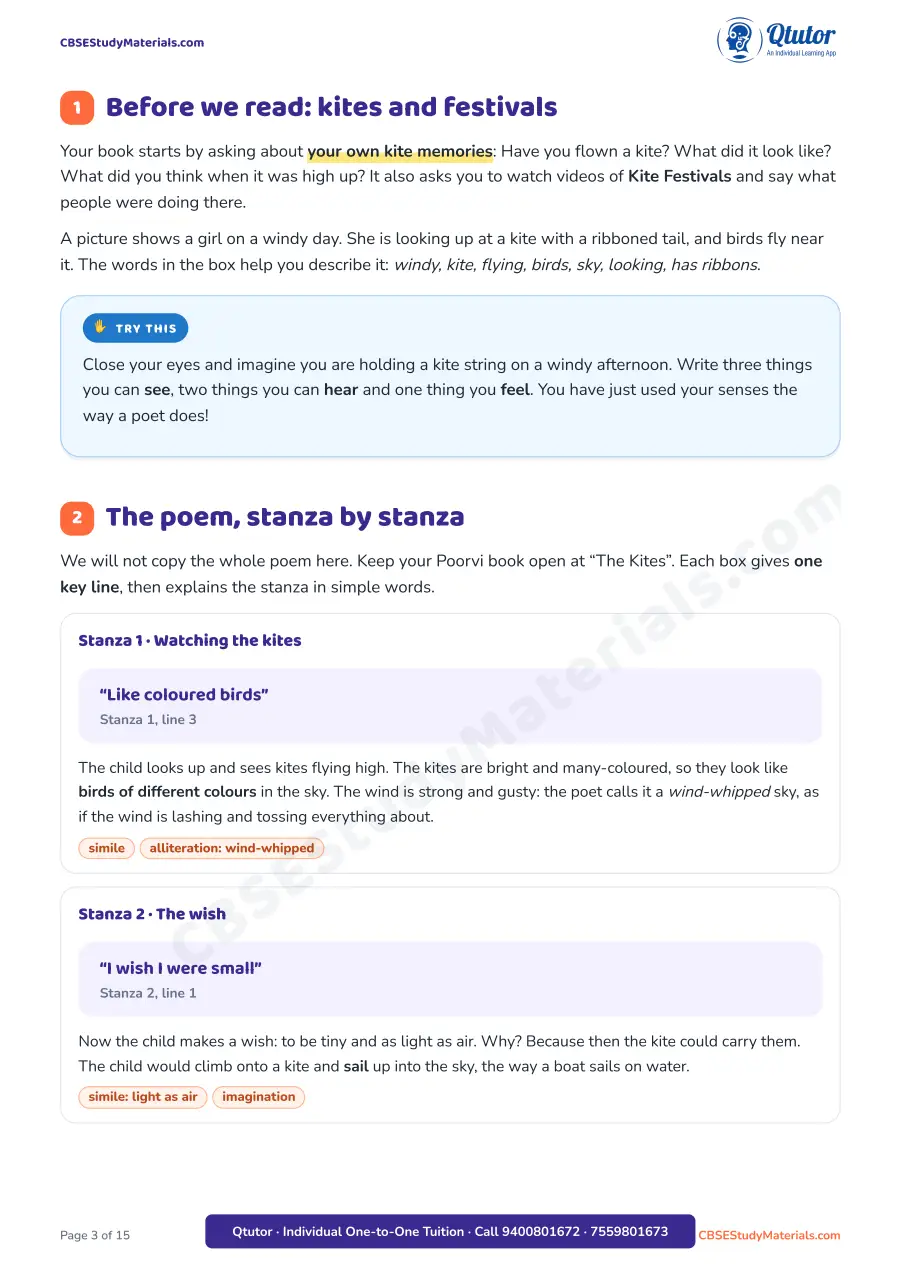
- The poem explained stanza by stanza in simple words, with one key line per stanza and the poetic devices marked
- A five-step picture of the poem's journey: watching, wishing, riding, looking down and being admired
- The speaker and the mood, with a bird's-eye-view picture of the park, rooftops and people far below
- Theme and message, plus a common-mistake card on what is real and what is imagined
- A poetic devices table: simile, alliteration, personification, metaphor, repetition, imagery and rhyme
- The rhyme pattern (a b c b) with every rhyming and non-rhyming end word
- 12 words to know, including wind-whipped, drift, gudi and kaagad
- A labelled kite diagram (nose, spine, cover, kite line, tail, reel) and a movement-words picture (drift, glide, soar, dive, swoop, circle)
- How to write a cinquain, with a new example poem
- Kites in India: Kite Festival facts from the listening task, five kite types, Namadeva's gudi, speaking and writing plans, and kite safety
- A mind map, a "Who or what does it?" table, a one-page summary and a "Can you do these?" checklist
- 12 "Check yourself" questions with a complete answer key
Structure of the PDF
| Part | What you get |
|---|---|
| Cover, objectives, chapter at a glance | The chapter in six quick answers |
| Sections 1-3 | Before we read, the poem stanza by stanza, the speaker and the mood |
| Sections 4-7 | Theme and message, poetic devices, rhyme, words to know |
| Sections 8-10 | Parts of a kite, movement words, cinquain, kites in India |
| Revision pages | Mind map, quick-check table, one-page summary and checklist |
| Check yourself | 12 questions and the answer key |
The Kites Class 6 Important Topics
- The child watches kites flying like coloured birds in a wind-whipped sky
- The wish to be small and light as air, climb on a kite and sail up
- Drifting on paper wings, the songs of the wild wind, and the view of the park and rooftops
- The people below who stand and stare: why "high, high" is repeated
- Simile, alliteration, personification and the a b c b rhyme scheme
- Parts of a kite, words of movement, cinquain poems and the Kite Festival (Uttarayan)
The Kites Class 6 Important Questions (Sample)
The notes set out the rhyme of every stanza in a table like this:
| Stanza | Rhyming end words | Non-rhyming end words |
|---|---|---|
| 1 | fly – sky | air, birds |
| 4 | down – town | be, park |
| 5 | stare – air | below, me |
A sample from "Check yourself": Which single word in stanza 2 tells you that the ride is only a dream? The answer key explains that "wish" (and later "would") shows the child is only imagining the ride.
Another sample asks: Arjun lives in Ahmedabad. In which month and for which festival is he most likely to fly kites? The answer: January, at Makar Sankranti, which is called Uttarayan in Gujarat.
How These Class 6 English Chapter 14 Notes Help
- The stanza-by-stanza explanation and journey picture make the poem easy to follow and retell
- Devices are named with the exact example from the poem, so you can answer "find the simile" questions quickly
- The kite diagram and movement-words picture cover the "Let us learn" exercises visually
- The mind map, checklist and one-page summary make quick revision easy before a class test
- Most of the 12 questions ask you to infer, compare or apply, which builds real reading skill
Who Should Use This Study Material
- Class 6 students reading the NCERT Poorvi English book under the CBSE 2026-27 syllabus
- Students who want a short poem summary, poetic devices, word meanings and important questions in one place
- Parents and tutors who want a clear, picture-rich explanation of the poem and its language work
How to Download the Class 6 The Kites Notes PDF
This is a premium PDF priced at ₹49. Use the download button below to get all 15 pages. It prints well in colour and is easy to read on a phone.
The Kites Class 6 English Chapter 14 Notes PDF (PDF · 15 pages · ₹49)
Related Resources
- Class 6 English Chapter 14 The Kites NCERT Solutions
- Class 6 English Chapter 14 The Kites Question Bank
- The Kites chapter page
- All Class 6 English study material
- Previous chapter: Hamara Bharat—Incredible India!
- Next chapter: Ila Sachani: Embroidering Dreams with her Feet
FAQs on Class 6 English Chapter 14 The Kites
Where can I download Class 6 English Chapter 14 The Kites notes PDF? On this page. Use the download button to get the 15-page premium notes PDF for ₹49.
Who wrote the poem The Kites in Class 6 English? The poem was written by Daphne Lister. It has five stanzas of four lines each.
What is the central idea of The Kites Class 6? A child watching kites wishes to be small and light enough to ride one, and imagines the fun of drifting high above the park and rooftops while people below stare. The poem celebrates imagination and the simple joy of kites.
What poetic devices are used in The Kites? Simile (like coloured birds, light as air), alliteration (wind-whipped, wild wind, stand and stare), personification (the wind sings), metaphor (paper wings) and repetition (high, high). Lines 2 and 4 of each stanza rhyme.
Which book and unit is The Kites from? It is from Poorvi, the NCERT English textbook for Class 6, Unit 5 "Culture and Tradition", after "Hamara Bharat—Incredible India!".
Do these notes include the textbook exercise answers? The notes explain every topic of the exercises. Full answers to every textbook question are in our separate The Kites NCERT Solutions PDF.
Study tip: retell the poem in five sentences, one for each stanza; if you can say which stanza is real and which are imagined, you know the chapter.