New Beginnings: Cities and States - Class 7 Social Science Chapter 4 Notes (PDF · 18 pages · ₹49) Unlock the full PDF for ₹49

Free sample: pages 1 to 3 of 18. The full PDF costs ₹49.
Why are the gateways of an ancient city kept deliberately narrow, and how could an assembly of elders choose its own rājā 2,500 years ago? These premium New Beginnings: Cities and States Class 7 notes cover CBSE Class 7 Social Science Chapter 4 from the NCERT book Exploring Society: India and Beyond (Grade 7, Part 1) as clear, NCERT based chapter notes with maps, a timeline and practice questions.
This is a premium 18-page Chapter Notes PDF (₹49) of revision notes for CBSE 2026-27. It is independent study material made from the NCERT chapter and is not an official CBSE or NCERT publication. The notes follow the chapter's three Big Questions: what the "Second Urbanisation" of India means, why the janapadas and mahājanapadas mattered, and what kind of governance they built.
Class 7 Social Science Chapter 4 New Beginnings: Cities and States Notes: What Is Included
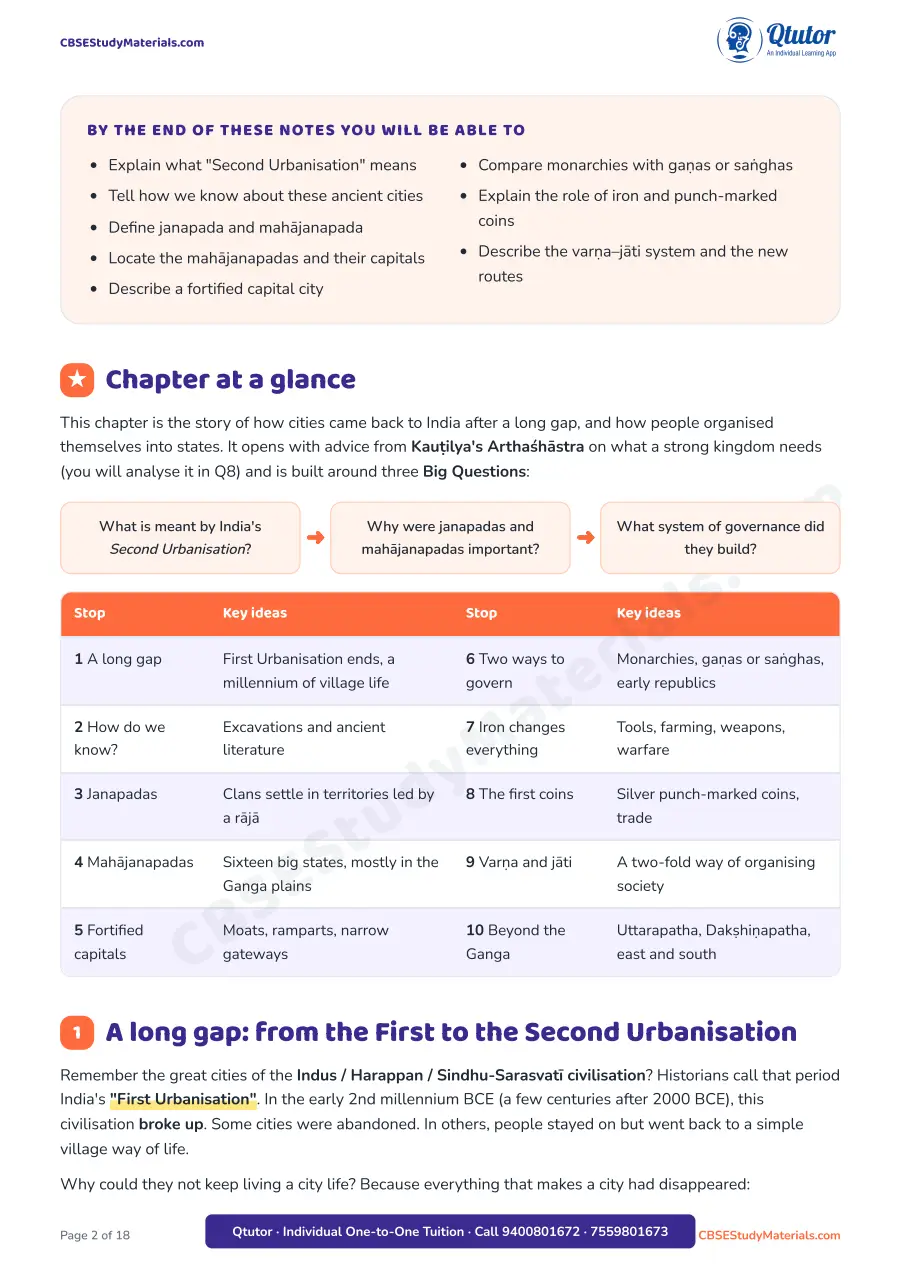
- A colourful cover, learning objectives and a "chapter at a glance" table of all ten sections
- Ten numbered, concept-first sections that follow the NCERT chapter from start to end
- A timeline from the Harappan cities to the mahājanapadas and the first southern cities
- Two original practice maps on the complete outline of India: the sixteen mahājanapadas with their capitals, and the Uttarapatha and Dakṣhiṇapatha routes with Śhiśhupalgarh and Kodumanal
- A numbered table of every mahājanapada and the capital marked on the textbook map
- Labelled diagrams: how we know (archaeology and literature), a fortified capital with moat, rampart and narrow gateway, monarchy vs gaṇa, two chains that start with iron, and the varṇa–jāti system
- A worked First vs Second Urbanisation comparison table (the textbook's Yes/No activity)
- Definition, "Did you know?", common mistake, real-life, "Think about it" and "Try this" cards
- Photos of ancient ruins, punch-marked silver coins and old clay objects
- A one-page summary (chapter summary), exam traps, a mind map and a key-terms grid
- 12 "Check yourself" important questions with a marking-style answer key
Structure of the PDF
| Part | What you get |
|---|---|
| Opening | Objectives, chapter at a glance, the three Big Questions |
| Sections 1 to 4 | First and Second Urbanisation, evidence, janapadas, the sixteen mahājanapadas (map + table) |
| Sections 5 to 8 | Fortified capitals, early democratic traditions, monarchies and gaṇas, iron, punch-marked coins |
| Sections 9 to 10 | The varṇa–jāti system; routes, Śhiśhupalgarh and the southern kingdoms (map) |
| Revision | One-page summary, exam traps, mind map, key terms |
| Practice | 12 questions (MCQ, assertion-reason, timeline, source-based, case-based, HOTS) with answers |
New Beginnings: Cities and States Class 7 Important Topics
- The break-up of the Harappan cities (First Urbanisation) and about a thousand years of village life
- The Second Urbanisation in the 1st millennium BCE, starting in the Ganga plains, and why it continues today
- Two kinds of evidence: archaeological excavations and late Vedic, Buddhist and Jain literature
- Janapada ("where the people have set foot") and the rājā; mahājanapadas by the 8th or 7th century BCE
- The 16 mahājanapadas from Gāndhāra to Anga and Aśhmaka; the four most powerful: Magadha, Kosala, Vatsa and Avanti
- Fortified capitals with ramparts, moats and narrow gateways
- Sabhā and samiti; monarchies vs gaṇas or saṅghas (Vajji and Malla) as early republics
- Iron metallurgy, bigger farming, iron weapons, warfare and alliances
- Silver punch-marked coins and growing trade
- Jāti and varṇa, the origin of the word "caste", flexibility in the early period and later rigidity
- Uttarapatha and Dakṣhiṇapatha, Śhiśhupalgarh (Kalinga), the Cholas, Cheras and Pāṇḍyas, Kodumanal
New Beginnings: Cities and States Class 7 Important Questions (Sample)
Here are three real excerpts from the PDF.
From the notes (Section 6): In a monarchy the rājā is the final authority and the post is usually hereditary. In a gaṇa or saṅgha such as Vajji or Malla, the assembly decides by discussion, by vote if needed, and even selects the rājā, which is why scholars call them "early republics".
Assertion-reason (Q6): A: India's first coins were made of silver. R: Silver is too hard for symbols to be marked on it. Answer: (c) A is true, R is false: silver is a soft metal, which is exactly why symbols could be punched into it.
From the worked comparison table:
| Feature | First Urbanisation | Second Urbanisation |
|---|---|---|
| Centred in the Ganga plains | No | Yes |
| Trade | Yes | Yes, with coins |
| Iron | No | Yes, the big new technology |
How It Helps
- Every NCERT topic is in one place, in short sentences and simple language for Class 7
- The maps and the mahājanapada table make "which capital belongs to which state" easy to revise
- The timeline fixes the order of events, a common source of mistakes with BCE dates
- Common-mistake cards and exam traps catch errors before the test
- The questions are mostly application, source-based and HOTS, so you practise thinking, not just recall
Who Should Use It
Class 7 CBSE students studying Exploring Society: India and Beyond Part 1, parents who help with revision at home, and teachers who want a ready chapter summary, practice maps and a quick question set for class.
How to Download the Class 7 New Beginnings: Cities and States Notes PDF
Use the download button below to get this premium 18-page study material as a PDF download. Print it or keep it on your phone for quick revision before a test.
New Beginnings: Cities and States - Class 7 Social Science Chapter 4 Notes (PDF · 18 pages · ₹49)
Related Resources
- Class 7 Social Science Chapter 4 New Beginnings: Cities and States NCERT Solutions
- Class 7 Social Science Chapter 4 New Beginnings: Cities and States Question Bank
- New Beginnings: Cities and States chapter page
- All Class 7 Social Science study material
- Previous chapter: Climates of India
- Next chapter: The Rise of Empires
FAQs on Class 7 Social Science Chapter 4 New Beginnings: Cities and States
Where can I download Class 7 Social Science Chapter 4 New Beginnings: Cities and States notes PDF? On this page. Click the download button to get the 18-page premium notes PDF.
What are the important topics in New Beginnings: Cities and States Class 7? The First and Second Urbanisation, janapadas and the sixteen mahājanapadas, fortified capitals, sabhā and samiti, monarchies and gaṇas, iron, punch-marked coins, the varṇa–jāti system, the Uttarapatha and Dakṣhiṇapatha routes, and the southern kingdoms.
What is the Second Urbanisation in Class 7 History? It is the new phase of city growth that began in the 1st millennium BCE in the Ganga plains, parts of the Indus basin and nearby regions, about a thousand years after the Harappan cities broke up. It has continued up to today.
Which mahājanapadas were early republics in Class 7 Chapter 4? Vajji (Vṛijji) and Malla. Their assemblies took major decisions and even selected the rājā, so scholars call them gaṇas, saṅghas or early republics.
What is the price of the New Beginnings: Cities and States notes PDF? It is a premium PDF priced at ₹49, with maps, diagrams, a one-page summary and 12 questions with answers.
Which book is New Beginnings: Cities and States Class 7 from? It is Chapter 4 of the NCERT Social Science textbook Exploring Society: India and Beyond, Grade 7 Part 1, under the theme "Tapestry of the Past".
Study tip: redraw the mahājanapada map from memory once, then check it against the table; capitals stick much better after one attempt.